

On February 18, 1885, American readers finally got their hands on a novel that captured the raw voice and restless spirit of life along the river. The long-awaited US release of Huckleberry Finn introduced a bold storytelling style that reflected real speech, real conflict, and a complicated nation still wrestling with its past.
Growing up along the banks of the Mississippi River, Mark Twain — the pen name of Samuel Clemens — dreamed of adventure. By age 30, he had already lived several lives. He worked as a riverboat pilot, served briefly in a Confederate militia unit during the Civil War, and headed west during the mining boom hoping to strike it rich. While working for newspapers in Nevada and California, he discovered his real talent. He could tell stories in a way that sounded natural, funny, and unmistakably American. That discovery shaped the rest of his life.
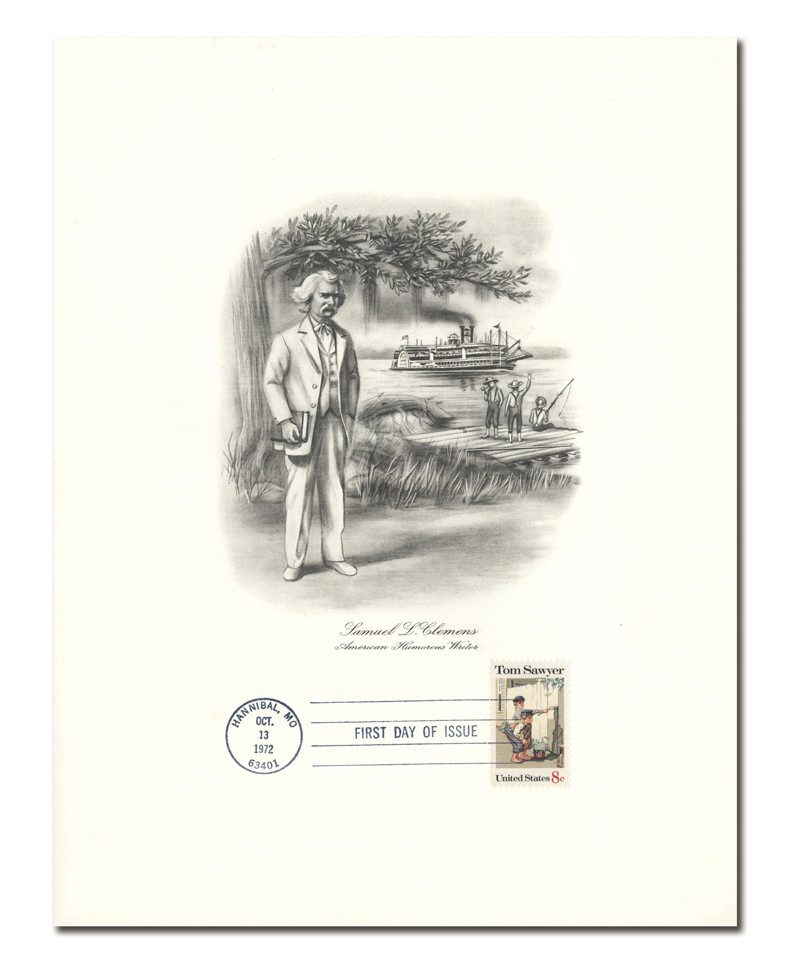
Twain first gained national attention in 1865 when his humorous story about mining camp life spread through newspapers across the country. Readers loved his sharp humor and realistic characters. Over the next decade, he built a reputation as one of America’s most popular writers and lecturers. In 1876, he published The Adventures of Tom Sawyer. The novel drew heavily from his childhood in Hannibal, Missouri, a river town that later became the emotional and geographic foundation for many of his stories.

That same year, Twain began sketching ideas for a sequel using pages he had cut from Tom Sawyer. At first, he planned to call the new project Huckleberry Finn’s Autobiography. He imagined following Huck into adulthood. But Twain struggled to keep momentum. He frequently paused work to focus on lectures, travel writing, and business ventures. Years later, after traveling along the Hudson River, his creative energy returned. He abandoned the adulthood idea and focused instead on Huck’s teenage journey. By 1883, he completed the manuscript.
The novel was first published in Canada and the United Kingdom on December 10, 1884. Printing delays pushed the official American release to February 18, 1885. The story follows two runaways: Huck, escaping an abusive father, and Jim, an enslaved man seeking freedom. Together, they travel south on a raft, encountering con artists, feuding families, and the constant danger of capture.

Twain told the story entirely from Huck’s perspective. He used regional dialects and casual speech patterns. At the time, most writers used formal language. Twain’s choice shocked many readers but made the story feel real. His approach influenced later American writers who focused on authentic voices and everyday experiences.
Not everyone welcomed the book. Some libraries banned it almost immediately. The Concord Public Library in Massachusetts famously criticized the novel as crude and lacking moral value. Committee members called it rough and unsuitable for respectable readers. Twain reacted with humor. He believed controversy would increase sales, and he reportedly predicted the criticism would help sell tens of thousands more copies.

Over time, the novel gained recognition for its literary style and its portrayal of American society before the Civil War. The story does not present Huck as a perfect hero. He lies, cheats, and struggles with moral decisions. But through his friendship with Jim, Twain explored ideas about freedom, conscience, and social pressure. The novel also reflects the language and racial attitudes of its time, which has led to ongoing debate in schools and libraries.
Today, many scholars and readers consider the novel a cornerstone of American literature. Others still question its language and portrayal of race. What remains clear is that Twain created a story rooted in real places, real speech, and real moral conflict. Its lasting impact comes less from controversy and more from its honest portrayal of a divided society and the complicated journey toward personal conscience.
| FREE printable This Day in History album pages Download a PDF of today’s article. Get a binder or other supplies to create your This Day in History album. |
Discover what else happened on This Day in History.
Truly a great author.
Nice reminder of what we used to read
Great article about one of my favorite authors. Thanks.
The history of the author, books and reactions to them all, like this short piece reflect life in a very real manner. The information about it all, including the author as a person has meant more than the stories. The stories however, need to be read again, all these years later, as the visions of the words are clearly of another time. The writing reflects the authors personality and ability to tell a story. Fact or fiction like life blends into something more than we often expect. The stamp of the day is a fabulous example of the variety of life. Looking to the future aware of the present the past definitely matters. Thank you for the reminders. Every stamp seen now brings a pause to examine it wondering about it all. The stamp like life represents something far more than the initial reason it is placed on the envelope for. The future, like this author and books, brings out meanings only the passing of time allows. Pausing to discover what that meaning is makes the future better. Thank you for bringing this stamp into the present.
Should be required reading for young adults prior to graduation. His house in Hartford Connecticut is now a museum.
Genuine Americana. Thanks again Mystic.
He spent time in Hawaii. I have a picture of him with King Kalalau sitting on the porch of the Royal Hawaiin Hotel.- maybe it’s the Hana Hotel in Maui.
Collecting Hawaiian Monarchy stamps is the best!! Thanks Mystic.
One of the most satisfying experiences of my life was reading “Huckleberry Finn” the first time.
Amen, brutha! :o)
Apparently, Twain waited so long to finish and publish “Huckleberry Finn,” is that he couldn’t devise a believable way to conclude the story. An escaped slave like Jim traveling “down” the Mississippi River deeper into slave territory is illogical. The last part of the book when Tom Sawyer reappears in not the best part of the book.
It was impossible to raft “up” the Mississippi. And the reappearance of Tom Sawyer was a logical place at the end of Huck’s adventure. And as the Mystic article said, Twain had to readdress how he used Huck in the story, and how far in his life he would go. Your critique is interesting, but lacked rationale.
It’s still illogical for an escaped slave to travel south deeper into slave territory. Huck and Jim could have headed north and crossed the Ohio River into the free states and maybe all the way into Canada, but that wouldn’t have allowed them to meet and deal with all the interesting people they were to meet along the Mississippi River.
Huckleberry Finn reminds me a lot of growing up in Northern Alberta during WW II and after.
Food was scarce (rationing) but plentiful in the bush. By the time I was twelve I was an experienced farm hand, hunter, trapper and pulled many a mile of winch cable when my dad had me travel with him hauling freight into the northern areas for HBCo, reservations, and churches.
Wish a guy like Mark Twain had written about that. I’ve tried but was to busy working, and playing, until I forgot most of what I learned about the time I lived.
Now stamps remind me of history, life and the world.
The author of this article has a great flare with word like Twain!
I wanted to know more about his confederate service. If it has already been addressed my apologies. A.I. tells us:
“The full history of Clemens’s involvement in the militia is unclear. Essentially, he served in a Confederate militia in Missouri for a total of around two weeks in 1861 at the “rank” of 2cd Lieutenant.”