
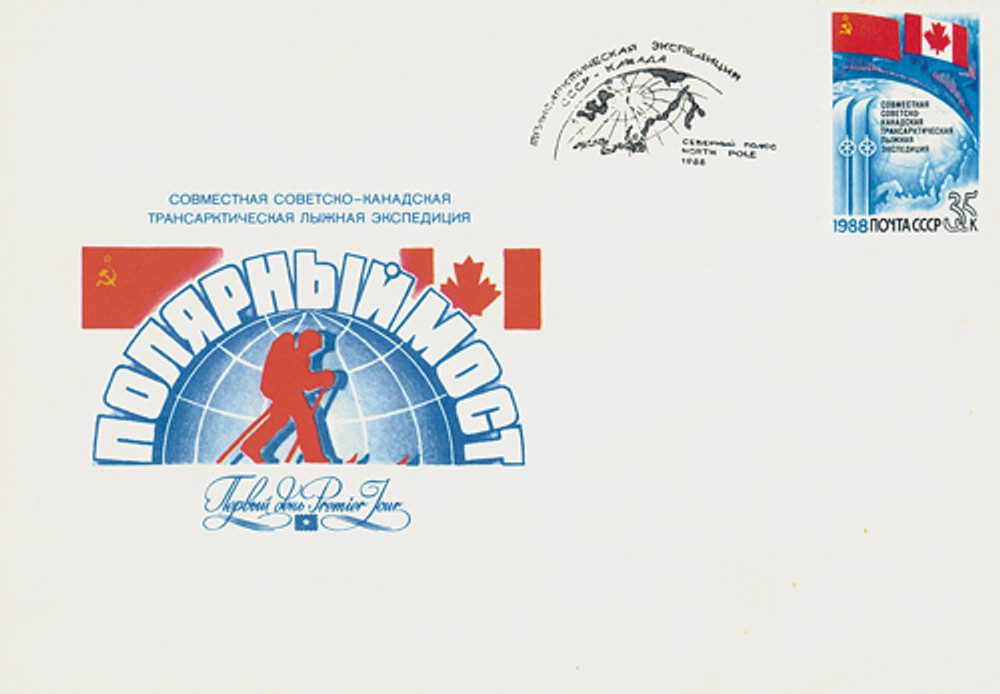
On April 25, 1988, a team of nine Soviet and four Canadian skiers reached the North Pole — on foot, carrying everything on their backs, after 54 days on the Arctic ice. It was the largest expedition ever to reach the pole, and the first to ski the entire distance from Siberia to Canada via the North Pole without dogs, sleds, or motorized support.
The idea started simply enough. In 1986, a group of Soviet scientists and radio amateurs began planning a ski expedition to the South Pole. Over the next year, the concept evolved considerably. The Canadians heard about the Soviet plans and proposed something more ambitious — a crossing of the entire Arctic Ocean, from the Siberian coast over the North Pole and all the way to Canada. The Soviets agreed.
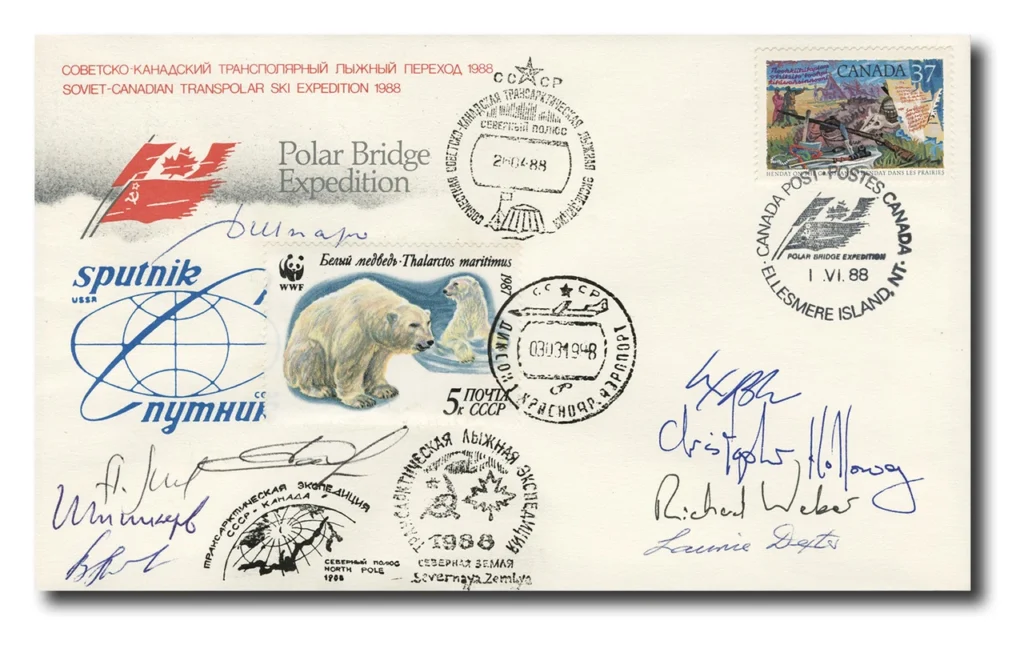
The four Canadian team members were selected from 300 applicants. Richard Weber, 26, and Reverend Laurie Dexter, a 42-year-old Anglican minister, were chosen following a training camp in the Soviet Union. The other two Canadians — Chris Holloway, 30, and Dr. Maxwell Buxton, 31 — were added later. In the months before departure, the skiers trained intensively and began learning each other’s languages. The four Canadians spoke no Russian, and the Russians spoke little English.
The expedition set out from Cape Artichevsky on the Severnaya Zemlya Islands off the Siberian coast. The planned March 1 start was pushed back two days due to severe weather. When they finally departed on March 3, temperatures sat at -47°C with blizzards. Much of the journey took place in polar night, which didn’t end until May 23.
Each skier carried a backpack weighing between 45 and 50 kilograms — nearly as much as some of the skiers themselves weighed. They received six airdrops of fresh supplies from Russian and Canadian planes along the way, but used no dogs, sleds, or vehicles at any point. The total distance — 609 miles from Russia to the pole, and 466 miles from the pole to Canada — was 1,075 miles in all.
The Arctic Ocean presented constant hazards. The Transpolar Drift Stream breaks up sea ice and causes it to move, creating open leads of water that had to be crossed or waited out. The team might rest for a full day only to find their position had shifted several miles due to ice drift. Early radio messages described the physical toll: frostbite scarring faces, toes and fingers permanently numb, boots and clothing impossible to dry because clothes froze solid the moment they were removed.
The expedition divided their route into stages of two to three hundred miles each, requiring about a dozen days of skiing per stage. Their daily routine involved a 10- to 12-hour trek, then setting up their 12-man tent, switching on their Emergency Locator Transmitter, and spending a few minutes on shortwave radio. Position updates were also transmitted via the UoSAT-OSCAR-11 satellite, which passed overhead and broadcast their location on the two-meter VHF amateur radio band. Thousands of schoolchildren and radio amateurs around the world tracked their progress daily through these transmissions.

Along the way, small cultural exchanges broke the tension. Canadian members noted in one radio message that the Soviets were initially unfamiliar with peanut butter but “taken to it with vigor,” prompting the daily ration to be doubled to 100 grams per person. A radio message from April 17 noted temperatures had “warmed” from -48°C to -25°C — described by the team as “balmy.” Both Soviet leader Mikhail Gorbachev and Canadian Prime Minister Brian Mulroney sent telegrams wishing the team success.
When the team reached the North Pole on April 25, they radioed a message to Prime Minister Mulroney in Ottawa: “The Polar Bridge Expedition has reached the North Pole. As we pass from the USSR into Canada, we would like to express our experience of friendship and understanding with our polar neighbors.” Journalists, dignitaries, and radio operators had been flown in by helicopter to meet them, and a special airdrop of champagne and caviar marked the occasion.
The expedition concluded on June 1, 1988, at 14:35 UTC, when all 13 skiers stepped ashore at Ward Hunt Island, off the coast of Cape Columbia, Ellesmere Island, Northern Canada. The full crossing had taken 91 days.
Click here for a photo from that day. and Click here to view more photos from the expedition.
| FREE printable This Day in History album pages Download a PDF of today’s article. Get a binder or other supplies to create your This Day in History album. |
Discover what else happened on This Day in History.
Interesting piece of history, but the bugs makes it impossible to purchase. This app needs an update.
The -47 degrees centigrade sounds extremely frigid. It sounds like a well planned trip that the people went on. I am so very glad that I wasn’t invited. I had a long appointment with sunny and warm weather.
It sounds like -53 degrees F.
Very interesting. I am not a skier or outdoors man but truly admire such daring. Well done. How long was the total trip? Also, thank you Mystic for these daily articles.
I don’t remember what I was doing on this day in 1988 or June 1,1988 (completion date) but my hat is off to the crew at the top of the world for their accomplishment. While my hat is off I’m going to scratch my head and wonder why I haven’t heard of this before.
I agree. I certainly remember 1988 but had no idea this took place. Thanks Mystic for great information.
Wonderful article? I was wondering why an Anglican reverend was selected and what happened to her life after the event?
The reason why no one in the US did not hear of this undertaking, is because it did not involve any American’s. The same is with the first black astronaut. He was Cuban whose last name is Tamayo. He was part of the team of the Salyut space missions, in the 1970’s.