
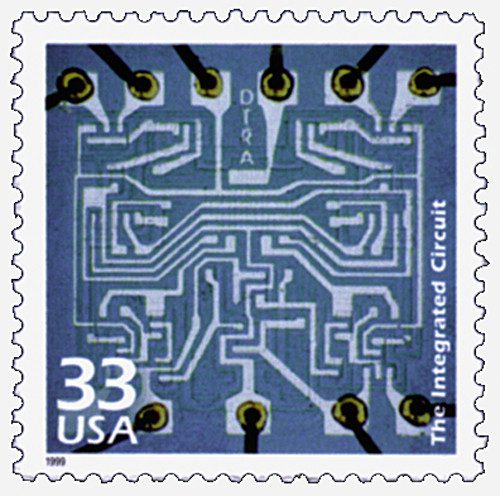
On February 6, 1959, Texas Instruments engineer Jack Kilby filed the first patent for an integrated circuit, a modest document that described a bold new way to build electronics. That filing helped set in motion a shift from room-sized machines to pocket-sized devices that would unfold over the next several decades.
The integrated circuit, often called an IC or microchip, is a set of electronic components—such as transistors, resistors, and capacitors—formed together on a single piece of semiconductor material. Most chips are made from silicon, a material that can be precisely controlled to conduct electricity. By placing many components on one small chip, engineers could replace bulky assemblies of wires and separate parts. This change made electronics smaller, more reliable, and easier to mass-produce.
Kilby’s idea grew out of a practical problem. In the 1950s, electronic devices were built from individual components connected by hand. As systems became more complex, the number of parts and connections increased. This led to higher costs and frequent failures, a challenge known as the “tyranny of numbers.” While working at Texas Instruments in the summer of 1958, Kilby realized that all the parts of a circuit could be made from the same material and connected internally. His first working integrated circuit, demonstrated later that year, used germanium and fine wires, but it proved the concept, and he filed the patent the following February.
At the same time, other engineers were working toward similar goals. One of the most important was Robert Noyce at Fairchild Semiconductor. Noyce independently developed a practical version of the integrated circuit using silicon and a technique called the planar process. This method, created by Jean Hoerni, allowed circuits to be built layer by layer and protected by an insulating surface. Noyce’s design made it easier to manufacture chips in large quantities and to add metal connections directly on the chip. His approach became the foundation of the modern integrated circuit industry.
The roots of this technology reach back to World War II. During the war, military needs pushed engineers to reduce the size and weight of electronic equipment such as radar systems. After the war, the invention of the transistor in 1947 replaced fragile vacuum tubes and made smaller devices possible. Engineers then began looking for ways to combine multiple transistors and components into compact forms. This research led directly to the integrated circuit, which began to appear in commercial products in the early 1960s.
Early integrated circuits were used mainly in specialized equipment. Minicomputers and high-speed mainframes adopted them to improve speed and memory while reducing size. Even so, computers of the 1960s were still large and expensive, often filling entire rooms and used only by governments, universities, or large corporations. The key change was that more and more circuit functions could be placed on fewer chips.
As the decade progressed, engineers learned how to pack greater numbers of components onto a single chip. Circuits for memory, logic, and control could now be manufactured together. Instead of thousands of separate parts, a computer could be built from just a handful of integrated circuits. This improvement increased reliability, since there were fewer connections that could fail.
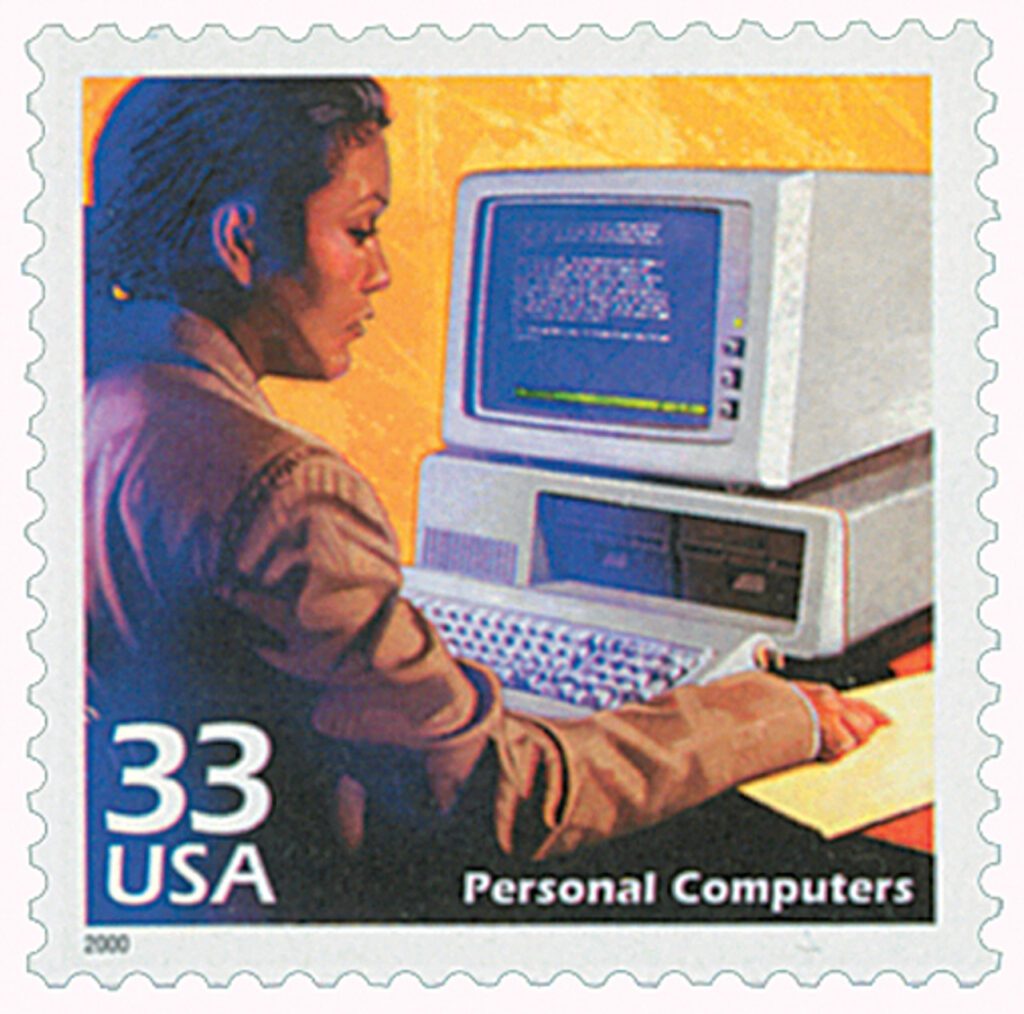
Over time, integrated circuits spread into many areas of daily life. They became essential to aircraft navigation systems, space vehicles, and military instruments, where reliability was critical. They also made possible consumer products such as hand-held calculators, digital watches, and later personal computers. The steady reduction in size and cost helped electronics move from laboratories into homes.
Today’s integrated circuits are far more advanced than Kilby or Noyce could have imagined. Modern chips can contain billions of transistors on a single piece of silicon smaller than a fingernail. These chips power smartphones, medical devices, cars, and global communication networks. While the basic idea remains the same—many components working together on one chip—the scale and precision have increased dramatically.
| FREE printable This Day in History album pages Download a PDF of today’s article. Get a binder or other supplies to create your This Day in History album. |
Discover what else happened on This Day in History.
As usual, great, interesting article. Thank you.