
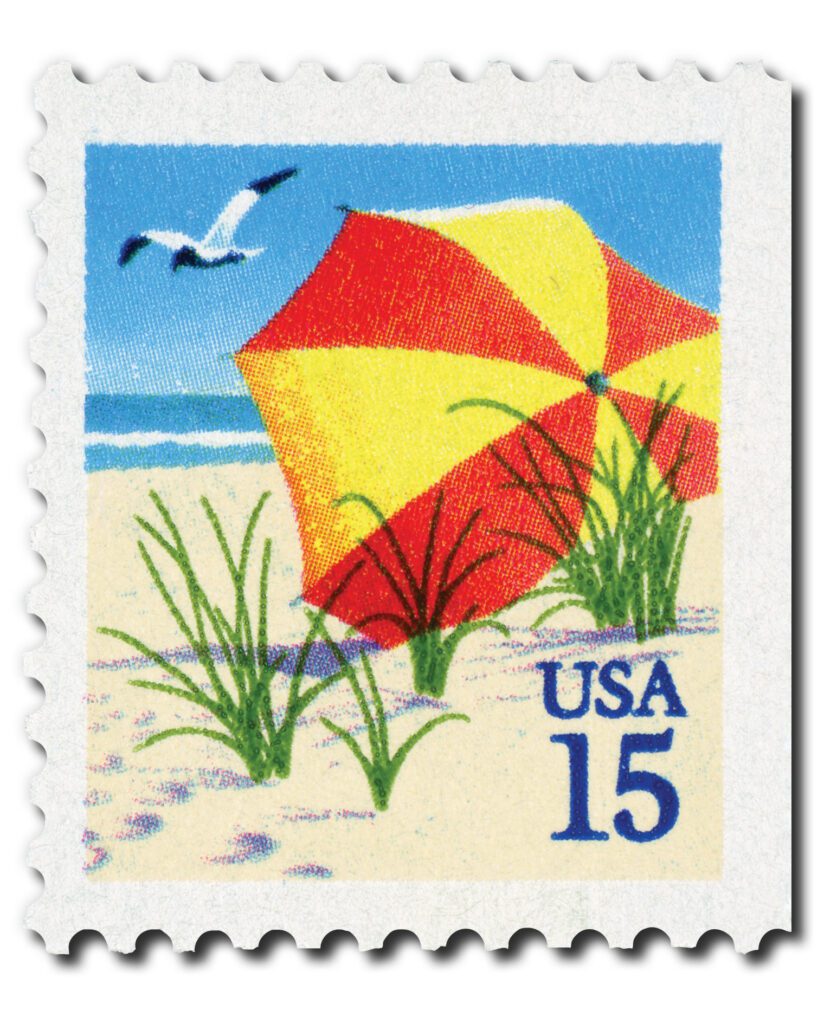
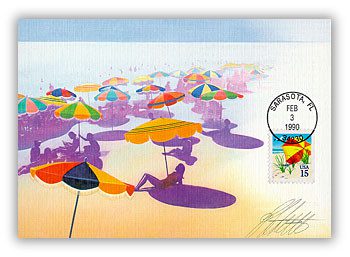
On February 3, 1990, the US Postal Service issued a small, colorful stamp that marked a quiet shift in how everyday American mail could look. That Beach Umbrella stamp became the first release in the short-lived but distinctive Mini-Scapes Series.
The Mini-Scapes Series grew out of discussions held during the summer of 1988 by the Citizens’ Stamp Advisory Committee (CSAC). Committee members were looking for ways to refresh the appearance of definitive stamps, which are printed in large quantities and used for routine mailing. At the time, many definitives featured portraits of “bewhiskered unknowns” or familiar patriotic scenes, such as flags and government buildings. Some on the committee felt these designs had become repetitive and uninspiring for daily use.
The USPS had experimented with picturing famous landmarks, including Yosemite National Park. While attractive, those images did not always translate well to the small size of definitive stamps. Important details were often lost, and the designs could feel crowded. CSAC members began discussing alternatives that would read clearly at a reduced scale while still feeling familiar and appealing.
To explore new options, CSAC hired three artists and asked them to develop concepts that were bright, cheerful, and colorful. The artists were encouraged to think in two directions. One was to create “generic landscapes” that could represent many parts of the country rather than a single, specific place. The other was to design small, tightly focused scenes or objects that would be recognizable to a broad audience. These images needed to be simple, clear, and effective at stamp size.
One of the artists selected was Pierre Mion, who lived and worked in Virginia. Mion produced sketches based on ideas suggested by CSAC, including a hot-air balloon, a child holding an umbrella, and a piggy bank. He also submitted additional concepts of his own. These included a beach umbrella, a portion of a small boat, the end of a pier, and a child riding a carousel. His work stood out for its clean lines, strong color choices, and ability to convey a scene quickly.
CSAC responded positively to Mion’s sketches and asked him to develop finished paintings of several designs. Around the same time, the USPS identified a practical need. The postcard mailing rate required a new definitive stamp, and the design had to be simple, appealing, and suitable for booklet production. Mion’s beach umbrella image met those needs and was selected.
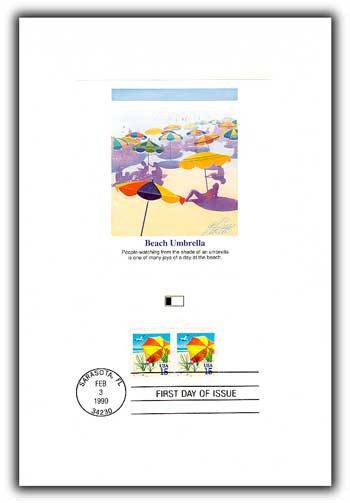
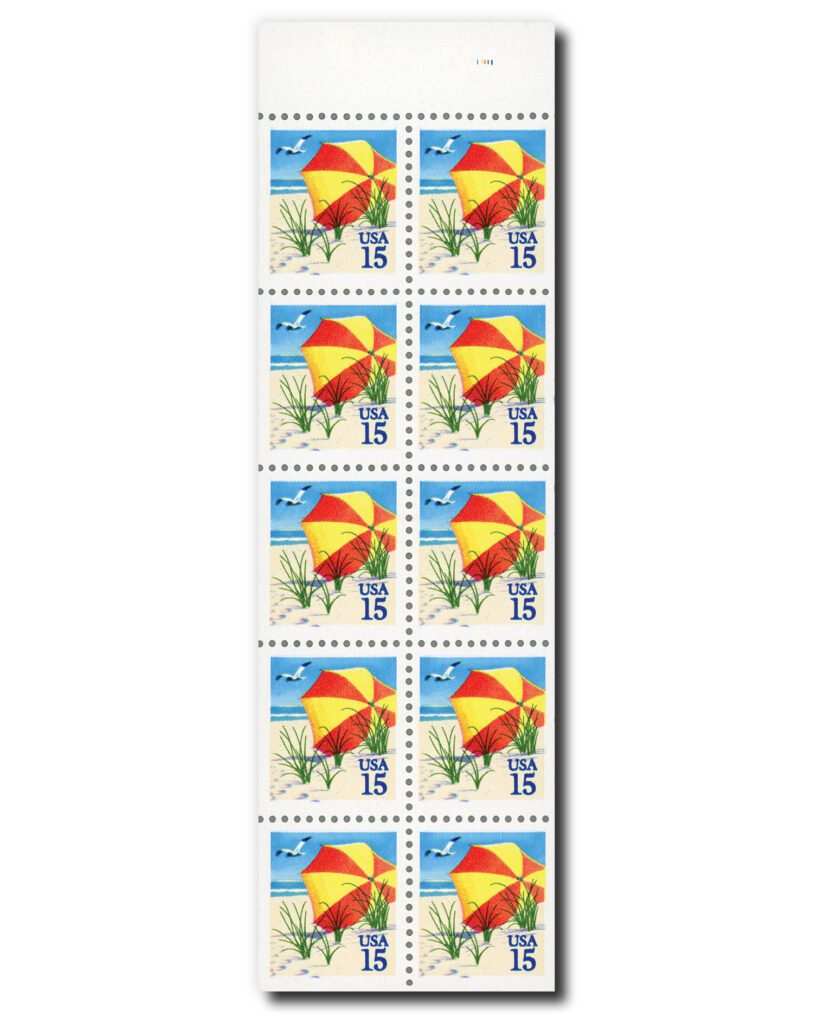
The resulting Beach Umbrella stamp became notable for several reasons. It was the first stamp issued in what would be called the Mini-Scapes Series. It was also the first postcard-rate stamp issued exclusively in booklet form. This made it especially convenient for vacationers, who often mailed postcards while traveling and were more likely to purchase booklets rather than sheets.
From a production standpoint, the stamp also introduced a technical change. It was the first US stamp in which phosphorescent tagging was mixed with two different ink colors. Phosphorescent tagging allows automated mail-sorting equipment to detect stamps. Traditionally, the tagging was applied as a coating or mixed into a single ink color. Using two ink colors was unusual and reflected ongoing experimentation in stamp printing.
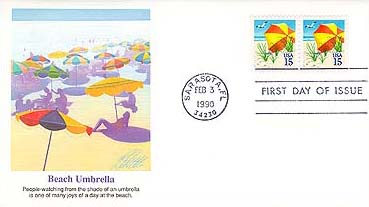
The Beach Umbrella stamp was officially issued on February 3, 1990, in Sarasota, Florida. The ceremony took place during Sarapex 90, a stamp show sponsored by the Sarasota Philatelic Club. The location fit the image, as the beach umbrella suggested leisure, travel, and warm weather.
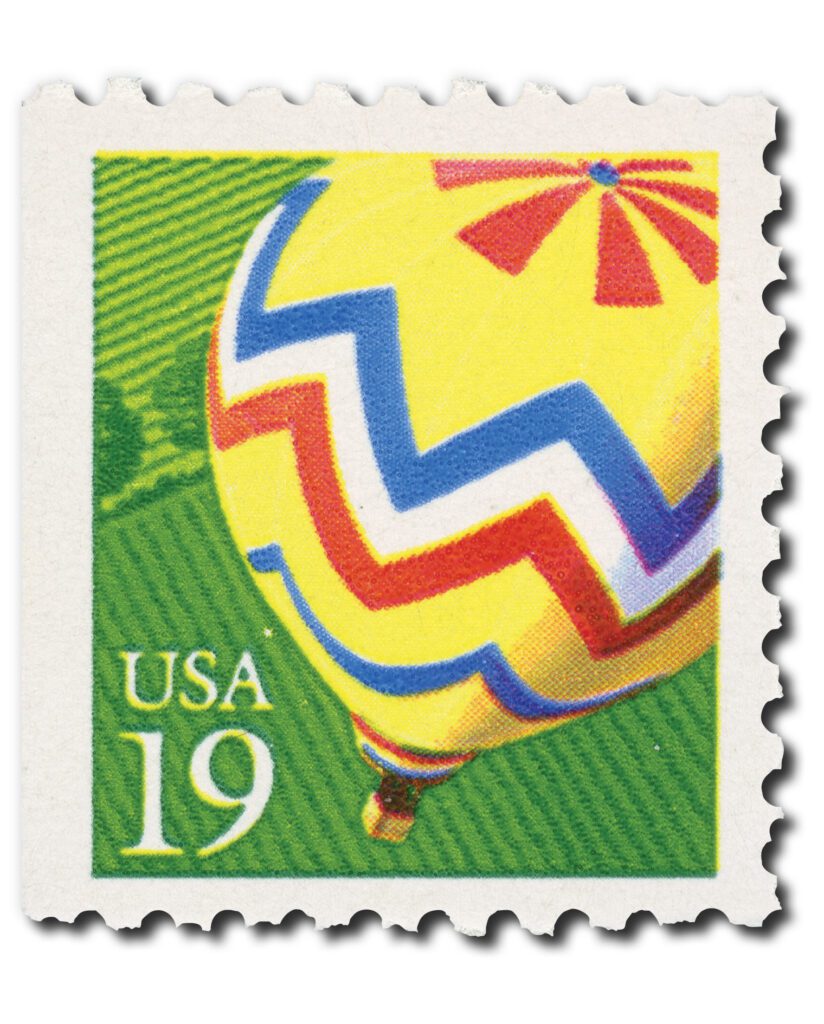
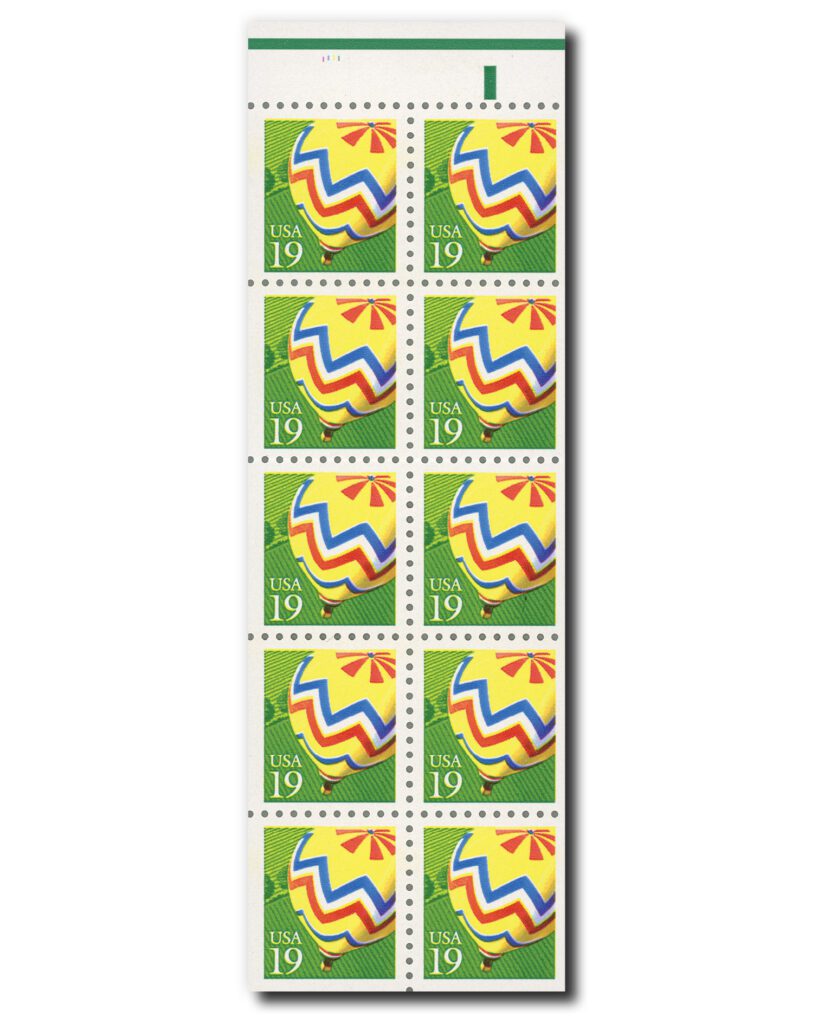
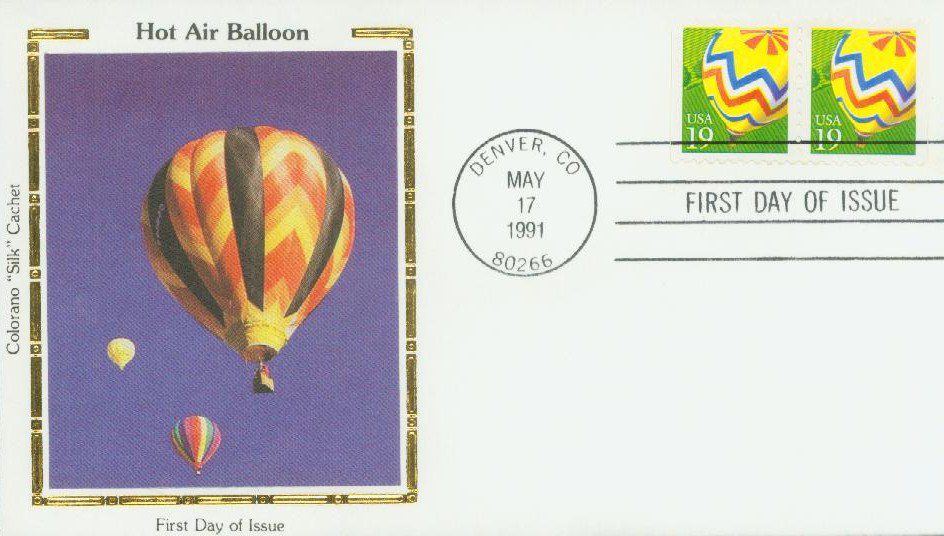
Changes in postal rates soon led to additional Mini-Scapes stamps. In 1991, the postcard rate increased from 15 cents to 19 cents. To meet this new rate, the USPS issued the second stamp in the series on May 17, 1991. This stamp featured Mion’s hot-air balloon design, continuing the focus on simple, familiar imagery. The stamp was issued during Rompex 91, a stamp show in Denver, Colorado. Though there was no official US Postal Service ceremony, the organizers held their own complete with an actual hot-air balloon.
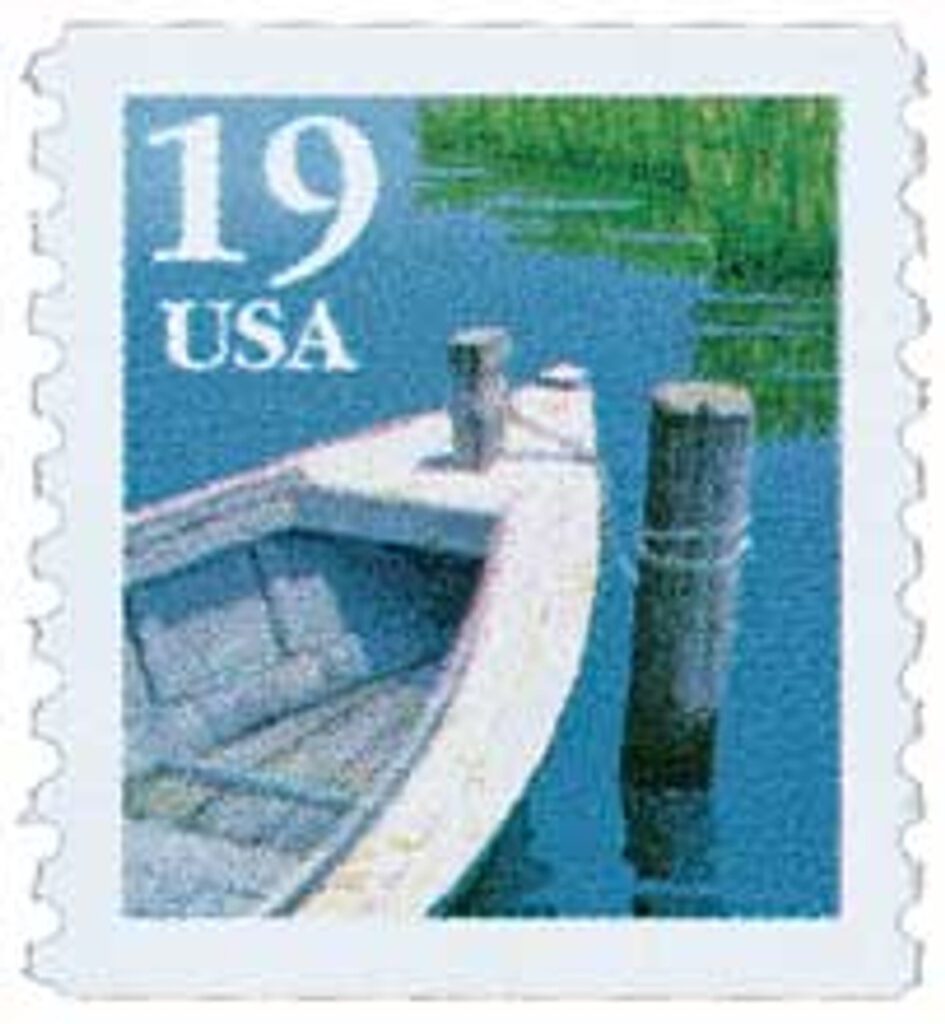
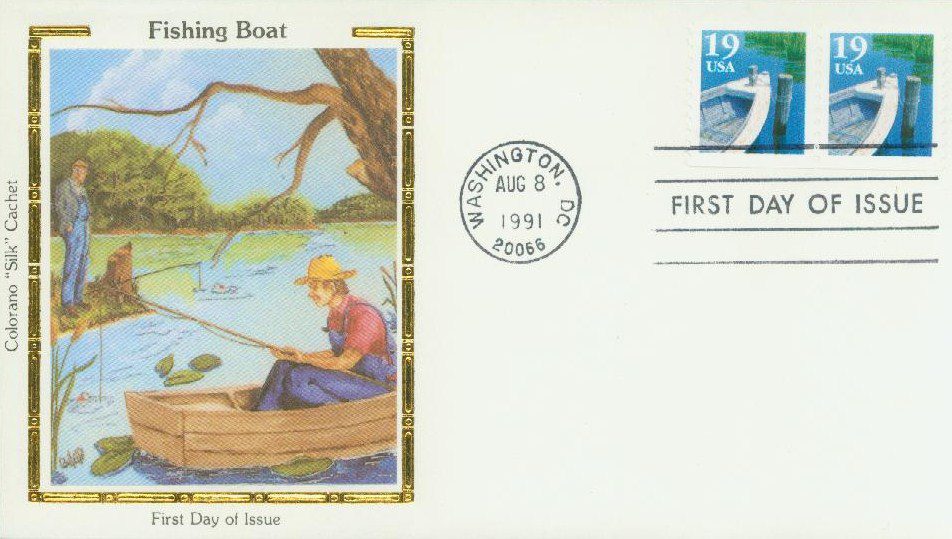
The third and final stamp in the Mini-Scapes Series was issued on August 8, 1991. It showed the prow of a fishing boat tied to a pier along a marshy shoreline. The boat resembles those used for oystering or crabbing along the East Coast. Like the earlier stamps, it relied on a close-up view and everyday subject matter. Unlike the other two stamps, it was issued in coils, rather than boklets.
Although brief, the Mini-Scapes Series reflected a thoughtful effort to rethink the look of everyday US postage, balancing practicality with modest visual appeal.
| FREE printable This Day in History album pages Download a PDF of today’s article. Get a binder or other supplies to create your This Day in History album. |
Discover what else happened on This Day in History.
Not exciting but interesting information about why these stamps were issued.
Personally I like these stamps. They are colorful, cheerful and the designs fit well on definitives. I like the term “bewhiskered Unknowns.” Cute!
Personally, I think the CSAC has gone way off course in their selections for stamp subjects over the past 15 to 20 years. Many of the stamps they have approved are pretty poor, in my estimation. But, they are a reflection of our “modern” society – which has a lot of “fluff”, and little substance (again, just my opinion). I would like to see more stamps with historical significance and stamps that are educational about the USA, its history, – historical persons and historical events. I guess that’s too much to hope for.
I agree with Charles – I liked the stamps of the 50’s
I agree with Mr. Troutman. In recent years there have been commemoratives that are actually “ugly” and have little or no historical interest to me, which is why I began collecting US stamps many years ago! Bring back the “bewiskered unknowns” so they can become known! Thank you!
A disappointment for me regarding a subject for a stamp has been the fact that that Bill Wilson and Bob Smith have not been recognized. These two men founded Alcoholics Anonymous. This organization has helped thousands of alcoholics achieve sobriety.
Good point Mr. Hummel. Their inspiration has been a godsend and saving power in millions of people’s lives all over the world including some of my friends and family. I heartily endorse and encourage the CSAC to consider and execute a stamp or stamps to promote this recognition. Again, thank you George Hummel, for bringing this to our awareness.
The umbrella subject was ‘pushed through” CSAC by its beloved long time member Mary Ann Owens of Brooklyn NY. She was known worldwide for her topical collections of “Umbrellas” and “Elephants”. If she were still on CSAC you wouldn’t be seeing some of the junk coming out lately. Mary Ann, we miss you!
I have a few of the hot air balloon stamps that I received in a mixed lot. I like them, but I never knew anything about them. Mystery solved!
Thank you Mr Charles Troutman. I to would prefer stamps depicting historical, geographical, and engineering themes. That is why the stamps of the 50’s, 40’s, and even 30’s have a certain aura to them that contemporary stamps do not.