

On February 5, 1953, Walt Disney released his 14th animated feature, Peter Pan. The film brought a beloved stage story to life in a way audiences had never seen before, using animation to turn fantasy into motion, color, and sound.
The story of Peter Pan began decades earlier with its creator, James Matthew Barrie. J.M. Barrie was born on May 9, 1860, in Kirriemuir, Scotland. He was the second youngest of nine children in a working-class family. Barrie was deeply affected by childhood loss, especially the death of his older brother David, who died in an ice-skating accident at age 13. This experience shaped Barrie’s lifelong interest in childhood, memory, and the idea of never growing up.
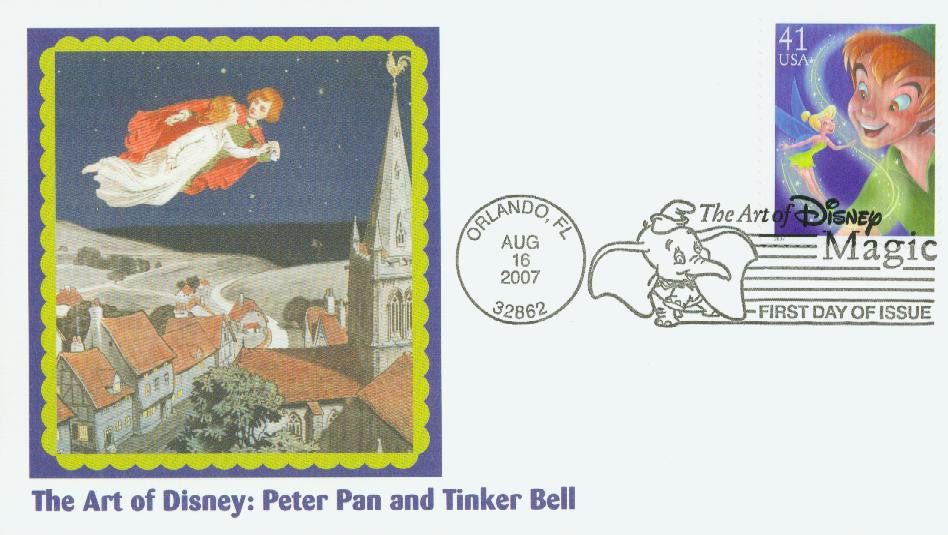
Barrie developed the character of Peter Pan through stories he told to the sons of his close friend, Sylvia Llewelyn Davies. The boys—George, Jack, Peter, Michael, and Nicholas—became the inspiration for many characters and ideas in the story. Peter Pan’s name came partly from one of the boys, Peter Davies, and partly from Pan, the playful Greek god associated with nature and mischief. Barrie first introduced Peter Pan to the public in the 1902 novel The Little White Bird. The character gained wider fame in the 1904 stage play Peter Pan, or The Boy Who Wouldn’t Grow Up. Barrie later expanded the story into the novel Peter and Wendy, published in 1911.
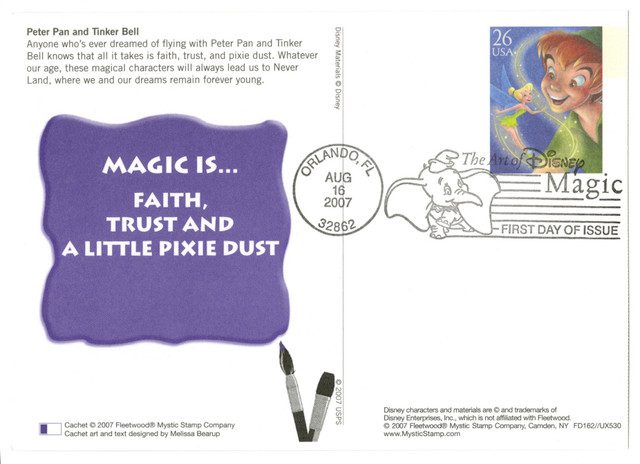
Walt Disney had admired Peter Pan for many years. He saw the stage version in the early 1900s and considered it one of his favorite stories. In 1935, Disney hoped to make Peter Pan his second animated feature, following Snow White and the Seven Dwarfs. Securing the rights proved difficult. Negotiations took four years, and Disney did not finalize the agreement until 1939. Once the rights were secured, the studio began early work on story development and character designs.

Progress slowed dramatically after the United States entered World War II in December 1941. Disney’s studio shifted its focus to producing military training films and propaganda shorts for the government. As a result, Peter Pan was placed on hold, along with several other ambitious projects. When the war ended in 1945, the studio faced serious financial problems. It took nearly two more years before Disney could afford to resume full production on the film.
Animation on Peter Pan resumed in the late 1940s, with many of Disney’s top artists involved. There has long been an accepted rumor that Captain Hook was a self-caricature of animator Frank Thomas, while Hook’s loyal but timid sidekick, Mr. Smee, resembled animator Ollie Johnston. Another persistent rumor claimed that Tinker Bell was modeled after Marilyn Monroe. In reality, animator Marc Davis used actress and dancer Margaret Kerry as the live-action reference model for Tinker Bell’s movements and expressions.
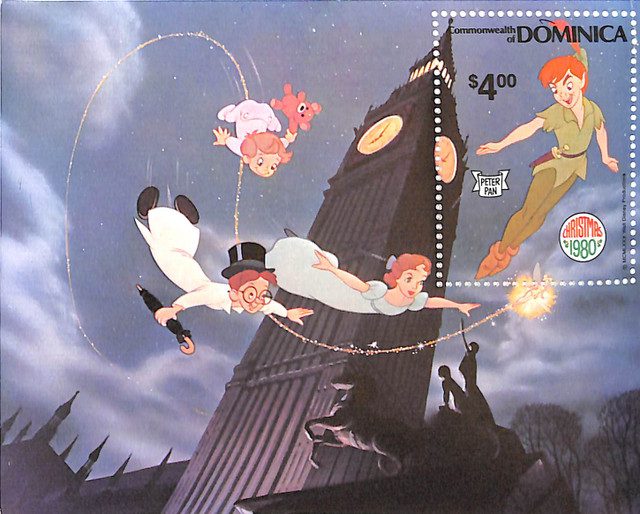
Peter Pan premiered on February 5, 1953, and received mostly positive reviews in the United States. Critics praised its animation, humor, and visual imagination. Some British audiences and critics, however, objected to changes Disney made to Barrie’s original work. These viewers felt the film took liberties with tone and character. Disney’s version reflected the different demands of film rather than live theater, where effects had always been limited by physical staging.
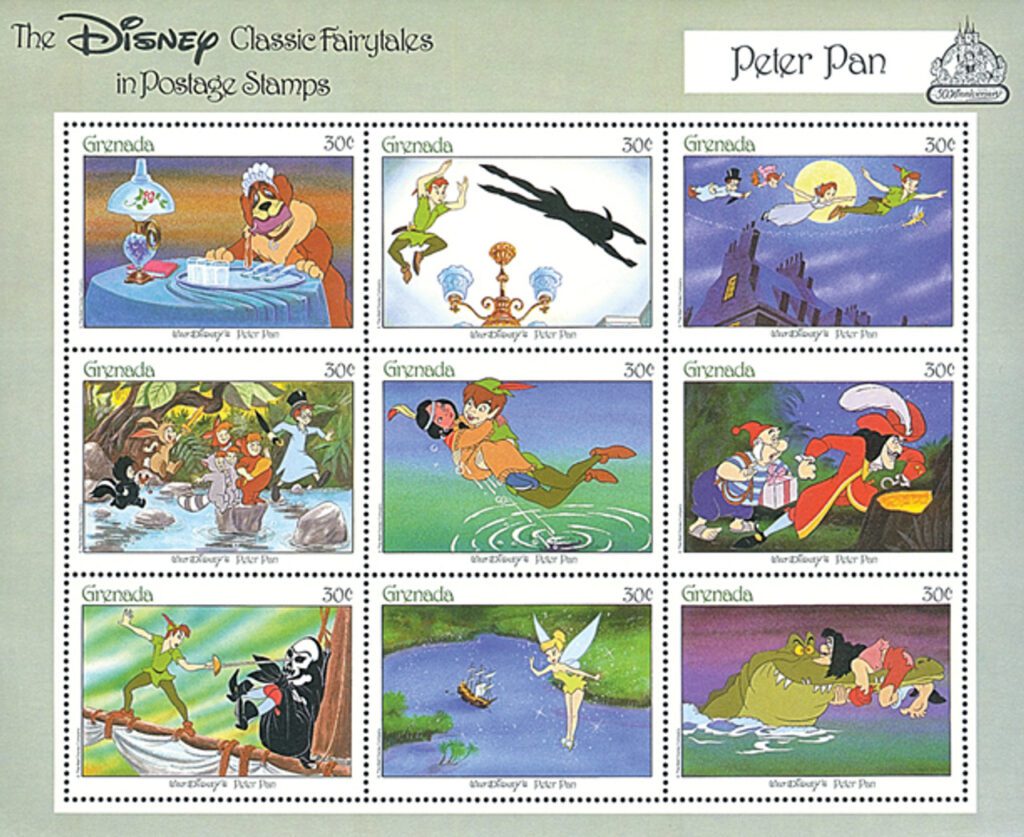
Animation allowed Disney to realize elements Barrie could only suggest on stage. In the film, Peter’s shadow moves independently and behaves like a character of its own. Tinker Bell becomes a fully expressive fairy, capable of jealousy, pride, and affection. She darts through scenes like a hummingbird, leaving trails of glowing pixie dust behind her. In the stage play, Tinker Bell could only appear as a moving light. The animated film also shows Nana as a real dog carrying a tray, something nearly impossible to portray convincingly on stage. The crocodile, complete with its ticking clock, becomes a constant and visible threat to Captain Hook.
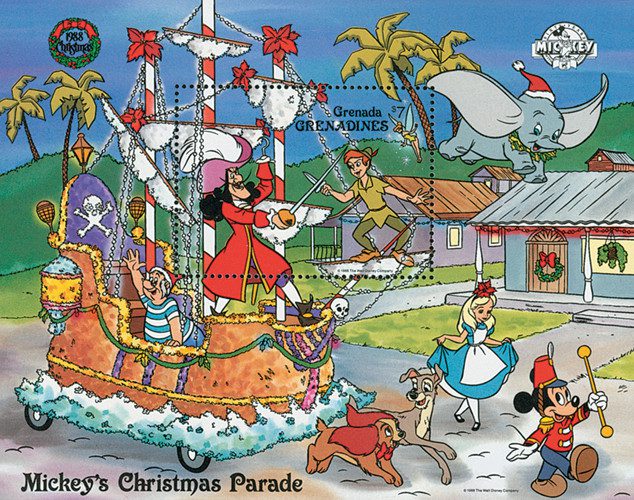
These animated choices made the characters clearer and more visually engaging. Their personalities were easier to understand at a glance. The result was a story that felt vivid and immediate to audiences of all ages.
Peter Pan became the highest-grossing film of 1953, earning about $7 million. Its success led to multiple theatrical re-releases over the following decades. The film secured its place as a lasting part of Disney’s animated legacy and introduced new generations to the boy who never grew up.
Learn more about Disney on US postage stamps.
Click here for lots more worldwide Disney stamps.
| FREE printable This Day in History album pages Download a PDF of today’s article. Get a binder or other supplies to create your This Day in History album. |
Discover what else happened on This Day in History.
Like the peanut butter too!
Thanks again for the daily history lesson and insight to so many interesting subjects. Keep ’em coming.
I WONT GROW UP!!
I don’t want to go to school!
The theme of lost childhood makes this film a bit sad. But, it was the first film I truly loved. I still miss Walt Disney.
I love the Disney Postage Stamps that I have a book “The Art of Disney Stamp Book” that I bought it from USPS Postal Store Online on 2015.
I don’t want to go to school!
In 1960 Mary Martin performed a rendition of Peter Pan for television that I enjoyed very much as a 10 year old.
The date on the pdf is incorrect.
I remember this movie so well. I took the girl next door, Donna, to see it. I was 7, she was 6. Of course, my mom took us and stayed a couple of rows back, but it was our first, official date.