

On December 8, 1831, the man who shaped one of the most iconic buildings in American history—James Hoban—died in Washington, DC. Although his name isn’t as well known as the presidents who lived in his masterpiece, Hoban’s work left a permanent mark on the nation. As the architect of the White House, he helped design not only a home for America’s leaders but also a symbol of the country’s identity. His life story stretches from rural Ireland to the heart of the young United States, where his talent built the setting for generations of American history.

James Hoban’s exact birth date is unknown, but historians believe he was born around 1758 in Callan, County Kilkenny, Ireland. He grew up on the estate of the Earl of Desart, where he likely developed early exposure to building and craftsmanship. Before becoming an architect, Hoban spent several years working as a wheelwright and carpenter—hands-on experience that helped shape his later design skills.
His life changed when he was admitted as an “advanced student” at the Dublin Society’s Drawing School, one of Ireland’s leading training centers for aspiring architects and craftsmen. Hoban excelled there, earning the Duke of Leinster’s medal for his highly detailed drawings of architectural elements such as brackets, staircases, and roofs. He later apprenticed with Thomas Ivory, a respected architect who helped guide Hoban’s technical abilities and artistic style.

After the American Revolutionary War ended, Hoban decided to seek new opportunities in the growing United States. He arrived in Philadelphia in 1785, at a time when American cities were expanding and needed talented builders. Two years later, Hoban moved to South Carolina, where he quickly made a name for himself by designing elegant plantation homes and prominent public buildings. One of his most admired projects was the Charleston County Courthouse, a graceful structure that reflected European influences.

In 1791, President George Washington toured the South and noticed Hoban’s work in Charleston. Impressed by the young architect’s skill, Washington invited Hoban the following year to Philadelphia—the temporary national capital—to compete in the design contest for the new presidential residence. Hoban submitted a plan inspired in part by classical European styles, and he won the competition.
The winning design originally featured a three-story façade. However, historical evidence suggests that Hoban worked closely with Washington to revise the plan to two stories and expand the front to eleven bays. Hoban drew not only from his training but also from familiar Irish and French country houses, blending Old World elegance with the needs of a new republic. For the next eight years, he oversaw construction of the White House, guiding the project from blueprint to completed residence.

After the building was finished, Hoban remained in Washington for the rest of his life. He became one of the supervising architects for the US Capitol and worked on the Octagon House, another important early American structure. As the capital city grew, Hoban contributed to many public projects and helped shape the architectural character of Washington, DC.

Hoban also played a role outside of architecture. He served on the city council and supported the development of Georgetown University, St. Patrick’s Parish, and the Georgetown Visitation Monastery. Despite living in America, he maintained ties to Ireland and even designed the Rossenarra House there in 1824.
When British troops burned the White House during the War of 1812, Hoban returned to his most famous project and personally supervised its rebuilding. His leadership ensured that the president’s residence would rise again, stronger than before.
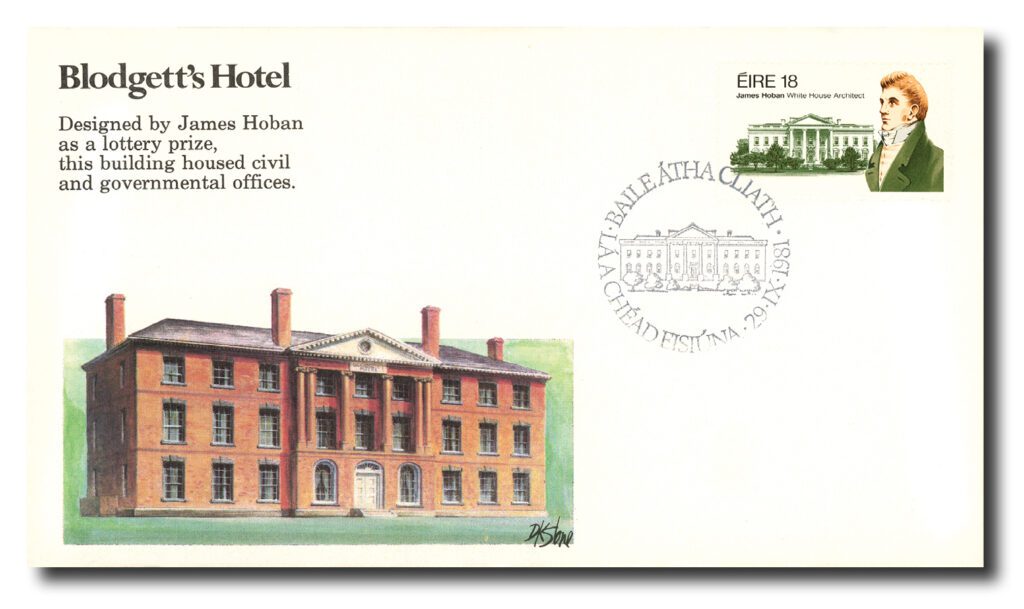
James Hoban died on December 8, 1831. Much of his personal history is still a mystery because most of his papers were destroyed in a fire during the 1880s. As a result, the full list of buildings he designed is incomplete. Still, several structures are commonly attributed to him, including Prospect Hill and the William Seabrook House in South Carolina, the McCleery House in Washington, DC, Oak Hill—President James Monroe’s home—in Virginia, the First Bank of the United States in Philadelphia, and the Belcampe House in Ireland.

In 2008, both the United States and Ireland celebrated the 250th anniversary of Hoban’s birth, honoring the man whose architectural vision gave America one of its most enduring symbols.
Click here to view drawings and photos relating to Hoban’s work from the Library of Congress.
| FREE printable This Day in History album pages Download a PDF of today’s article. Get a binder or other supplies to create your This Day in History album. |
Discover what else happened on This Day in History.
Immigrants- they get the job done!
What’s the story behind the two denominations?
Great article, thanks Mystic. The history of the White House should be respected and any changes should come before a committee of individuals who would do just that.
Committees don’t get the work done as costs spiral over time. The President has already proved his architectural designs work. 250 yr Anniversary deserved celebration with improved area for visitors. And he’s getting it done at no cost to tax payers. Resilience