

On January 6, 1941, President Franklin Roosevelt gave his “Four Freedoms” speech while delivering the State of the Union Address. The Four Freedoms represented America’s goals for a peaceful post-war world.
By January 1941, World War II had wreaked havoc across the globe. Germany invaded Poland, Belgium, and the Netherlands. Additionally, France had been defeated by a German blitz, the Soviet Union invaded Finland, and Japan was ruthlessly battling China.

In the US, President Franklin Roosevelt was just elected to an unprecedented third term. Across the nation, Americans did not want to get involved in the war. The president earnestly tried to convince them that completely ignoring the war was dangerous not just to other countries, but also America. He knew America would eventually be forced into the war and, more than anything, worried the country would not be ready.
When President Roosevelt delivered his State of the Union address on January 6, 1941, he stressed the serious nature of the situation and that “at no previous time has American security been as seriously threatened from without as it is today.” He continued to explain that the US must assist the Allied nations in defeating the Axis powers from taking over all of Europe.

President Roosevelt continued with perhaps one of his most famous speeches, saying, “In these future days which we seek to make secure, we look forward to a world founded upon four essential human freedoms.” Those freedoms are the freedom of speech and expression, the freedom to worship in one’s own way, freedom from want, and freedom from fear. He concluded his speech stating that “Our strength is our unity of purpose. To that high concept, there can be no end save victory.” Roosevelt’s speech resonated around the world, offering hope to civilians suffering under Nazi oppression.


The following year, Norman Rockwell began a series of four paintings that pictured ordinary Americans in scenes portraying the ideals for which the United States had gone to war. Called The Four Freedoms, the series consisted of Freedom of Speech, Freedom of Worship, Freedom from Want, and Freedom from Fear.
Unlike much of his other work, these paintings were not designed as illustrations, but as original works of art. More than one million people saw the original paintings in the 16-city tour to promote the sale of war bonds. The tour was so successful that it raised over $130 million for the cause. Publishing the paintings as inside illustrations, The Saturday Evening Post generated an equally impressive response from its readers. The government agencies that had turned the series down when Rockwell offered it to them soon realized their error – these powerful images struck a chord that reverberated around the country.
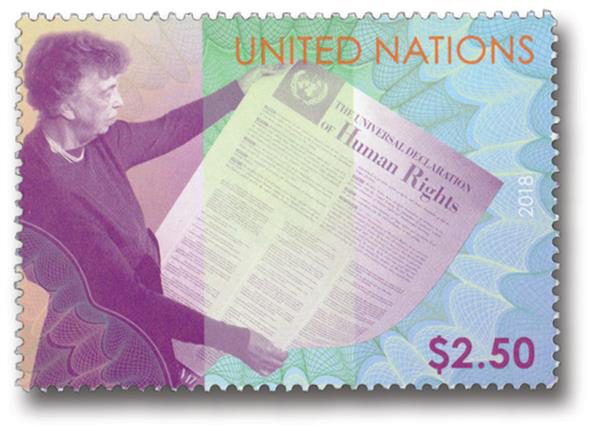
The ideals expressed in the Four Freedoms became a guiding influence on the Universal Declaration of Human Rights, shaping its emphasis on both political liberties and basic human needs. The Declaration reflects these principles through protections for free expression and religious belief, as well as rights to security, work, education, and an adequate standard of living—echoing freedom from fear and freedom from want. Eleanor Roosevelt played a central role in translating these broad ideals into a practical, international document. As chair of the United Nations Commission on Human Rights, she led lengthy negotiations, balanced competing viewpoints, and insisted the declaration speak in clear, accessible language. Her steady leadership helped ensure that the Four Freedoms were embedded in a global human rights framework, giving them lasting international significance beyond their American origins.
Click here to watch part of Roosevelt’s speech. And click here to view larger versions of Rockwell’s paintings.
| FREE printable This Day in History album pages Download a PDF of today’s article. Get a binder or other supplies to create your This Day in History album. |
Discover what else happened on This Day in History.
A great message that should be embraced by all. Unfortunately some in power are driven by their own greed and are blind to the four freedoms. New Hampshire has on their license plate “Freedom isn’t Free” which I believe is a message to all of us to pay attention and hold our elected leaders accountable.
Maybe a little closer look at the so called “four freedoms” is in order. I refer you to another stamp, and the celebrant on that stamp, Ayn Rand, in her article “Man’s Rights,” in her anthology, “The Virtue of Selfishness>” Freedom from Want, at whose expense? Freedom from fear? Fear is what you experience when something threatens a value. (that’s how Ayn Rand analyzed it.) Freedom of Speech and Religion? Roosevelt believed that the government had an obligation to provide the material implementation of those rights. At whose expense? Roosevelt’s Four Freedoms are not freedoms but another form of slavery. Let’s recognize it as such.