

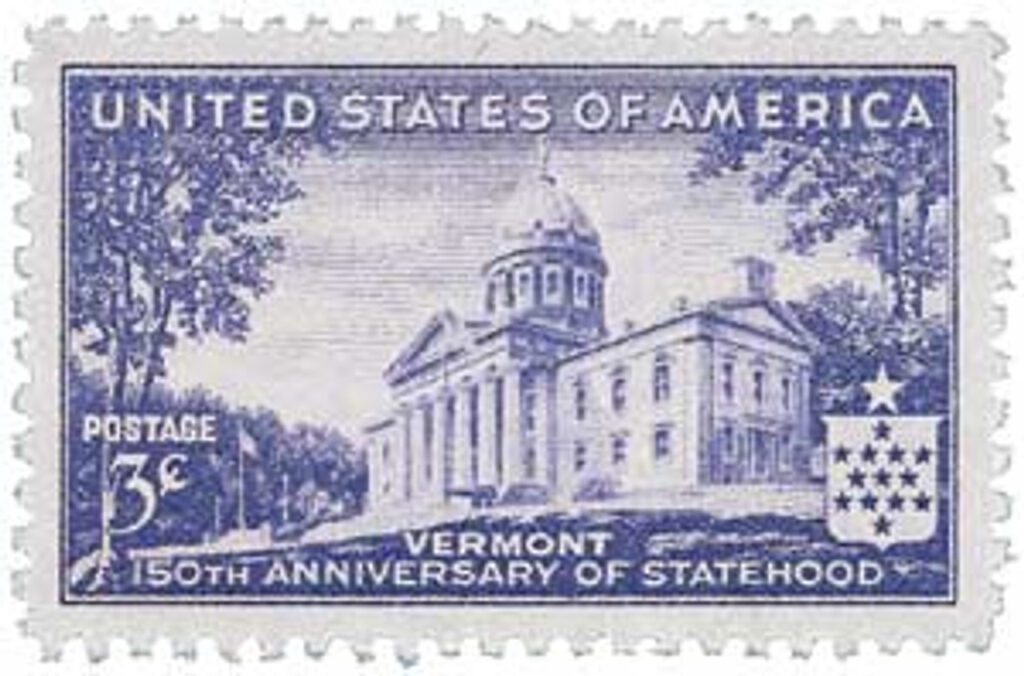
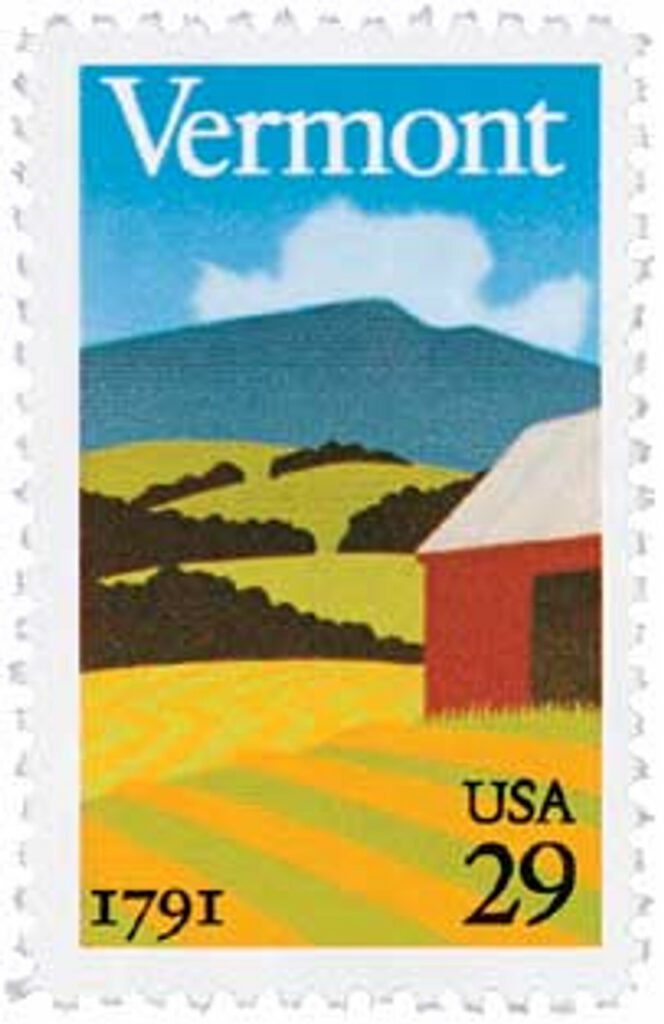
On March 4, 1791, Vermont was admitted to the Union. After years of land disputes, frontier battles, and even a period as an independent republic, the small mountain region officially became the 14th state of the United States.
Long before statehood, the land that is now Vermont was home to Native American tribes, especially members of the Algonquian-speaking Abenaki people. They used the forests and rivers mainly for hunting, fishing, and seasonal farming. The area’s thick woods and cold winters made large permanent settlements difficult, but Lake Champlain provided a vital transportation route.
In 1609, French explorer Samuel de Champlain reached the lake that now bears his name, Lake Champlain. He claimed the surrounding region for France as part of New France. In 1666, French soldiers built Fort Sainte Anne on Isle La Motte in Lake Champlain to protect their claims and strengthen ties with Native allies. The English also tried to establish control. In 1690, they built a fort at Chimney Point near present-day Middlebury. However, early settlements were small and often abandoned because of conflict.
The first permanent English settlement in the region was Fort Dummer, built in 1724 near today’s Brattleboro by colonists from Massachusetts. It was meant to defend the western frontier from French and Native American attacks. During the French and Indian War (1754–1763), Vermont became a contested battleground between Britain and France. When Britain won the war, it gained control of most of North America east of the Mississippi River, including Vermont.
After the war, new problems arose. The royal governors of New Hampshire and New York both issued land grants in the Vermont area. Many settlers received “New Hampshire Grants,” which promised them land titles. But in 1764, the British government ruled that the territory belonged to New York. Settlers were told they must either pay New York for their land again or leave.
This angered many residents. In response, Ethan Allen and others formed the Green Mountain Boys, a militia group determined to defend the settlers’ land claims. They used threats and force to drive out New York officials and settlers who tried to enforce New York’s authority. The conflict made it clear that Vermont’s residents wanted local control.
When the American Revolution began in 1775, the Green Mountain Boys quickly joined the patriot cause. In May 1775, Ethan Allen, along with Benedict Arnold and about 80 men, captured Fort Ticonderoga from the British. The fort, located in New York on Lake Champlain, held valuable cannons that were later transported to Boston to help drive British troops from the city.
In 1777, British forces advanced south from Canada. American troops retreated from Fort Ticonderoga, and a rear guard led by Seth Warner slowed the British advance. On August 16, 1777, American forces defeated a British detachment at the Battle of Bennington, which actually took place in present-day New York. The victory weakened British General John Burgoyne’s army and contributed to his surrender at Saratoga later that year.
Amid these events, Vermont took a bold step. On January 15, 1777, delegates declared the region an independent republic called New Connecticut. By July 1777, they adopted a constitution and renamed the republic Vermont, from the French “vert mont,” meaning “green mountain.” Vermont’s constitution was one of the most progressive of its time. It banned adult slavery, provided for universal male suffrage without property requirements, and called for public schools.
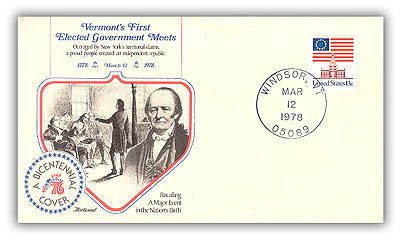
For 14 years, Vermont operated as an independent republic. It created its own currency, postal service, and government. However, it was not officially recognized by the Continental Congress, largely because of objections from New York. Leaders like George Washington worried that Vermont’s independence could cause division among the states. In 1783, Washington even suggested that force might be needed if Vermont refused to join the Union, though no military action was taken.
The path to statehood required compromise. In 1790, Vermont agreed to pay New York $30,000 to settle the land dispute. New York then gave up its claims, and New Hampshire had already done so. With these obstacles removed, Congress approved Vermont’s admission. On March 4, 1791, Vermont became the first state admitted to the Union after the original 13 colonies.
In the years that followed, Vermonters continued to serve in national conflicts. During the War of 1812, they fought in battles such as Chippewa, Lundy’s Lane, and Plattsburgh. Yet many citizens opposed the war because Vermont relied heavily on trade with Canada. The war disrupted commerce and hurt the economy.
Economic changes shaped Vermont throughout the 1800s. The completion of the Champlain Canal in 1823 linked Lake Champlain to the Hudson River. This allowed farmers to ship goods to New York City more easily. Sheep farming became highly profitable. By 1840, Vermont had about six sheep for every resident. However, competition from Midwestern farms later caused wool prices to fall. Many farmers shifted to dairy production. Over time, Vermont became known for its dairy farms, butter, and cheese.
The state also developed industries based on its natural resources. Timber supported wood-processing businesses. Granite and marble quarries, especially in Barre and Rutland, became nationally known. Railroads expanded in the mid-1800s, helping factories and farms reach wider markets. Even so, many young Vermonters moved west or to cities for better opportunities.
After the Civil War, Vermont continued to change as the nation industrialized. Railroads expanded across the state, linking small towns to larger markets in Boston and New York. Granite quarrying in Barre grew into a major industry, earning the city the nickname “Granite Center of the World.” Marble from Rutland was used in public buildings across the country. Textile mills, tool factories, and food-processing plants provided jobs, especially in river towns. At the same time, many hill farms were abandoned as families moved west or to cities. Forests slowly reclaimed old farmland, reshaping much of Vermont’s landscape by the early 1900s.
The early 20th century brought new challenges and opportunities. Vermonters served in both World War I and World War II. Hydroelectric dams were built on rivers to provide power. Improved roads and the rise of the automobile made tourism easier. By the 1930s and 1940s, ski areas began to develop in the Green Mountains, laying the foundation for a winter recreation industry. After World War II, interstate highways, including Interstate 89 and Interstate 91, improved travel and commerce. Small manufacturing firms expanded, while dairy farming became more efficient but declined in number. By the late 20th century, Vermont had shifted toward a mixed economy that combined agriculture, manufacturing, tourism, and a growing service sector.
Today, Vermont remains one of the least populous states, with about 650,000 residents. Agriculture is still important. Dairy farming continues, though on a smaller scale than in the past. The state is famous for maple syrup production and is one of the leading producers in the United States. Tourism is another major industry. Visitors come for skiing, hiking, and fall foliage in the Green Mountains. Manufacturing also plays a role, including food production, machinery, and specialty products.
In recent decades, Vermont has focused on small businesses, renewable energy, and environmental protection. The state promotes sustainable forestry and local agriculture. Education and healthcare are significant employers. While Vermont faces challenges such as an aging population and limited workforce growth, it maintains a strong sense of community and civic involvement.
| FREE printable This Day in History album pages Download a PDF of today’s article. Get a binder or other supplies to create your This Day in History album. |
Discover what else happened on This Day in History.
Read more of the history of the area than was ever taught in school – ‘back in the day’ – amazing that there was this much conflict and such in the area – never would have known. Always had athe idea that the area was so peaceful. Ha! Thanks for the historical snapshot.
Great Summary!
I like this program this day history
Mystic provides one of the best sources of information and/history. KEEP UP THIS GOOD WORK
As always a very interesting history of a state. Would be nice to add facts about Vermont in the 20th century.
Good article. I have my father’s bible. The frontispiece has his handwriting with his name and the note ” TroopJ 2nd U. S. Cav, Fort Ethan Allen, Vermont” . He met my mother in Plattsburg and they were married in 1916. Interesting reading about Vermont. Thanks.
I find every one of the “This Day in History to be very information and look forward to reading them. I have learned much about our nation that is not taught in history classes. Thank you
Surprised that they left out how the battle of Bennington contributed to the American victory at Saratoga that in turn lead to France entering the American Revolution that in turn led to Yorktown. Good to use any opportunity to tie historic events together.
“The Battle of Bennington and the surrender at Yorktown ended British occupation of the northern colonies.” Yorktown? I think you mean Saratoga.
I had wondered why Vermont was not one of the original colonies considering its proximity. So in essence it was but not as an entity. Great information Mystic and not the first mention of maple syrup.
Nice article from Vermont glad to read about our state.
I was stationed at Plattsburg AFB, a short ferry ride from Vermont and central to today’s article. I learned more in this short article than I ever learned in the 3 years I lived there. Good work, Mystic.
Wonderful article! My great aunt in Bennington would be pleased.