

On March 7, 1903, Maud Lewis was born in South Ohio, Nova Scotia. Few could have guessed that this child, who would face lifelong physical pain and poverty, would become one of Canada’s most recognized folk artists.
Maud Lewis was born Maud Kathleen Dowley in Yarmouth County, in the small community of South Ohio. Her parents, John and Agnes Dowley, lived in a modest house and supported themselves through various forms of work. As a child, Maud developed juvenile rheumatoid arthritis. The disease caused swelling and stiffness in her joints. It also affected her growth. She stood just over four feet tall as an adult. Her shoulders were rounded, and her hands became twisted over time. Everyday tasks required extra effort.

Despite these challenges, Maud showed artistic interest at a young age. Her mother encouraged her to draw and paint. Agnes taught her how to mix colors and apply paint to simple surfaces. The family did not have much money, so materials were limited. Maud often used small pieces of cardboard. She painted Christmas cards by hand and sold them locally for a few cents each. These early works helped her develop her style.
Her childhood was quiet. She attended a local school but did not continue her education for long. Social life could be difficult. Her physical differences made her stand out. Still, she found comfort in familiar surroundings. The rural landscapes of Yarmouth County left a deep impression on her. She remembered oxen pulling sleds, fishing boats along the shore, and fields covered in snow. These memories later became the main subjects of her paintings.
In her early twenties, Maud’s life changed sharply. Her father died in 1935. Her mother died soon after. Maud, who had depended on them, was left without stable support. She moved to Digby, Nova Scotia, to live with an aunt for a short time. Seeking independence, she answered a newspaper advertisement placed by Everett Lewis. He was a fish peddler looking for a housekeeper. In 1938, Maud went to work for him. The two married later that year.
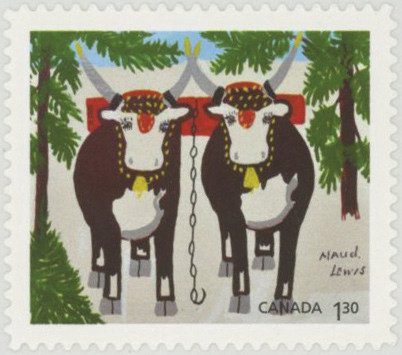
Everett Lewis was quiet and often reserved. The couple lived in a very small one-room house near Marshalltown, west of Digby. The structure measured about 10 by 12 feet. It had no running water and no electricity. Heat came from a small stove. Winters were cold. Money was scarce. Everett sold fish door to door. Maud kept house and began to paint more seriously.
Painting brought her joy and focus. Her arthritis made holding a brush painful. She adapted by gripping it tightly and working in small movements. When she could not afford art supplies, Everett brought home scraps of Masonite or drywall. He also brought leftover house paint. Maud used whatever colors were available. Bright yellows, reds, greens, and blues became common in her work.
Even when she acquired proper artist’s board or canvas, she did not limit herself. She painted directly on the walls of their tiny home. She covered doors, window frames, and cupboards with flowers, birds, and butterflies. She painted a large ox team pulling a sleigh across one wall. The house itself became her largest artwork. Today, that painted house is preserved inside the Art Gallery of Nova Scotia in Halifax.
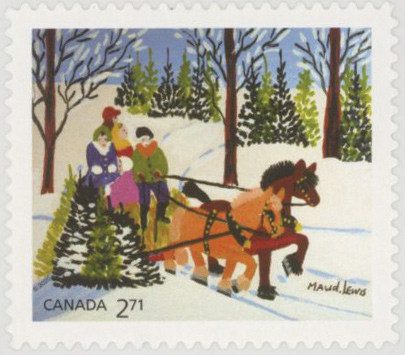
Maud worked without photographs or sketches. She painted from memory. Her scenes often showed covered bridges, fishing boats, cats with wide eyes, and couples skating. Many works included the words “Maud Lewis” written clearly on the surface. She sold paintings from her home for $2 to $5 each. Tourists traveling through Digby County began to stop and buy them. Word spread slowly.
In the 1960s, her work gained wider attention. A 1964 article in the Star Weekly magazine introduced her to readers across Canada. In 1965, she was featured on CBC Television. That same year, she received a letter from Lester B. Pearson, who then served as Prime Minister. He wrote to express admiration for her art. This recognition did not change her simple lifestyle, but it increased demand for her paintings.
Maud Lewis continued painting through worsening health. Years of arthritis had taken a heavy toll. She died on July 30, 1970, in Digby, Nova Scotia. She was 67 years old. During her lifetime, she rarely traveled far from her small community. Yet her paintings traveled widely. They captured scenes of rural Nova Scotia with directness and bright color.
| FREE printable This Day in History album pages Download a PDF of today’s article. Get a binder or other supplies to create your This Day in History album. |
Discover what else happened on This Day in History.
What a story…the images bring me joy
Wonderful write up. Such a talented artist who kept going despite unthinkable odds. Heart warming!
Beautiful stamps. My brief research about Maud Lewis suggests that her life and persona have been painted with a very soft brush that might well not be deserved. It was remarkable that she stuck to painting, but how “remarkable” Maud Lewis was, and granting her disabilities, (and is true of many people, famous or infamous, one has to decide just how much one can separate the art from the individual. Thank you, once again, Mystic Stamp for furthering knowledge.
Thanks for enlightening me on Maud Lewis. Thanks also for expanding on topics to include Canada.