
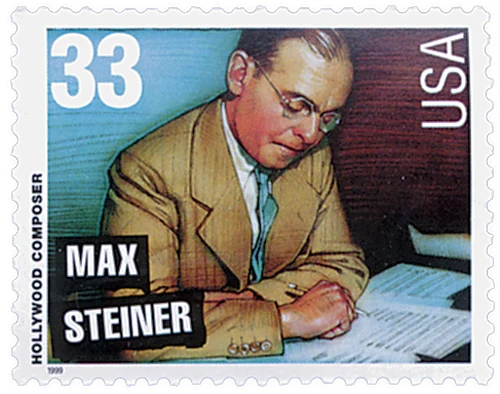
On May 10, 1888, Max Steiner was born in Vienna, Austria-Hungary, into a family already tied to music and theater. He later helped shape the sound of Hollywood with scores for King Kong, Gone with the Wind, Casablanca, and hundreds of other films.
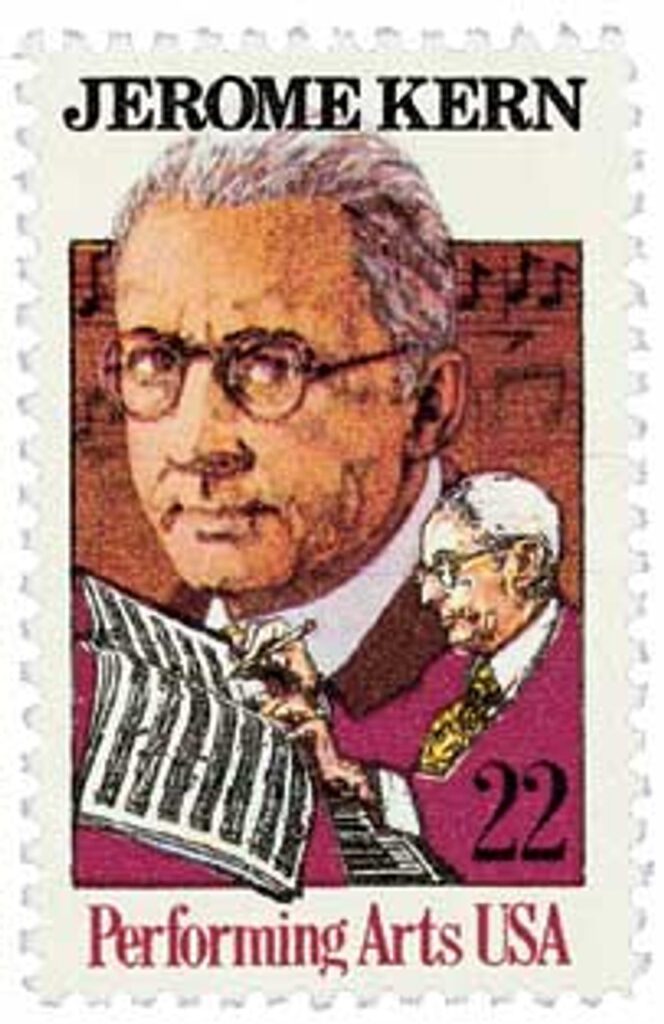
Maximilian Raoul Walter Steiner grew up surrounded by performance. His grandfather, Maximilian Steiner, managed theaters in Vienna and helped promote Viennese operetta. His father, Gabor Steiner, was also a major theater manager and impresario. Max’s godfather was composer Richard Strauss, and his early musical training reflected that world. He studied piano, organ, violin, trumpet, and composition, and he showed skill at a young age.
Steiner later studied at the Imperial Academy of Music in Vienna. He moved quickly through his lessons and became a professional musician while still a teenager. By age 16, he was already conducting and composing. One of his early stage works, The Beautiful Greek Girl, was produced in Vienna when he was still young. His career seemed likely to remain in European theater, but the next decades carried him far from Vienna.

In 1906, Steiner moved to England. There he worked in musical theater, vaudeville, opera, and light entertainment. He conducted and arranged music in London, gaining the speed and discipline he would later need in Hollywood. He also worked with well-known stage figures, including George Grossmith Jr. and other producers connected to the British theater world.

World War I changed his life. Because Steiner had been born in Austria-Hungary, Britain considered him an enemy alien after war broke out in 1914. He left England and arrived in New York with little money. According to accounts often repeated about his life, he had only $32 when he reached the United States.
Steiner soon found work on Broadway. He arranged and conducted music for stage productions and worked with famous composers and performers of the period. His credits included arrangements connected to shows by Victor Herbert, Jerome Kern, and George Gershwin. This experience taught him how to adapt quickly to different styles, moods, and dramatic needs.
During the silent-film era, Steiner also arranged music to be played during movie screenings. These films had no recorded dialogue or synchronized score. Theater musicians used cue sheets or compiled music to match the action. Steiner learned how music could support a scene, guide an audience’s emotions, and smooth transitions from one moment to the next.

In 1929, Steiner moved to Hollywood and joined RKO Radio Pictures. Sound films were still new, and many studio leaders were unsure how much music movies should have. Some feared that audiences would wonder where the music was coming from if no orchestra appeared on screen. Steiner helped change that thinking.
His score for King Kong in 1933 became one of the key examples of dramatic film music. Producer-director Merian C. Cooper gave Steiner room to create a large orchestral score. The music did not simply decorate the film. It gave size, danger, sadness, and energy to Kong and the world around him. The film starred Fay Wray, Robert Armstrong, and Bruce Cabot, but Steiner’s music became one of its strongest features.

Steiner scored many RKO films, including Little Women in 1933 and The Informer in 1935. The Informer, directed by John Ford, brought Steiner an Academy Award. Steiner’s music helped create the tense, shadowy mood of the story.
In 1939, producer David O. Selznick hired Steiner to score Gone with the Wind. Steiner created a huge score with recurring themes for characters, places, and emotions. The most famous was the “Tara” theme, linked to Scarlett’s family plantation. The score became one of the best-known in movie history, even though it did not win the Oscar that year.

Steiner later became closely associated with Warner Bros. There he wrote music for stars such as Bette Davis, Humphrey Bogart, Errol Flynn, Joan Crawford, and James Cagney. His Warner Bros. scores included Now, Voyager in 1942, starring Bette Davis, Paul Henreid, and Claude Rains. That score won Steiner another Academy Award.
Also in 1942, Steiner scored Casablanca, starring Humphrey Bogart and Ingrid Bergman. He did not write “As Time Goes By,” the song by Herman Hupfeld that became central to the film. Instead, Steiner built it into the score and used it to deepen the story’s memories, regrets, and choices.
Steiner won his third Academy Award for Since You Went Away in 1944. He also scored Mildred Pierce in 1945, starring Joan Crawford, and later wrote the famous theme for A Summer Place in 1959. By the end of his career, his music had been heard in more than 300 films. He died in Hollywood on December 28, 1971, leaving behind a body of work that helped define how movies sound.
| FREE printable This Day in History album pages Download a PDF of today’s article. Get a binder or other supplies to create your This Day in History album. |
Discover what else happened on This Day in History.