
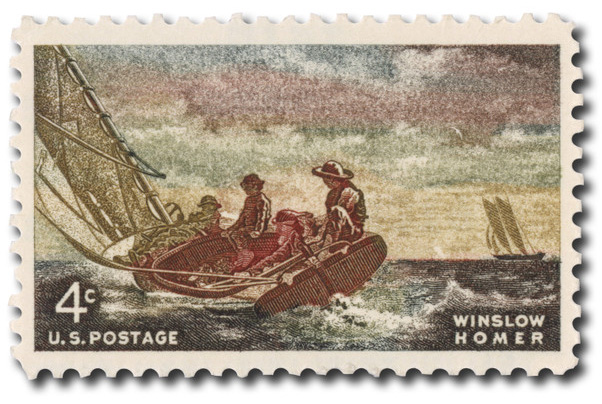
On September 29, 1910, Winslow Homer died at Prouts Neck, Maine, after a career that helped define American art. He began as a magazine illustrator, but his paintings and watercolors came to portray war, work, childhood, and the sea with unusual clarity and force.
Winslow Homer was born on February 24, 1836, in Boston, Massachusetts. He was the second of three sons. His mother, Henrietta Benson Homer, was an accomplished amateur watercolorist who encouraged his early interest in art. Homer was not an exceptional student, but he showed artistic ability at a young age.

His father, Charles Savage Homer, pursued a series of speculative business ventures, including a California trip during the Gold Rush. After Homer finished high school, his father arranged an apprenticeship with Boston lithographer John H. Bufford. Homer learned to draw on stone and create designs for commercial printing, including sheet-music covers. The work was useful training, but it was repetitive. In 1857, after about two years, he left to become a freelance illustrator.
Homer soon sold illustrations to publications including Ballou’s Pictorial and Harper’s Weekly. He declined a staff position at Harper’s, preferring the independence of freelance work. Years later, he recalled, “From the time I took my nose off that lithographic stone I have had no master, and never shall have any.” He moved to New York in 1859, opened a studio, and took drawing classes at the National Academy of Design. Although he had little formal training as a painter, he developed quickly through observation, illustration, and practice.

The Civil War gave Homer subjects that would establish his reputation. Harper’s Weekly sent him to Virginia in 1861 to sketch Union soldiers and camp life. He visited the front repeatedly during the war, recording sentries, drill, boredom, homesickness, and the strain of military service. Rather than glorifying combat, many of his pictures focused on ordinary soldiers and the war’s effects on civilians. He also depicted women on the home front, including wives and mothers waiting for news.
While still working as an illustrator, Homer began to exhibit oil paintings. His Home, Sweet Home, shown at the National Academy in 1863, depicts Union soldiers listening to a band play the familiar song. The work was warmly received and marked his public emergence as a painter. In 1866, Homer traveled to France and spent about a year there. He painted scenes of peasant life, though he did not become a follower of any single European school.

After the war, Homer increasingly turned to scenes of children and rural life. His Crossing the Pasture is part of this period, when his work often suggested the ordinary pleasures and uncertainties of postwar America. In 1875, he gave up commercial illustration to concentrate on painting and watercolor. The decision reduced his dependable income, but it allowed him to pursue his art more freely.
Homer’s work appeared at the 1876 Centennial Exposition in Philadelphia, including Snap-the-Whip and Breezing Up. That same year, he traveled to Petersburg, Virginia, where he painted scenes of Black life during Reconstruction. Works such as A Visit from the Old Mistress confront the uneasy relationship between formerly enslaved people and their former enslavers.

Watercolor became central to Homer’s career after 1873. He treated it as a serious medium rather than merely a tool for sketches. His watercolors could be quick and luminous or highly finished, and they brought him both critical attention and much-needed sales.
In 1881, Homer traveled to Cullercoats, a fishing village on England’s northeast coast. He remained there for about eighteen months. The demanding lives of local fishermen and the women who supported their work deepened his interest in labor and the sea. When he returned to the United States in 1882, critics recognized a more powerful and mature artist.
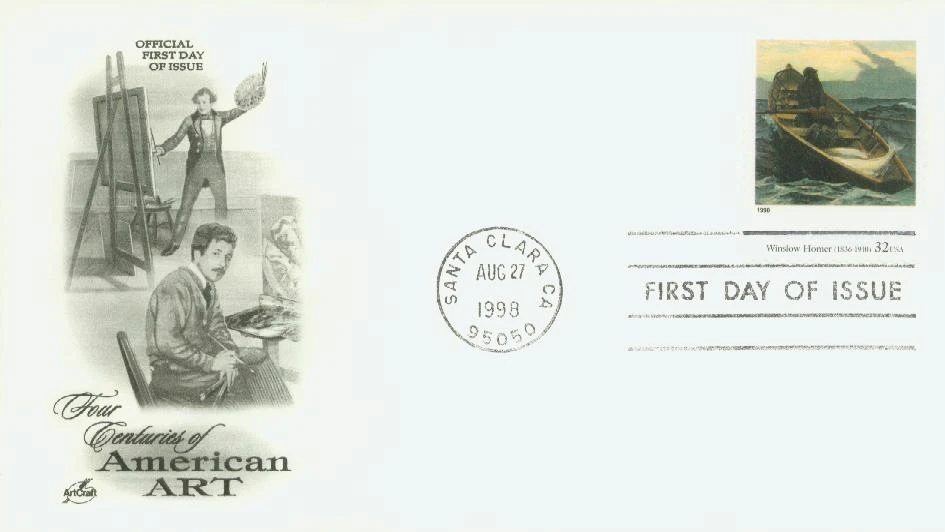
In 1883, Homer settled at Prouts Neck, Maine. From his studio overlooking the Atlantic, he produced dramatic paintings of waves, fishing, rescue, danger, and endurance. He also made winter trips to Florida, Cuba, and the Bahamas, creating vivid tropical watercolors. His The Fox Hunt became a major success in 1893 when the Pennsylvania Academy of the Fine Arts purchased it.
By his final years, museums and collectors sought Homer’s work at increasingly high prices. He continued to paint until his death, leaving Shooting the Rapids unfinished. His art remains admired for its directness, technical skill, and lasting attention to people facing the forces of history and nature.
Click here to see more of Homer’s paintings.
| FREE printable This Day in History album pages Download a PDF of today’s article. Get a binder or other supplies to create your This Day in History album. |
Discover what else happened on This Day in History.
What an interesting, fulfilling life for an artist. This will renew interest in his work among Mystic Stamp followers.
A well written descriptive synopsis. Thank you for this fine early morning history lesson. Thanks for links to paintings!
Start of article states he died February 29, 2010–not September this to be a typo as february 1910 did not have 29 days. Otherwise, like always, an excellent article.
should read “… suspect this to be a typo as February …
What a wonderful picture , “Home, sweet home”… with holly branches down in the foreground, it was time for Christmas at home…
Great art and stamps are a beautiful combination. Miniature jewels!
Excellent article especially with the links to specific art works. Informative and dazzling.
Probably one of your best articles in a while
Once again, another great, fun-to-read article. Many thanks.
A great painter so well documented in stamps.