
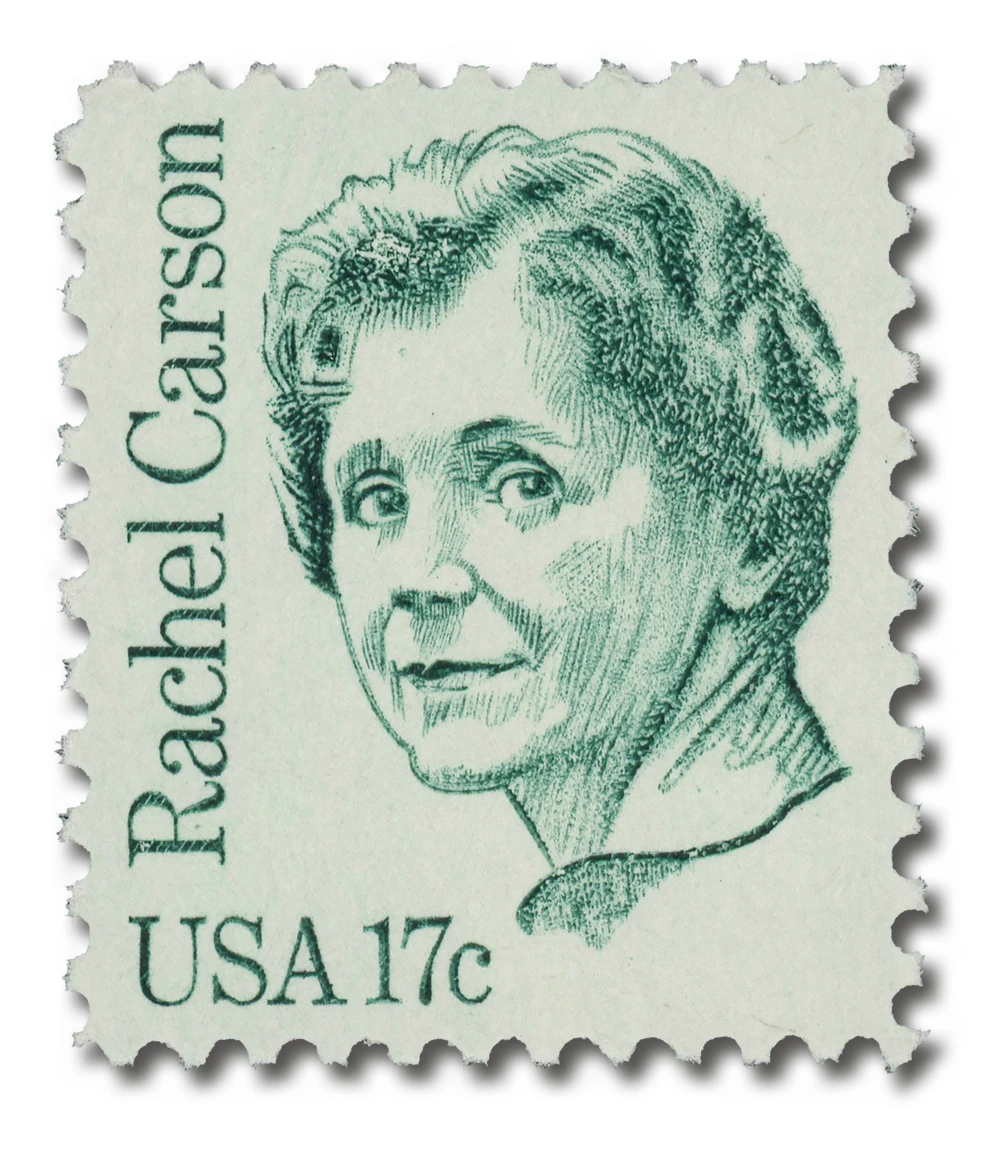
On September 27, 1962, Rachel Carson published Silent Spring, a book that challenged Americans to consider what happened after pesticides were sprayed. Drawing on scientific studies, government records, and reports from affected communities, Carson argued that chemicals meant to kill insects could also disrupt entire ecosystems.
Carson was born on May 27, 1907, in Springdale, Pennsylvania. She developed an interest in writing as a child, but she also loved the natural world around her family’s small farm. At the Pennsylvania College for Women, now Chatham University, she began as an English major before changing to biology. She graduated in 1929 and later earned a master’s degree in zoology from Johns Hopkins University.

In 1935, Carson began writing radio scripts for the US Bureau of Fisheries, a predecessor of today’s US Fish and Wildlife Service. The following year, she became a junior aquatic biologist. She was one of the first women hired by the agency through the civil-service system. Her work included writing reports, editing publications, and explaining marine science to the public. She remained with the federal government for 15 years and eventually became editor-in-chief of its publications.
Carson also wrote books about the sea. Under the Sea-Wind appeared in 1941. The Sea Around Us, published in 1951, became a bestseller and won the National Book Award for nonfiction. Its success allowed her to leave government service in 1952 and write full time. Her third sea book, The Edge of the Sea, followed in 1955. These books established her as a careful researcher who could explain science in clear, vivid language.

During the 1940s and ’50s, the United States widely used synthetic pesticides. DDT had helped control insect-borne disease and protect crops. Yet it also persisted in the environment. Carson became concerned that pesticides were being applied over large areas with too little attention to their effects on birds, fish, mammals, beneficial insects, soil, and water.

Her investigation began in earnest after a 1958 letter from Massachusetts writer Olga Owens Huckins. Huckins described birds dying after aerial spraying for mosquitoes near her property. Carson spent four years examining scientific research and consulting specialists in toxicology, ecology, medicine, entomology, and wildlife biology. She did not argue that every pesticide use should end. Instead, she criticized indiscriminate spraying and urged more selective methods, stronger oversight, and greater use of biological controls.
Silent Spring first appeared in three installments in The New Yorker during the summer of 1962. Houghton Mifflin published the book on September 27. Its title referred to a spring in which birds no longer sang because poison had moved through the food chain. Carson described insecticides such as DDT, dieldrin, and heptachlor as chemicals capable of remaining in soil and water, accumulating in animals, and affecting species beyond their intended targets.

The book faced a forceful response from chemical manufacturers and some agricultural interests. Critics questioned Carson’s scientific qualifications and accused her of opposing modern agriculture. Carson answered that pest control should be judged by its long-term consequences, not only by its immediate results. Her documentation helped bring a technical subject into public debate.
President John F. Kennedy asked his Science Advisory Committee to examine pesticide issues after the book appeared. Its 1963 report supported the need for stronger controls and further research. Carson also testified before a Senate subcommittee in June 1963. That year, she received the Audubon Medal and the Cullum Medal from the American Geographical Society.

Carson died of breast cancer on April 14, 1964, less than two years after Silent Spring was published. She did not live to see the Environmental Protection Agency created in 1970 or the EPA’s 1972 cancellation of most remaining US crop uses of DDT. Those actions resulted from scientific research, public concern, legal challenges, and government decisions over many years. Still, Silent Spring played a major role in widening public concern about pesticide regulation and environmental contamination.
Click here to read some of Silent Spring.
| FREE printable This Day in History album pages Download a PDF of today’s article. Get a binder or other supplies to create your This Day in History album. |
Discover what else happened on This Day in History.
Thank you Mystic for reminding us how one individual devoted to a cause can raise the consciousness of a nation. I believe there have been fifteen individuals who have been appointed Administrator of the Environmental Protection Agency. Some have served with distinction while while others have proven to poor choices.
I had never heard of her or her books. Looks like I need to put another book on my reading list.
A quote from the second paragraph above, “Her work received strong opposition from companies who manufactured the pesticides…” Isn’t that always the way? Profits before the public interest!
Thank you for this article. I read Silent Spring in high school. 1970. I took it to heart. Then and ever since. As with others through history, so many profiled daily here in this Mystic feature, I can’t help but wonder, what if there had nevet been Rachel Carson, or if she didnt write that book ? Thank you.
EPA said Roundup was safe. I have tumors, burning, itchy, dry skin after Roundup exposure in the early 90’s. Supreme Court said EPA didn’t do enough testing and yet the company making it is trying to win lawsuits by parroting ” Roundup is safe. The EPA said so”. So much for Rachel’s call to arms. Sad.