
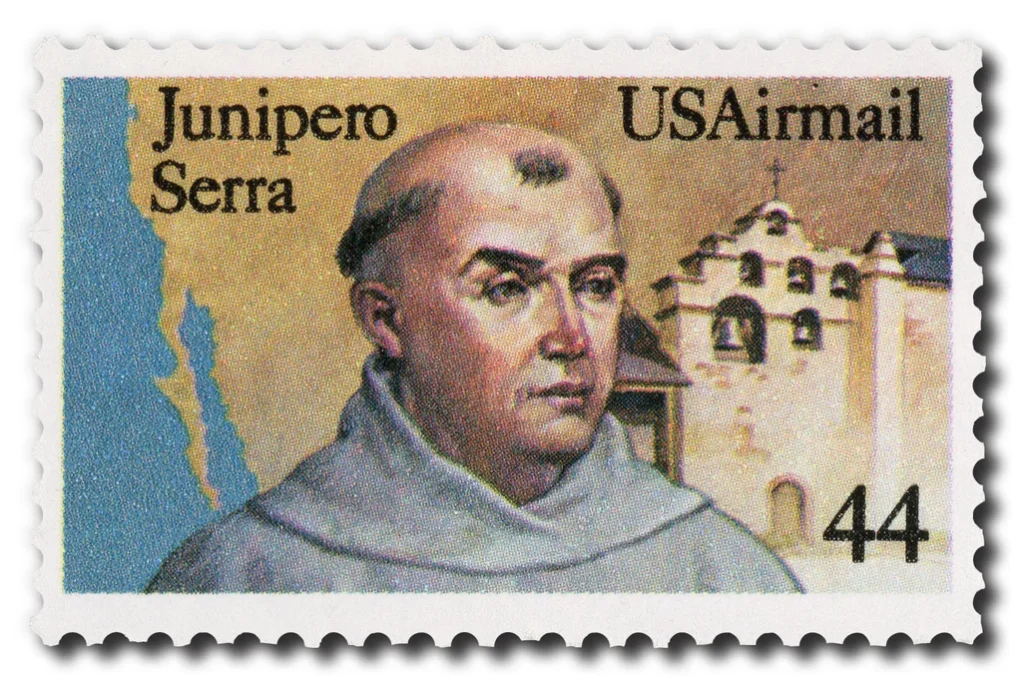
On November 24, 1713, Junípero Serra was born in Petra, a farming village on the Spanish island of Mallorca. He later became a leading Franciscan missionary in Spanish California, where the mission system reshaped Indigenous life and remains a subject of debate.

Serra was baptized Miguel José Serra. His parents, Antonio Nadal Serra and Margarita Rosa Ferrer, were farmers. He attended a Franciscan school in Petra, then moved to Palma at age 15 to study philosophy and theology. In 1730, he entered the Franciscan order as a novice. The next year, he took his vows and adopted the name Junípero, after a companion of Saint Francis of Assisi. Serra was ordained a priest around 1738 and earned a doctorate in theology in 1742. He later taught at the Lullian University in Palma.
In 1749, at age 35, Serra left Spain for New Spain, the Spanish colonial territories in the Americas. He arrived in Mexico in 1750 and served as a missionary in the Sierra Gorda region, working among the Pame people. He helped oversee church construction and developed missions as religious and economic centers. In 1767, after Spain expelled the Jesuits from its territories, Serra became president of the 15 former Jesuit missions in Baja California.
Spain was expanding north into Alta California, a region it feared other European powers might claim. In 1769, Serra joined an expedition led by Gaspar de Portolá. Traveling by land from Baja California, the party reached San Diego that summer. There, Serra established Mission San Diego de Alcalá, the first of 21 Franciscan missions founded along the California coast between 1769 and 1823. He founded eight more during his lifetime and made Mission San Carlos Borromeo de Carmelo, near present-day Monterey, his headquarters.

The nine missions Serra founded were San Diego in 1769; San Carlos in 1770; San Antonio and San Gabriel in 1771; San Luis Obispo in 1772; San Francisco and San Juan Capistrano in 1776; Santa Clara in 1777; and San Buenaventura in 1782. Spanish authorities built military outposts and settlements alongside the missions. Together, they supported Spain’s effort to establish control over the region.
The missions aimed to convert Indigenous people to Catholicism and bring them under Spanish rule. They introduced new crops, livestock, tools, and farming methods. Indigenous labor built and maintained the settlements. Mission life often restricted Native people’s movement, religious practices, and family ties. European diseases caused severe losses in Native communities, and missionaries and Spanish authorities used physical punishment. Indigenous people resisted the system. In 1775, Kumeyaay people attacked and burned Mission San Diego.
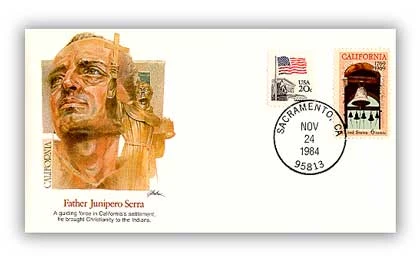
Serra also petitioned Spanish officials to address abuses by soldiers, including violence against Native women. He remained a leader of a system that sought to change Indigenous beliefs and daily life. The missions were part of Spanish colonization, which joined religious conversion with military and settlement efforts.
Serra traveled thousands of miles despite a chronic sore on his leg. In 1784, he died at Mission San Carlos, now in Carmel-by-the-Sea, California, and was buried at the mission church. Pope Francis canonized him in 2015. The missions remain historic sites, but their history includes both the growth of Spanish Catholic institutions and the disruption of Native communities.
Discover what else happened on This Day in History.