

On December 7, 1787, Delaware was the first state to ratify the US Constitution, making it America’s first state. But its quick decision wasn’t just a race to the finish—it marked the beginning of a new national identity, driven by bold choices, fierce debates, and a vote that helped shape the country we know today.
Two Algonquian tribes lived in the Delaware region when the first European explorers arrived. The Lenni-Lenape tribe lived along the Delaware River. The Nanticoke lived along the Nanticoke River. By the mid-1700s, white settlers had pushed most Native American out of Delaware.
The English explorer Henry Hudson was the first European to visit the Delaware area. In 1609, he sailed into Delaware Bay looking for a trade route to the Far East. When Hudson saw the bay led to a river, he left the region and continued his search farther north. In 1610, Captain Samuel Argall of the Virginia Colony took refuge in the Delaware Bay during a fierce storm. He named the bay De La Warr Bay, after Lord De La Warr, Virginia’s governor.
The Dutch attempted to create a settlement in the region at Zwaanendael (present-day Lewes) in 1631, but within a year, Native Americans massacred the settlers following a cultural misunderstanding. In 1638, Swedish settlers came to the region and founded the colony of New Sweden. They built Fort Christina, the first permanent white settlement, at the present-day site of Wilmington. The colony quickly expanded northward as new colonists arrived from Sweden and Finland. However, the Dutch believed New Sweden fell within their territory, and in 1651, the governor of the Dutch colony of New Netherland, Peter Stuyvesant, established Fort Casimir at the site of present-day New Castle. The Swedes captured Fort Casimir in 1654, but the following year the Dutch took control of New Sweden.

The British captured all of New Netherland in 1664. Delaware was made part of the colony of New York. In 1682, a year after William Penn founded Pennsylvania, it was made part of that colony. Delaware became known as the Three Lower Counties, because it was “down” the Delaware River from Pennsylvania. As Pennsylvania grew, Delaware asked Penn to grant them a separate legislature, which he did in 1704. However, Pennsylvania governors ruled Delaware until the American Revolutionary War.

Representatives from the Three Lower Counties attended the First Continental Congress in Philadelphia in 1774. At the Second Continental Congress on July 2, 1776, the Three Lower Counties voted for independence. Later that year, the Three Lower Counties became Delaware State and established a state constitution. New Castle became the state’s first capital.
Troops from Delaware fought throughout the Revolutionary War. But only one small battle was fought in the state, when outnumbered American troops attempted to stop the British from marching toward Philadelphia, Pennsylvania. The troops met the British at Coochs Bridge, near Newark, on September 3, 1777, but were quickly forced to retreat. The British marched on the defeated forces of General George Washington at the Battle of Brandywine. The British occupied Wilmington on September 12, 1777, forcing the legislature to move away from nearby New Castle. The legislature moved several times before making Dover the capital. Dover remains Delaware’s capital city to this day.
Delaware signed the Articles of Confederation (the forerunner to the US Constitution) on February 22, 1779. However, the state’s leaders were not satisfied with the document. Two leaders, John Dickinson and George Read, helped draft a constitution with a stronger body of laws. On December 7, 1787, Delaware voted unanimously to ratify the United States Constitution and became America’s first state. Delaware adopted a new state constitution in 1792. At that time it changed its official name from Delaware State to the State of Delaware.

Wilmington became known as the nation’s leading flour-milling area during the American Revolution. In 1802, the state’s chemical industry began when Éleuthère Irénée du Pont started a powder mill on the Brandywine Creek near Wilmington. When the British established a trade embargo against the United States during the War of 1812, Delaware responded by building new industries. British ships bombarded the city of Lewes during the War of 1812, but with little effect.
Ideologically, Delaware was caught in the middle of the American Civil War (1861-65). It was a slave state, but it was also a firm supporter of the Union. Its location between the North and the Deep South tied it to both sides. Although it fought on the side of the Union, many people from Delaware felt the Confederate States should have been allowed to leave the Union peacefully.

Delaware continued to prosper during and after the Civil War. Its farms and industries were further bolstered by the expansion of the railroads. Wilmington experienced exceptional growth as thousands moved to the city to work in its shipyards, iron foundries, machine shops, and manufacturing plants.

As Delaware’s economy grew during the 20th century, it improved its public services. By 1920, the state had established an industrial accident board, a board of welfare, and a highway department. Pierre S. du Pont gave the state several million dollars to build new schools and improve public education.
During World War II and the 1950s and ’60s, many new industries came to Delaware. Giant corporations like Chrysler, General Foods, and General Motors moved into the state. Du Pont expanded its operations and became the state’s leading employer. Many businesses are located in the state because Delaware’s business laws favor corporations. It’s easier and less expensive to run a corporation in Delaware than in most other states. This is true even if the corporation does most of its business elsewhere. Additionally, the state has a specialized court, the Court of Chancery, to handle corporate litigation.
Delaware also has some of the country’s richest farm regions. In Sussex County and in southern portions of the state, farmers raise broilers – chickens raised to 4-14 weeks old specifically for their meat. Poultry is Delaware’s leading agricultural output, making the state one of the country’s top producers when compared to its population. Farmers also grow corn, soybeans, wheat, other produce, and specialty crops that support both local markets and regional supply chains. The state’s central location on the East Coast allows goods to reach major population centers quickly, strengthening demand for fresh products.
| FREE printable This Day in History album pages Download a PDF of today’s article. Get a binder or other supplies to create your This Day in History album. |
Discover what else happened on This Day in History.
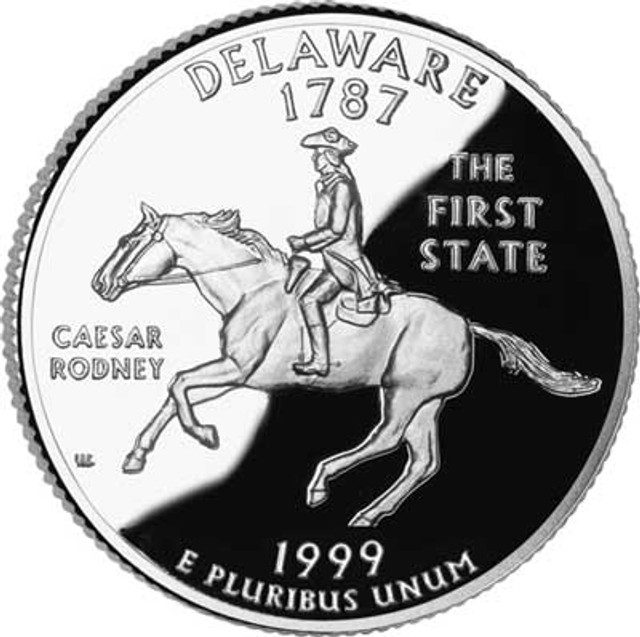
Would like more about Caesar Rodney.