
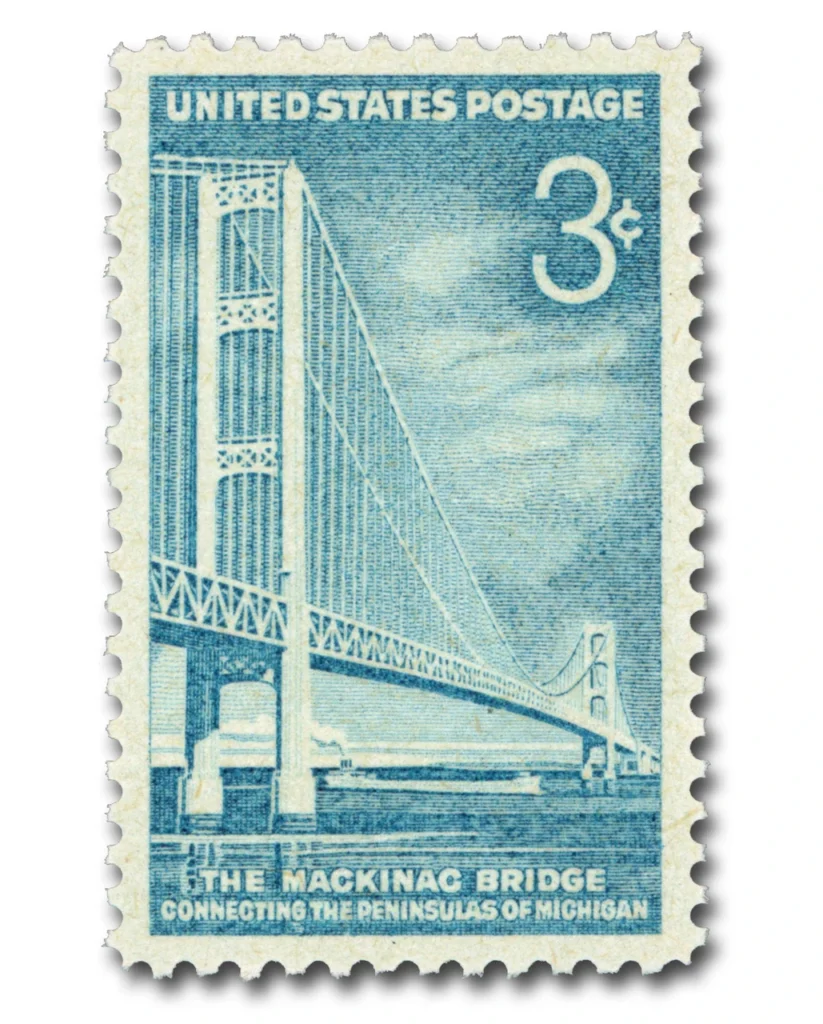
On November 1, 1957, the Mackinac Bridge opened, giving Michigan’s Upper and Lower Peninsulas a direct road connection. It was then the world’s longest suspension bridge between cable anchorages, replacing a busy ferry route with a five-mile crossing.
For centuries, people traveled and traded around the Straits of Mackinac, the waterway linking Lakes Michigan and Huron. The name Michilimackinac is often translated as “Great Turtle,” a possible reference to the shape of Mackinac Island. The region became an important meeting and trading place for Indigenous peoples. Later, European settlement and the growth of mining, timber, railroads and tourism increased traffic through the straits.
By 1881, three railroads had joined to operate car ferries across the water. After the Brooklyn Bridge opened in 1883, some people wondered whether a bridge could span the straits, too. The idea gained support as more travelers visited the area, but decades passed before plans moved forward.

In 1923, Michigan’s State Highway Department began operating automobile ferries between Mackinaw City and St. Ignace. The fleet eventually grew to nine boats and could carry as many as 9,000 vehicles a day. Demand still outpaced capacity. Lines of waiting cars could stretch for miles, while driving around the straits added a long detour. In the ferries’ final year, they carried about 900,000 vehicles.

Michigan studied the bridge proposal in the late 1920s and found it feasible, with an estimated cost of about $30 million. In 1934, the state created the Mackinac Straits Bridge Authority to develop plans and find funding. The authority sought federal support, including New Deal funds, but Congress did not provide the money. World War II further delayed the project.

The state created a new Mackinac Bridge Authority in 1950 to study the project’s feasibility. Its 1951 report said the bridge could be financed with revenue bonds. In 1952, the legislature authorized construction and the sale of bonds. Financing proved difficult at first, but investors eventually bought $99.8 million in bonds. The tolls would help pay them back.

Construction began on May 7, 1954. Engineer David B. Steinman designed the bridge, and work was carried out by two main contractors: Merritt-Chapman & Scott built the foundations, while the American Bridge Division of US Steel built the steel structure. The project took more than three years. Its construction cost was about $100 million.

The bridge opened to traffic on schedule on November 1, 1957, and the state ferry service ended that day. Cold weather postponed the formal dedication until June 1958. At nearly five miles long, including its approaches, the bridge connected the peninsulas with a crossing that usually took about ten minutes. Its roadway sits about 200 feet above the water at the center span.
The bridge’s design addressed the strong winds common over the straits. An open steel-grid roadway allows wind to pass through, reducing pressure on the structure. In severe winds, the center span can shift as much as 35 feet east or west. The movement is gradual and helps the bridge respond to wind and temperature changes.

The bridge became known as the “Mighty Mac.” Some drivers who are uneasy about crossing can request driver assistance, in which a bridge employee drives their vehicle across. On September 6, 2009, the 150 millionth vehicle crossed the bridge. It remains a major Michigan crossing and the longest suspension bridge between anchorages in the Western Hemisphere.
Click here to see photos from the construction of the Mackinac Bridge.
| FREE printable This Day in History album pages Download a PDF of today’s article. Get a binder or other supplies to create your This Day in History album. |
Discover what else happened on This Day in history.
Your dialogue along with the photos of the construction and the accompanying captions make an incredible goodnight story for me. I stayed up an extra half an hour to find out what’s new, or rather what is old on this day. You never disappoint. Goodnight.
Great information.
This brought back memories, for in 1967, my wife and I with 2 kids and a dog drove from Ohio, to Oregon to visit grandparents and returned via Canada, with our new Oldsmobile F-85 station wagon pulling a Coleman camping trailer. After traveling along the northern shore of Lake Superior, we crossed over the Mackinac Bridge to drive down the Upper Peninsula of Michigan to Ohio. The bridge was still considered new at the time, and it was an exciting adventure to cross the longest bridge in the world. A major surprise to us in reaching Michigan was to see large intrusive billboards again along side the highway, for at least in the 1960s there were no billboards along the Trans Canada Highway.
When I was stationed near SF, I traveled across the Golden Gate Bridge. They would post high wind warnings from time to time. I was actually blown across a lane in a small car. They must have learned a lot from the Narrows Bridge, in Tacoma, which buckled in the 30’s due to high winds. Can’t imagine driving on a bridge that moves up to 35 feet. No wonder they have “timmies”. Great story.
I love these daily history lessons.Many thanks.
Interesting information, as always. Nice to see that the tolls which started in 1957 would, after 20 years, have fully paid off the bonds. So I guess the tolls finished in 1977 – some 40 years ago!!!
True?
No, of course not. $4 per car.
Politians always promise to end the tolls when the bridge or toll road is paid for. But like any political promise they never come true
I remember a bridge in West Virginia that had a toll but was removed when it was paid off. It does happen sometimes but more often than not they will keep the toll to pay for maintenance or whatever excuse.
Mystic Stamp, Thank you for this look back in history. I well remember crossing the “Mighty Mac,” for the first time with my parents. It is still a thrill every time I cross it now. A beautiful area of the country and of the world. I feel fortunate to live just 115 miles away, in my own beautiful area of Norther Lower Michigan. Thanks for the photographs!
Remember a story of my aunt and uncle driving the bridge. It was ‘just a bridge’ – until they were a ways on to it. Then they became ‘timmies’ out on the bridge. Yes, on their way back from their trip, they gave in as timmies ‘before’ driving on to the bridge.
For the last 2 years we’ve taken the bridge on the way to see our son in Indiana. It is a beautiful drive through the both the upper and lower peninsulas and though it is longer it sure beats going through the traffic in Milwaukee and Chicago. This year we got to see the annual tractor crossing on the way down and experienced our first inclement weather on the way back.
As far as the “timmies” go, I could easily be one but if you keep your eyes focused ahead it is easy to cross and goes pretty quickly, although my wife telling me to look at all the white caps below when we were on the highest part during the inclement weather wasn’t nearly as funny to me as it was to her.
I crossed the Mac on November 12 1957 & have crossed every year at least once a year since that date. Also crossed by Ferry since I was a baby. Remember one year we waited 13 hours to board the Ferry. I am now 80 years old & will cross again this year. Don’t remember what the toll was on opening would like to know.
Google your question Don