

More than 70 years after the Titanic sank, a joint American-French expedition located its wreck on the North Atlantic floor on September 1, 1985. The discovery ended decades of failed searches and revealed that the ship still rested nearly 12,500 feet below the surface.
The Titanic struck an iceberg shortly before midnight on April 14, 1912, during its maiden voyage from Southampton, England, to New York City. It sank in the early hours of April 15. Of the roughly 2,200 passengers and crew members aboard, more than 1,500 died. The disaster exposed serious weaknesses in maritime safety, including too few lifeboats and inadequate radio monitoring. In response, international rules later required ships to carry enough lifeboat space for everyone aboard and to maintain continuous radio watches.
Finding the wreck proved difficult. The ship had gone down in the North Atlantic about 370 miles southeast of Newfoundland. Its wireless distress calls gave a position, but it was not exact. Ocean currents, navigational errors, and the limits of 1912 technology had affected the coordinates. Searchers also faced an enormous area of deep, dark seafloor.
Several expeditions attempted to find the ship during the 1970s and early 1980s. Texas oilman Jack Grimm sponsored three searches between 1980 and 1983. His teams photographed several promising objects, but none was confirmed as the Titanic. Other researchers used sonar to scan the bottom, but a shipwreck lying more than two miles below the ocean’s surface was a difficult target.
Oceanographer Robert Ballard of the Woods Hole Oceanographic Institution believed new deep-sea technology could make the search possible. Ballard was also a US Navy commander. The Navy agreed to support his work, but the Titanic search was not its main purpose. Ballard first had to examine the wrecks of two lost nuclear submarines, the USS Thresher and USS Scorpion, which had sunk during the Cold War.
That work gave Ballard an important idea. The submarines had broken apart and left long trails of debris across the seabed. Instead of searching only for a single hull, he could search for the larger debris field that the Titanic had likely left behind. The strategy greatly increased the area that might reveal evidence of the ship.

In July 1985, the French research vessel Le Suroît surveyed the search area with side-scan sonar. The French team found no confirmed wreck. Ballard then joined the research vessel Knorr, which arrived in the area in late August. Its crew towed an unmanned deep-sea camera system called Argo above the ocean floor. Argo sent live video images to scientists aboard the ship while it moved back and forth across the seabed.
Just after midnight on September 1, the monitors began showing small objects scattered across the mud. Then the team saw a large boiler. Its shape matched boilers installed on the Titanic. The debris trail soon led them to the ship itself.
The wreck lay in two major pieces about 2,000 feet apart. For decades, many survivors had claimed they saw or heard the ship split in half, but as they were largely women or had been children at the time of the sinking, their accounts were treated as a mass hysteria. The ship’s second officer and the most senior surviving member of the crew, Charles Lightoller, testified, “It is utterly untrue. The ship did not and could not have broken in two.” The discovery vindicated those survivors.
The bow remained recognizable, with its railings, anchor equipment, and rows of portholes. The stern had been badly damaged as it sank and struck the seafloor. Ballard’s team did not attempt to raise artifacts. He believed the site should be treated as a grave, since so many people had died in the disaster.

Ballard returned in 1986 with the crewed submersible Alvin and a small remotely operated vehicle called Jason Jr. Their cameras recorded the wreck in greater detail. Later expeditions recovered thousands of artifacts from the debris field, including dishes, luggage, jewelry, bottles, and personal belongings. In 1998, RMS Titanic Inc. raised a large section of the hull, often called the “Big Piece,” for public display.
The wreck continues to deteriorate. Saltwater, pressure, deep-sea organisms, and metal-eating bacteria have weakened its steel for more than a century. A 2024 expedition documented the loss of a section of the bow’s famous railing. The Titanic remains an important archaeological site, but its condition also raises continuing questions about preservation, artifact recovery, and respect for a maritime disaster site.
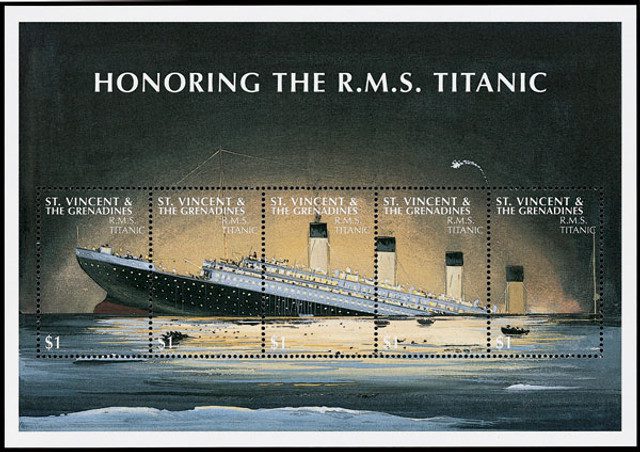
Click here for lots more Titanic stamps.
| FREE printable This Day in History album pages Download a PDF of today’s article. Get a binder or other supplies to create your This Day in History album. |
Discover what else happened on This Day in History.
This is one of the best “Day in history ” posts . Most enjoyable !
Great story. As was stated, a lot was learned and corrected from the Titanic sinking.
I am one that believes the wreck should not be exploited
That was the begining for safe sailing.
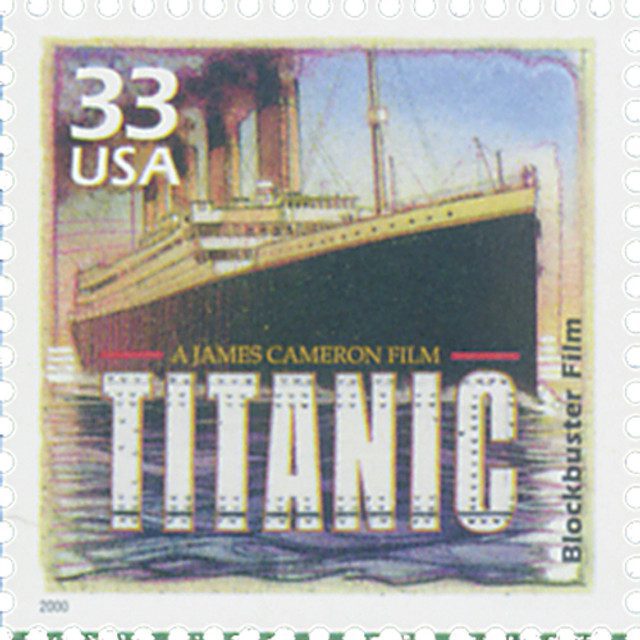
This is a great story to go along with the history of the ship and the times people lived in. I’m surprised however, The Titanic shown on US Celebrate the Century stamp, Scott # 3191 L was not shown in the article. Also, maybe the USPS should develop a series of famous “Ships lost at Sea”.
This is the day that Germany invaded Poland that triggered the start of World War II
The story mentions Ballard found much of the ship largely intact. I had been led to understand that the hull had split in two as it sank. Over the years, nothing diminishes the huge, tragic impact the Titanic’s sinking has made on all.
I mean, the ship split in half when she sank, but the bow section was highly in tact when she was found, but the stern was highly destroyed and mangled when that half was discovered.
For me today is the anniversary of the invasion of Poland and the beginning of the second world war in which my father served and lost many of his friends. It is not a pleasant memory but a reminder of the futility and cost of war.
As mentioned by Charles Kerbel, the Titanic broke in half as it sank, and the two portions of the hull were found about a half a mile apart.
God almost always draws good out of bad. As the article points out, the Titanic disaster brought about a number of new safety laws regarding number of lifeboats, monitoring the distress frequency, etc. The Titanic may well have saved more lives than she took.
Great information. To me, finding the main hull and marking it for historical reasons should have sufficed. I think exploring and exploiting the wreckage was a desecration of the final resting place of all those who died there and their memory.
Generally speaking, a very good series. Please keep it up. But on the other side, how could you miss Germany attacking Poland, the start of WWII? Probably the most important event in our lifetime. Im only 80 and was too little to participate. There are lots of WWII dates coming. Are you going to skip them all? Pearl Harbor, D Day, fall of Corregidor, MacArthur return to Philippines, Japan and Germany surrenders, Atom Bombs, etc. the list goes on and on. I realize your focus is stamps, but the series is titled This Day IN HISTORY, not stamp history.
Hi Warren,
Thank you for your comment. There has been some discussion here at Mystic on the selection of topics. Although we have, and will, continue to select many war-related events in history, we will also attempt to strike a balance with other, non-war related events. And we will keep your comment in mind when striving to reach that balance.
I can understand the person who stated that there was a lot of other instances of history concerning the years of world War II. I myself have enjoyed your days in history, and I know like he said that you are exposing the stamps which represent days in history, he can go to other sources and get the complete description of all those event he mentioned at another source than what you are presenting. You are doing a great job in presenting the stamps that were originated during the periods of time you are presenting for us who are stamp collectors. Thanks again for a wonderful job.
A great history-informing update. Thank you so much !!
Thank you Mystic for this reminder of today’s history. A very well written article and review.
It was believed by many that The Titanic could be sunk ‘…By God’. For this statement there is an account of a passanger that canceled her transit on the ship. For she believed that the statement was a mockery of the power of The Creator on all. There are those that believe that because of the attitude of superiority of men’s ablities and creativities, the Titanic was unsinkable. How WRONG we are!!