

On November 4, 1955, baseball legend Cy Young died in Newcomerstown, Ohio. He left behind records that still define a pitcher’s workload and a career that spanned baseball’s early major-league era.
Born Denton True Young on March 29, 1867, in Gilmore, Ohio, he was the oldest of five children. His family called him Dent. He attended school through sixth grade, then left to help on the family farm. Baseball was part of his life from an early age. As a boy and teenager, he played on local teams as a pitcher and second baseman.

In 1888, Young pitched for a semi-professional team in Carrollton, Ohio. In 1889, he played for teams in Leesburg and New Athens. The next year, he signed with Canton’s minor-league team. His fastball impressed the scouts. One story says that his pitches knocked boards off the grandstand, leading someone to say it looked as if a cyclone had struck. Reporters began calling him “Cyclone Young,” soon shortened to “Cy.” He played for Canton for 14 weeks, winning 15 games and losing 15.

The Cleveland Spiders signed Young in 1890. On August 6, he made his major-league debut against the Chicago Colts. He allowed three hits and led Cleveland to an 8–1 win. The following season, he recorded the first of 16 seasons with at least 20 victories. In 1897, he threw his first no-hitter, against the Cincinnati Reds. The scoring of that game was disputed, and Young himself believed he had allowed one hit.
Young’s best season by wins came in 1892, when he won 36 games. He reached 30 victories in five seasons. His durability stood out in an era when starting pitchers often worked through games instead of turning the ball over to a bullpen. Young regularly pitched complete games and was still active in his forties. His career covered major changes in the sport, including an increase in the distance between the pitching mound and home plate.
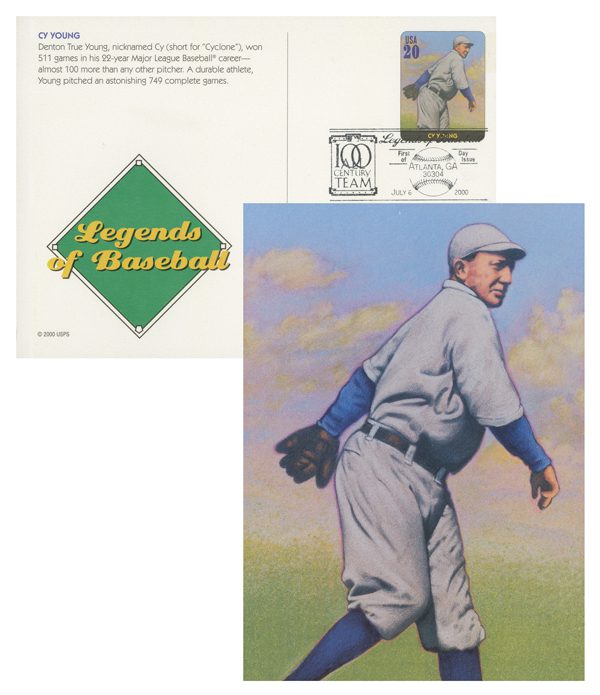
In 1899, Cleveland owner Frank Robison transferred Young and other players to the St. Louis Perfectos, later known as the Cardinals. Robison owned both clubs. Young played two seasons in St. Louis and developed a lasting partnership with catcher Lou Criger. In 1901, when the new American League declared itself a major league, Young joined the Boston Americans, later known as the Red Sox. That year, he won 33 games and led the league in wins, strikeouts, and earned-run average, earning the league’s pitching Triple Crown.
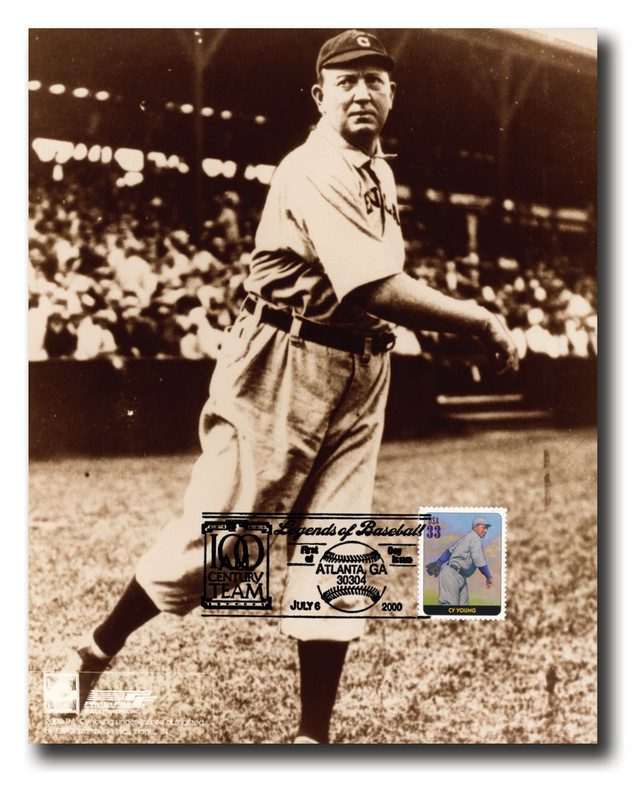
Young helped Boston win the first modern World Series in 1903. He pitched in four games and won two as Boston defeated the Pittsburgh Pirates. The next year, he threw a perfect game against the Philadelphia Athletics, retiring all 27 batters. It was one of three no-hitters in his career. His perfect game came during a stretch of 25⅓ consecutive hitless innings, a major-league record. He threw his third no-hitter in 1908, at age 41.
Young spent his final seasons with Cleveland and Boston, retiring after the 1911 season. His last victory came on September 22, and he lost his final game in October. Across 22 major-league seasons, he won 511 games, started 815, completed 749, and pitched 7,356 innings. All four totals remain major-league records.

After baseball, Young returned to farming and took on other work. He also managed the Cleveland Green Sox, a minor-league team. In 1937, he was elected to the National Baseball Hall of Fame. Young died at age 88. The Cy Young Award was created in his honor in 1956. For its first 11 seasons, one award went to the top pitcher in the major leagues. Since 1967, one pitcher in each league has received the honor.
Click here for more on Young from the Baseball Hall of Fame.
| FREE printable This Day in History album pages Download a PDF of today’s article. Get a binder or other supplies to create your This Day in History album. |
Discover what else happened on This Day in History.
Really nice article on baseball’s early history, I often wondered where the name Cy came from. Keep up your great work!
I think it is short for Cyprus
Re-read the story (especially, the third paragraph) –“…his fastball destroyed the fences, making them look like they’d been hit by a cyclone. Reporters started calling him Cyclone, which they later shortened to Cy, a nickname he would use for the rest of his life.”
Denton True Young was nicknamed Cy because one day he pitched a ball against a barn and broke the wood. Someone there said that he pitches as fast as a cyclone.
Unfortunately there was no way to measure exactly how fast a fastball any Pitcher
from years gone by could throw but I bet the fastest then were as fast as the fastest now.
2nd paragraph you want hit by cyclone. Out of curiosity, do you have the dollar amount he was earning at the top salary for the league? I’m sure it would seem like a pittance given what today’s players are being paid. (IMHO way too much in most cases)
Thanks for the story of Cy Young. Always hear about the yearly awards, but not much about the man behind it. Sports casters assume we know as much as them.
Along with the record for most wins he has the record for most losses meaning that with over 800 decisions he holds that record too. There were not many 3 days rest in that career.
A nickname “Cy” that was shortened from a nickname “Cyclone”…Pretty interesting little tidbit to add in there! Thanks!!
There was a pitcher for Baltimore in the 80’s , who for the life of me I can’t remember his name , who Jim Palmer referred to as “Cy” clone, as in clone of Cy Young. Nicknames. Adding additional color to the most colorful of people.
Interesting read on early baseball. I like learning how those persons traveled at these times.
To put his record in perspective, years ago a young pitcher asked his manager what he had to do to match Cy Young’s win total. The answer was brutally simple: win 20 games a year for 20 straight seasons, and then go out and win another 111.