
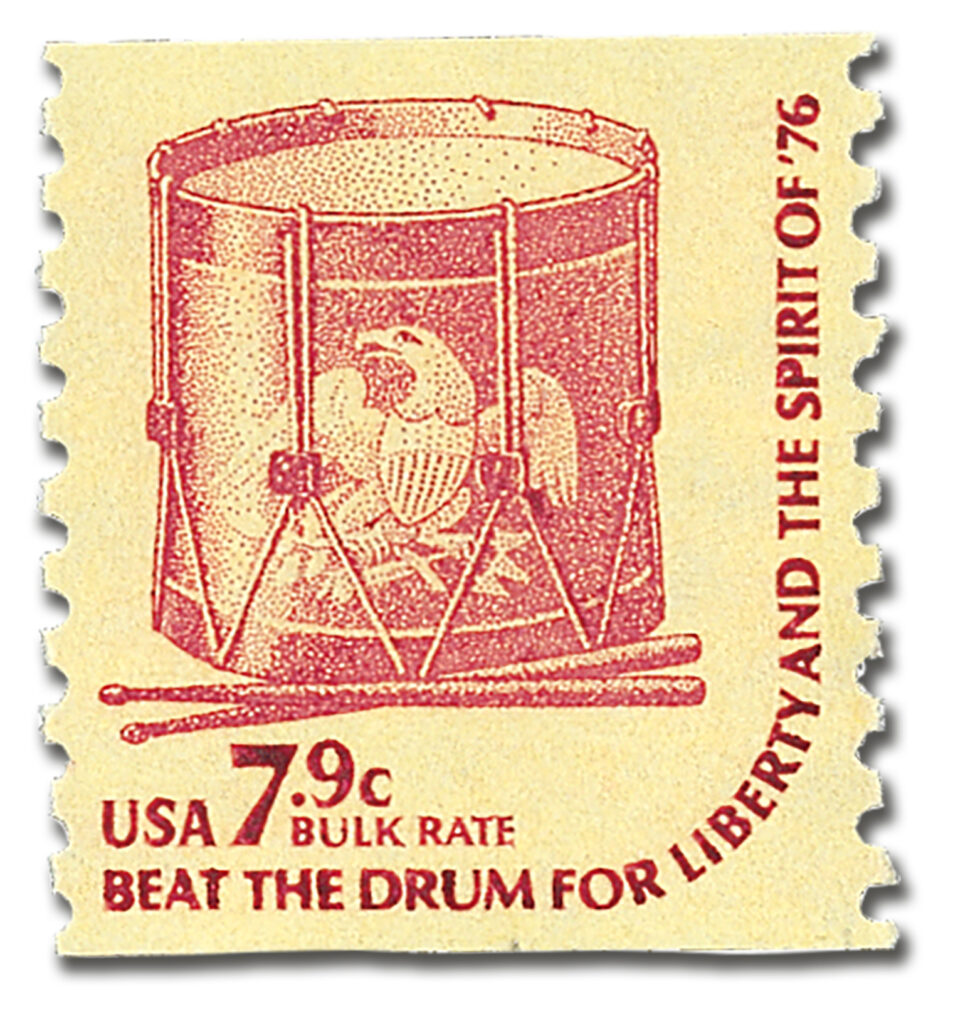
On April 23, 1976, the USPS issued the first regular postage stamp to include a service indicator. While most Americans would never use it or notice it, the 7.9-cent Drum coil stamp quietly solved a problem that had complicated bulk mailing for decades.
Before this stamp, businesses and organizations sending large volumes of mail had limited options. They could use a permit imprint indicia — a printed box in the upper-right corner of an envelope that read “U.S. Postage Paid,” along with a permit number and city. The permit imprint became the most popular way to pay for high-volume mailings, allowing businesses to print postage information directly onto each piece rather than affixing individual stamps. It was efficient — but it looked impersonal, and many recipients treated it as a signal to toss the piece without opening it.
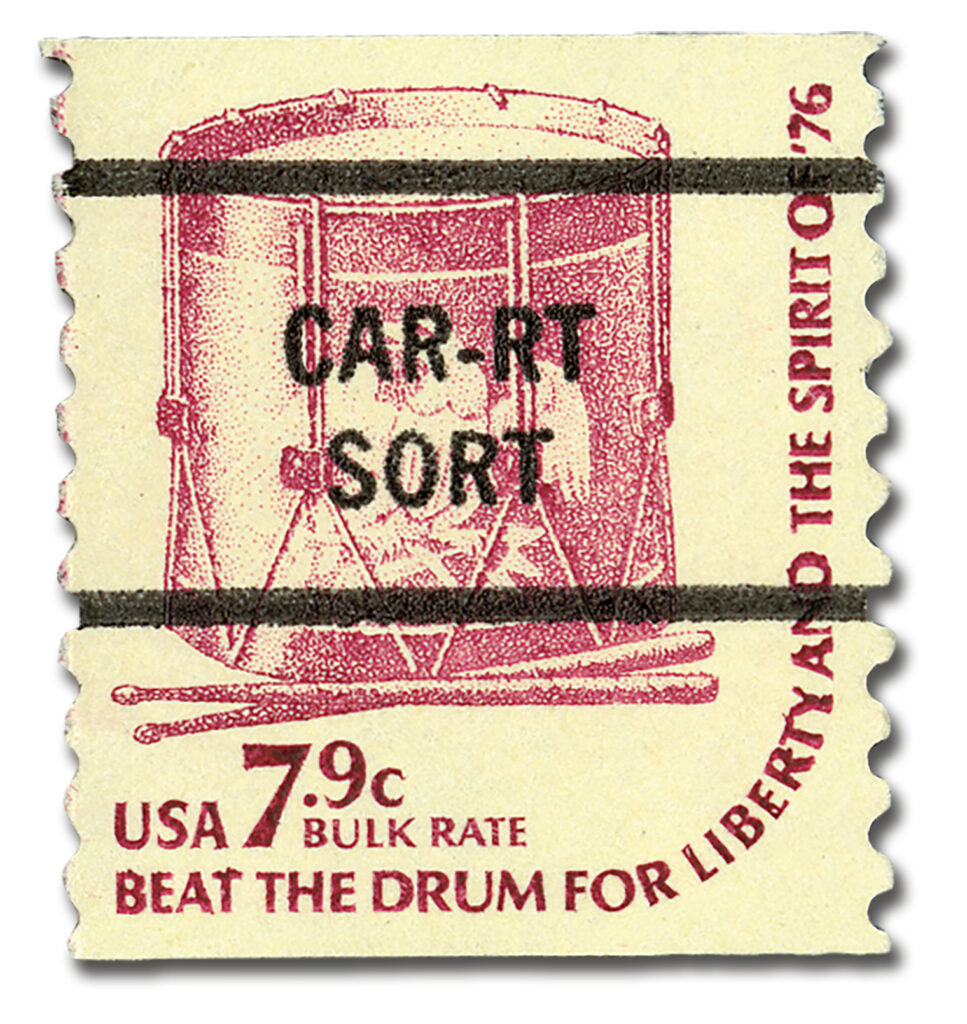
The other option was a precanceled stamp. Precanceled stamps had existed for more than a century, authorized by the US Post Office Department in 1887. The most common style showed a city and state name printed between two horizontal bars — a Bureau precancel, applied at the Bureau of Engraving and Printing before the stamp reached the local post office. Because the cancellation was already applied, those pieces didn’t have to pass through a canceling machine. But the system was complicated: each precancel had to match the specific city where the mailer held its permit, and managing that across large operations was a logistical headache.
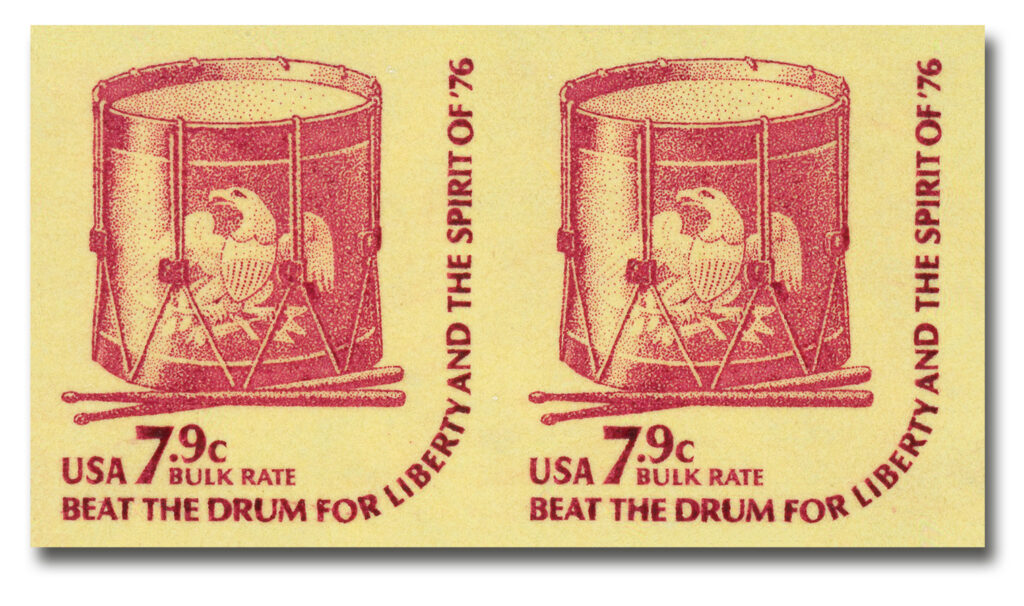
The Drum stamp changed the model entirely. Part of the Americana series, it was inscribed directly with “Bulk Rate” — the name of the mailing service it was intended to fulfill — built into the design from the start. That inscription was the service indicator. For actual postal use, the stamp was overprinted with Bureau precancels from 107 cities, each still showing a city and state name between horizontal bars. But the key innovation — “Bulk Rate” printed into the design itself — told postal workers immediately what class of mail they were handling, without needing a canceling machine. Examples without the Bureau precancellation were produced for philatelic purposes only.
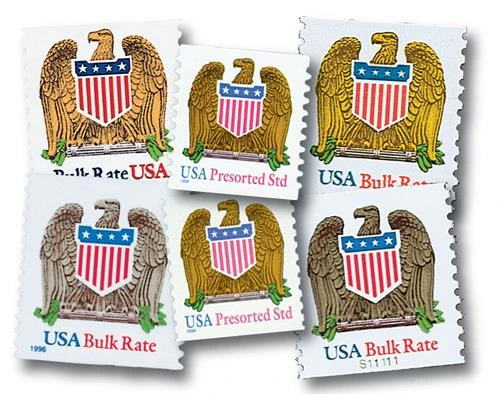
The concept expanded quickly. The 7.7-cent Saxhorn stamp followed just months later with its own “Bulk Rate” inscription for a decreased third-class rate effective July 1976. The 3.1-cent Guitar coil, issued in 1979, became the first stamp issued specifically for nonprofit bulk mail. Over time, the USPS added service-inscribed stamps for Presorted First Class, and Postcard rates — each one allowing qualifying mailers to pay a reduced rate in exchange for pre-sorting their mail and doing some of the postal system’s work in advance. These stamps carry the service designation but no denomination — the actual postage value doesn’t appear on the stamp itself. To use them, mailers must apply for a permit — they are technically precanceled stamps and cannot simply be purchased over the counter. Within a couple of years of the Drum stamp’s debut, Bureau precancel overprints with city and state names were discontinued entirely. The service indicator had made them unnecessary.
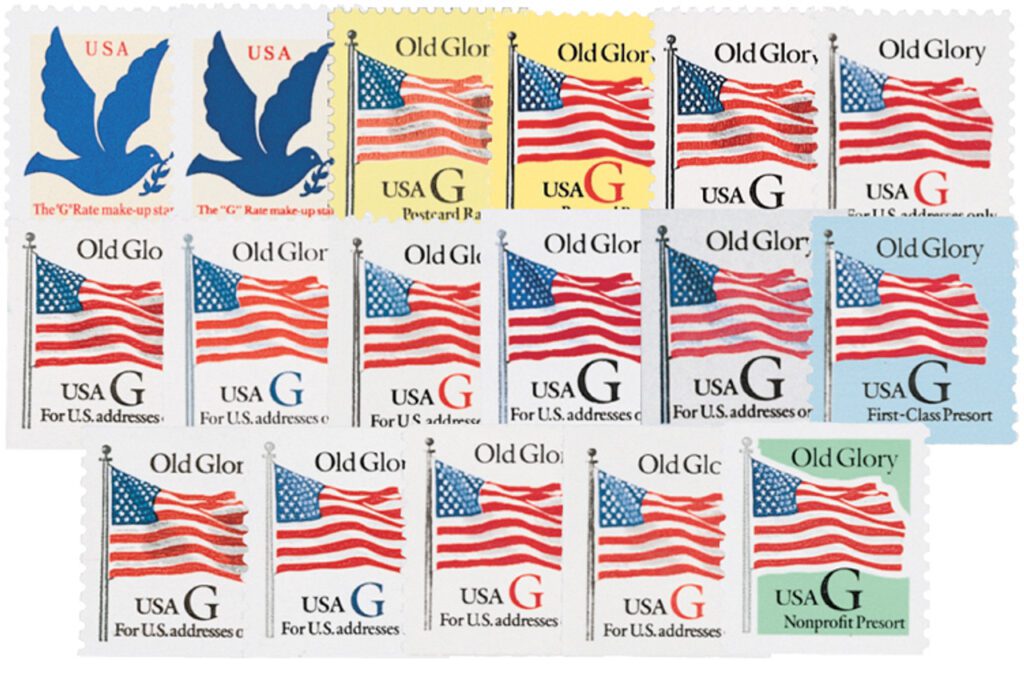
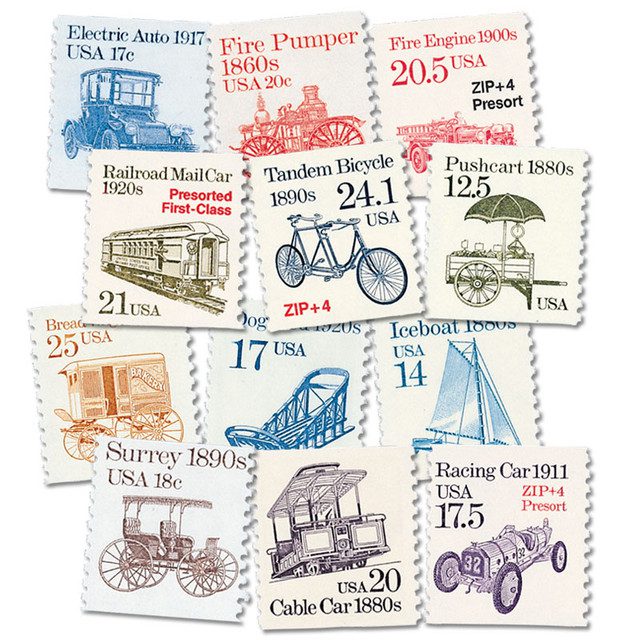
The format then evolved through two more phases. The USPS began placing the service inscription between the horizontal lines of the Bureau precancel itself — rather than in the stamp’s design. “Bulk Rate” and “Nonprofit Organization” were common examples of this middle-generation format. Then, with the 16.7-cent Transportation coil (Scott 2261), issued July 7, 1988, the USPS returned to the original concept — the service inscription once again became part of the stamp’s design, serving as the cancellation itself. With the cancellation incorporated directly into the design, these pieces no longer needed to pass through canceling machinery, and since tagging exists specifically to trigger those machines, the USPS stopped producing tagged versions entirely.

What the Drum stamp established in 1976 is now standard practice across every service category — purpose-built stamps where the service inscription isn’t a label applied to an existing design, but the reason the stamp exists at all. When bulk rates changed in the early years, older service-inscribed stamps didn’t simply become invalid — the USPS could authorize them for false franking, a formal arrangement allowing mailers to use the older stamp and pay the difference at the post office at time of mailing. It was workable, but cumbersome.
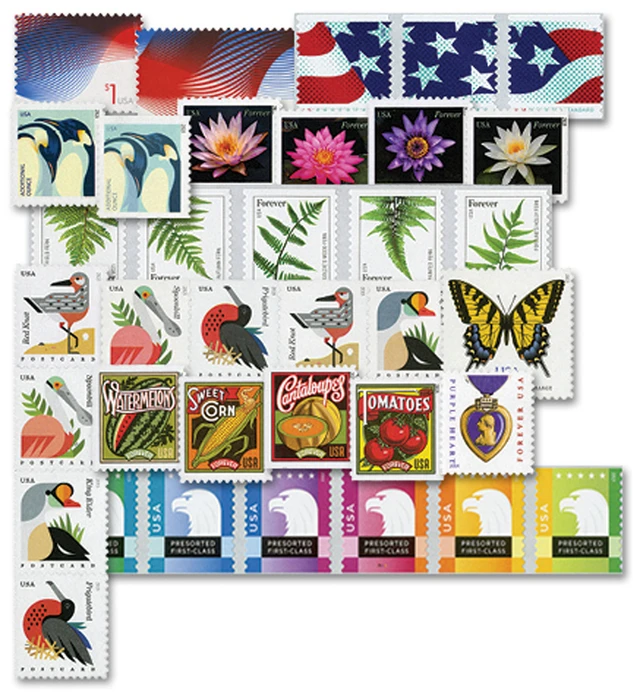
Today’s nondenominated service-inscribed stamps have solved that problem: carrying no printed dollar value, they are always valid for whatever the current rate for their designated service happens to be. It’s the same principle the USPS eventually brought to everyday consumers — first with the Forever stamp for first-class mail in 2007, and then in 2015 with purpose-inscribed Forever stamps for postcards, additional ounces, and non-machinable mail. In each case, the service description does the work that a denomination used to do — and does it better.
| FREE printable This Day in History album pages Download a PDF of today’s article. Get a binder or other supplies to create your This Day in History album. |
Discover what else happened on This Day in History.
How I dreaded sorting bulk mail, minutely by zip code and making the bundles, which explains why there was really only one person in the (nonprofit) office that could tolerate it and do it properly. Mere mention of bulk mailing elicits upcoming bulk mailing angst after 60 years. One wrongly assembled packat would ruin the entire mailing. (Human postal clerks viewed them, you see). Is all that minute sorting still required I wonder. Perhaps I missed mention of it. Fascinating history as always.