

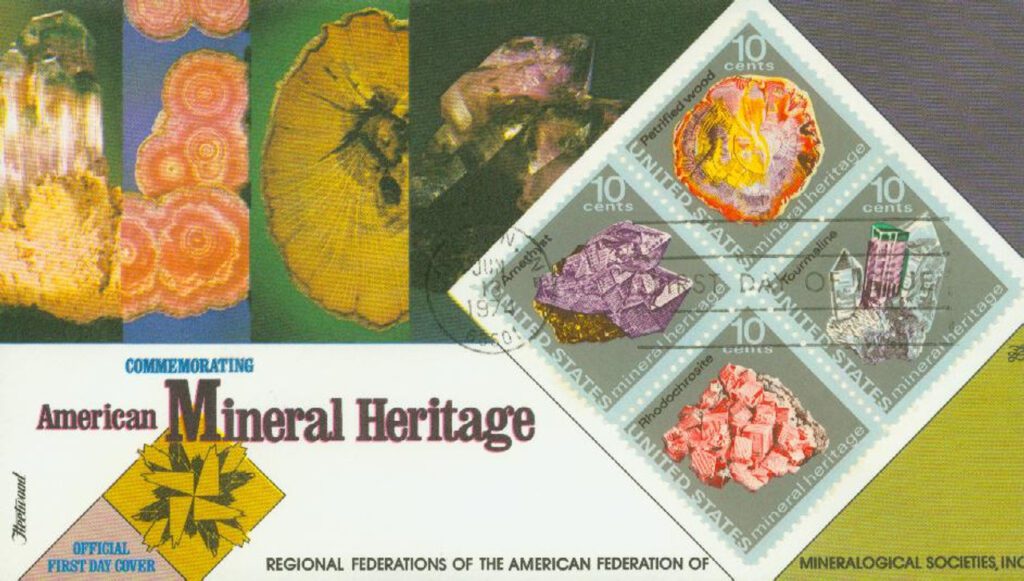
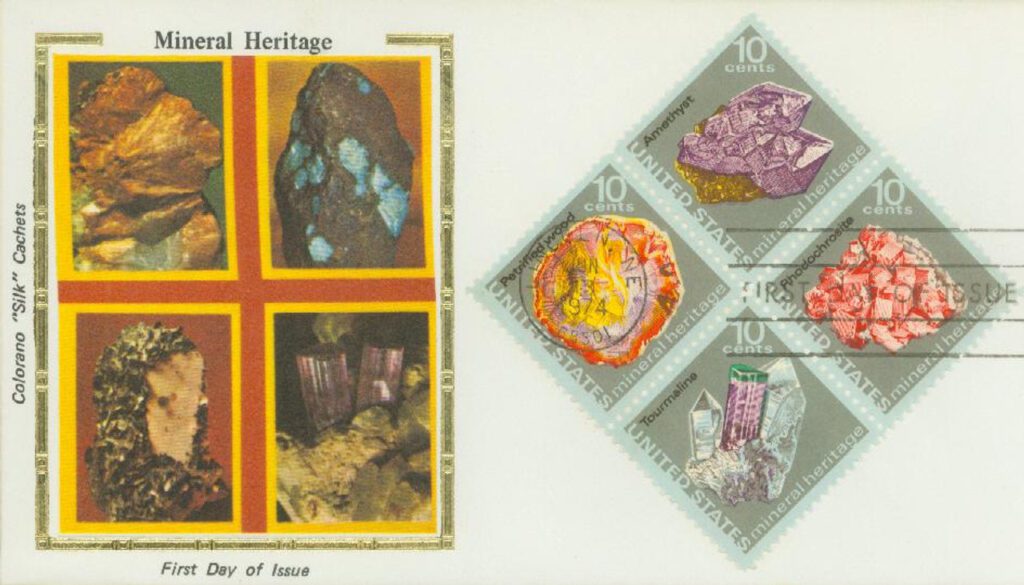
On June 13, 1974, the US issued its first stamps designed in a diamond format, honoring America’s Mineral Heritage. The four bright 10¢ stamps turned ordinary minerals into miniature works of art and gave rock collectors a long-awaited place in US postal history.
The idea began with Lillian Scheffers Turner, a rock enthusiast whose interest in minerals started at a 1961 gem and mineral show. There, she saw what she later called “nature in the rough.” The display made such an impression that she became a “rock hound,” the nickname often used for people who collect and study rocks, gems, and minerals.
Three years later, Turner was helping with special events at a national gem and mineral show in Washington, DC. During the event, someone asked a simple question: “Why don’t we have a mineral stamp?” Turner took the question seriously. She believed minerals were colorful, scientific, and closely tied to American land and industry. She also believed they would make attractive stamps.
What followed was a 10-year campaign. Turner wrote letter after letter to postal officials. She also became a familiar visitor around Capitol Hill, where she gained support for the idea. Her campaign showed how one determined collector could influence the subject of a US stamp issue. At the time, commemorative stamps often honored people, anniversaries, historic events, or famous places. Minerals were a less common subject, even though they were important to science, mining, jewelry, building materials, and everyday life.
Eventually, the US Postal Service agreed to create the stamps. Postal officials worked with the Smithsonian Institution’s Hall of Geology, Gems, and Minerals to choose specimens that would reproduce well in a small space. Color mattered. The stamps needed minerals that were not only important, but also vivid enough to catch the eye.
Turner stayed involved in the process. At one point, she pointed out that one proposed mineral should be removed because it was not found in the United States. Since the issue was meant to honor America’s mineral heritage, the final choices needed a clear connection to American locations.
The stamps were issued on June 13, 1974, at the National Gem and Mineral Show in Lincoln, Nebraska. Each stamp had a 10¢ denomination and pictured a different specimen. The set included petrified wood from Petrified Forest in Arizona, tourmaline from San Diego County, California, rhodochrosite from Colorado, and amethyst from Due West, South Carolina.
The petrified wood stamp showed a material formed when ancient wood was buried and slowly replaced or filled by minerals, often silica carried by groundwater. The result could preserve the shape and grain of the original tree while turning it into stone. Petrified Forest National Park in Arizona is famous for large deposits of colorful fossilized wood.
The tourmaline stamp represented one of the most colorful mineral groups. Tourmaline can appear in shades of pink, green, blue, black, and other colors. Some crystals even show more than one color in the same specimen. San Diego County became known for gem-quality tourmaline, especially from pegmatite deposits.
Rhodochrosite added a bold rose-red color to the set. The mineral is a manganese carbonate and is often valued for its rich color and attractive crystal forms. Colorado is especially associated with fine rhodochrosite specimens, making it a natural choice for a stamp honoring American minerals.
The amethyst stamp pictured the purple variety of quartz. Its color comes from trace elements and natural radiation within the crystal structure. Amethyst has long been used as a gemstone, and the South Carolina specimen gave the set another bright and recognizable mineral.
The Mineral Heritage stamps were printed by the Bureau of Engraving and Printing using multicolor lithography and engraving. They were issued in sheets of 48 and could be collected as a se-tenant block of four, meaning the different designs were printed together on the same sheet. Their unusual diamond appearance helped them stand out from other US commemoratives of the time.
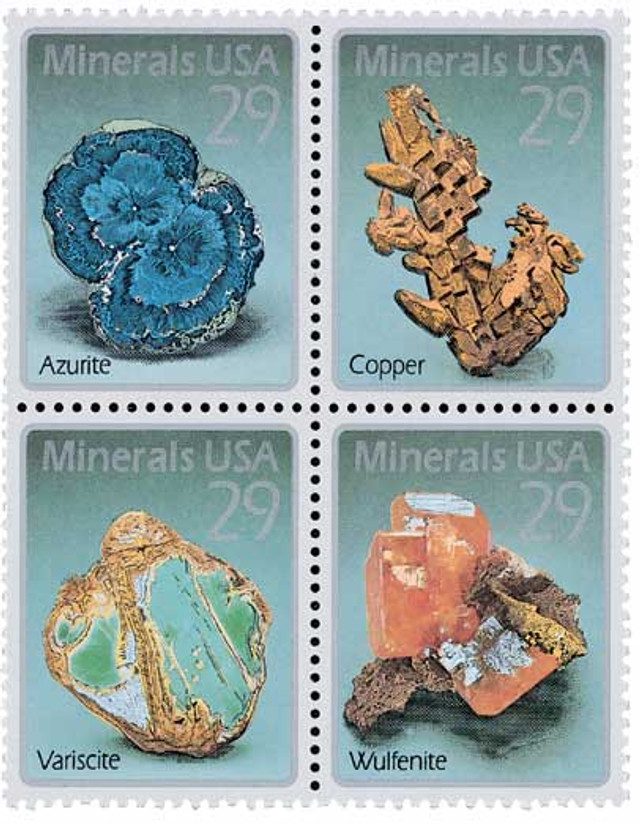
The stamps proved popular with collectors and the public. They were voted the most popular US stamp issue of 1974. For Turner, the victory did not end the story. She soon began pushing for another mineral issue. That effort took even longer, but in 1992 the USPS issued a second set of mineral stamps. It was a fitting continuation of the idea that began with one question at a gem and mineral show.
| FREE printable This Day in History album pages Download a PDF of today’s article. Get a binder or other supplies to create your This Day in History album. |
Discover what else happened on This Day in History.
Funny that they say they’re in a “diamond shape” when actually the stamps are square, they just appear to be diamond shaped because the image and the text is at a 45° angle from the perpendicular sides of the stamps.
The rhodo is not from the Sweet Home mine but from the American Tunnel at Silverton, Colorado.