
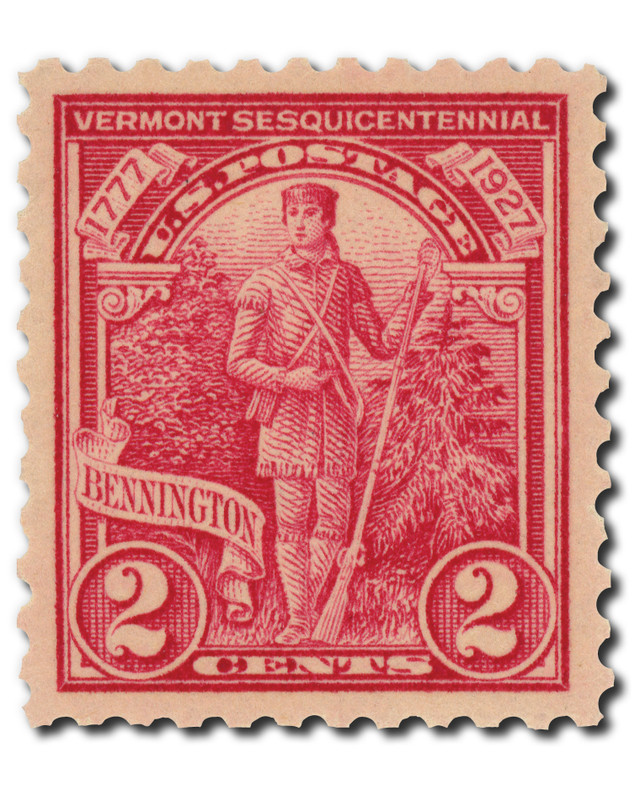
On August 16, 1777, American troops won the Battle of Bennington—even though most of the fighting took place across the border near Walloomsac, New York. The victory denied British General John Burgoyne badly needed supplies and cost his army hundreds of men at a critical point in the Saratoga campaign.
In the summer of 1777, Burgoyne led a British army south from Canada through the Lake Champlain-Hudson River corridor. His objective was Albany, where he expected to meet British forces moving north from New York City. A second force under Lieutenant Colonel Barry St. Leger was advancing east through the Mohawk Valley. British planners hoped the campaign would help separate New England from the other states and secure an important route between Canada and New York.
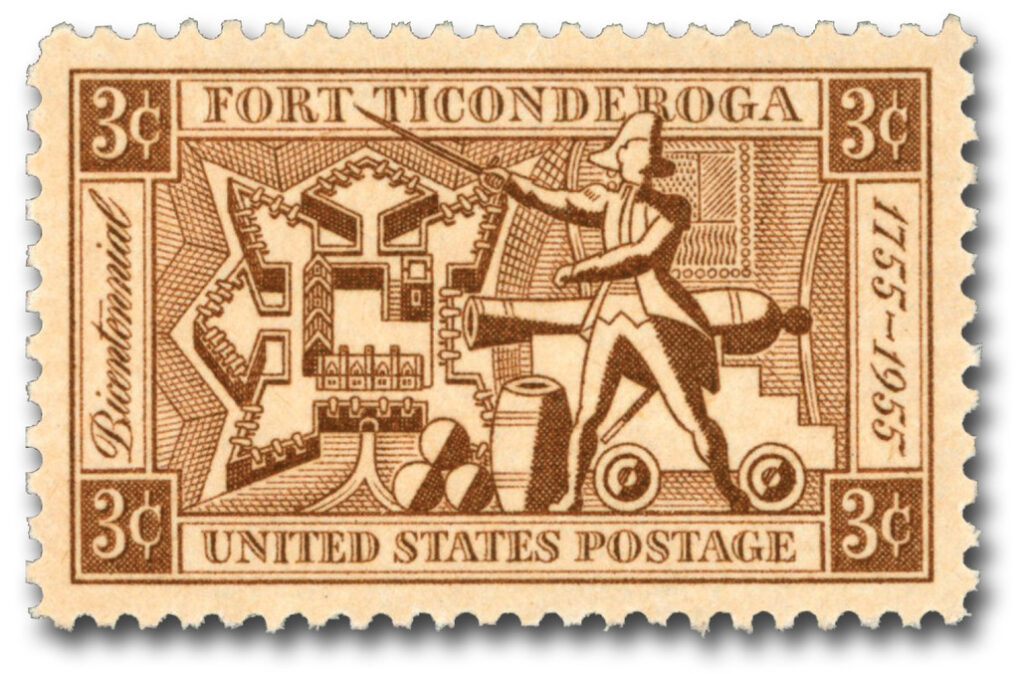
At first, Burgoyne moved quickly. His army captured Fort Ticonderoga in July and pushed south toward Fort Edward. American Major General Philip Schuyler slowed the advance by destroying bridges, felling trees across roads, and making transportation increasingly difficult. Burgoyne’s supply line stretched farther with every mile. His army soon needed food, horses, cattle, wagons, and other supplies.
Reports suggested that valuable American stores were located at Bennington, in territory that had recently declared itself the independent state of Vermont. Burgoyne sent Lieutenant Colonel Friedrich Baum to seize them. Baum commanded a mixed force that included German soldiers, Loyalists, Canadians, and Native American allies. His German dragoons also needed horses, since many were fighting on foot. Burgoyne expected local Loyalists to support the expedition and believed American resistance would be limited.

He was mistaken. New Hampshire had raised a militia brigade under Brigadier General John Stark, a veteran of Bunker Hill, the Canadian campaign, and Trenton. By the time of the battle, Stark commanded about 2,200 militiamen. Roughly 1,400 came from New Hampshire and about 600 from Vermont, with smaller groups from Massachusetts, New York, and Connecticut.
On August 14, Baum encountered American scouts at Sancoick Mill, about eight miles west of Bennington. After learning that a larger force opposed him, he stopped and fortified high ground near the Walloomsac River. Heavy rain on August 15 delayed both sides. Baum improved his defenses while waiting for about 500 German reinforcements under Lieutenant Colonel Heinrich von Breymann.
The weather cleared on August 16. Stark divided his men into several columns, sending troops around Baum’s flanks and rear while another force threatened the front. At about 3 p.m., the Americans attacked from several directions. According to tradition, Stark rallied his men by pointing toward the enemy and declaring that they were theirs, “or Molly Stark sleeps this night a widow.”
The fighting was fierce. Baum’s German troops defended their earthworks until their ammunition ran low. Many of his Native American allies escaped early in the battle. Within about two hours, the Americans overran the main position. Baum was mortally wounded, while many of his soldiers were killed or captured.
The victory was not yet secure. Stark’s men had scattered to pursue fugitives, guard prisoners, and collect captured equipment when Breymann’s reinforcements finally arrived. At almost the same time, Colonel Seth Warner’s regiment reached the battlefield and helped Stark rally his forces. A second engagement continued until sunset, when Breymann’s battered troops retreated. The Americans even turned captured British artillery against them.
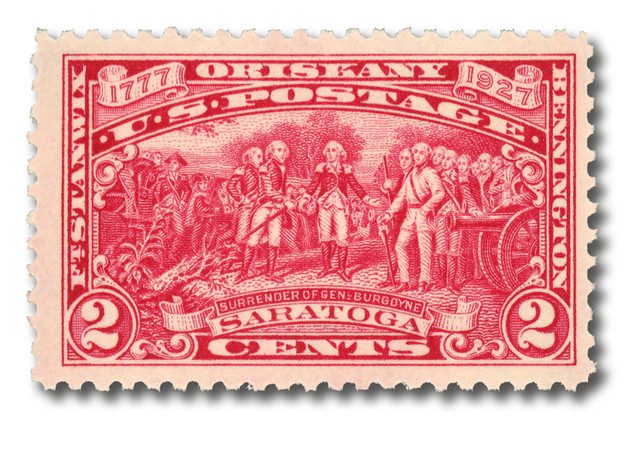
By the end of August 16, Burgoyne’s expedition had been devastated. The National Park Service estimates that he lost almost 900 men at Walloomsac, while the raid failed to obtain the supplies his army needed. The defeat also discouraged many of Burgoyne’s Native American allies and encouraged additional American militia to join the campaign.
Bennington did not by itself defeat Burgoyne, but it made his already difficult position worse. His army continued south and fought the Americans at Freeman’s Farm on September 19 and Bemis Heights on October 7. Surrounded and short of supplies, Burgoyne surrendered at Saratoga on October 17, 1777. That victory helped persuade France to formally ally with the United States the following year.
| FREE printable This Day in History album pages Download a PDF of today’s article. Get a binder or other supplies to create your This Day in History album. |
Discover what else happened on This Day in History.
The engraved stamp commemorating the Green Mountain Boys at the Battle of Bennington is historically informative, and bought very easily. The stamp is a great piece of engraving. It and the “76” flag stamp are easily recognizable as postage stamps too. Modern stamps, often simply look like stickers. Some very colorful like the seed package stamps and the different birds. But no more denomination, except on special issues. There is something lost for the hobby. I hope Mystic can boost interest, at least in the older issues. Thanks for all you do for the slowly dying hobby.
A very useful service to collector and history buff alike.
great part of our country,s history proud to be american
idn’t realize that there was TWO Battles for Saratoga. Something that the school system forgot to mention.
Not quite the way the battle formed and went but close enough for goverment work.
Great news Thanks
The history that you bring to each stamp is absolutely fascinating. Having collected stamps for over 60 years this brings stamp collecting to a whole new level. I have this Bennington flag and as a veteran it has such a significant part of our countries history. What else is U.S. stamp collecting, but a treasure of history of our great country.
Really enjoy your “This day in History” series. I’ve learned a lot about history and geography over the years from stamps. Keep up the good work.
Very nice article,I have been a customer of Mystic for a few years and this is the first time I have seen your news articles,very interesting. Keep it up………..
Enjoyed it and learned, too.
The Britishers were in no position to win this war and gave in easily to loose the power in Saratoga war.
Enjoying allthese “Day in History” and always learning something.
The Bennington Battle Monument, in Bennington, Vt., tallest structure in the state, commemorates the battle, worth a visit. The story of the battle is told in the nearby Bennington Museum.