
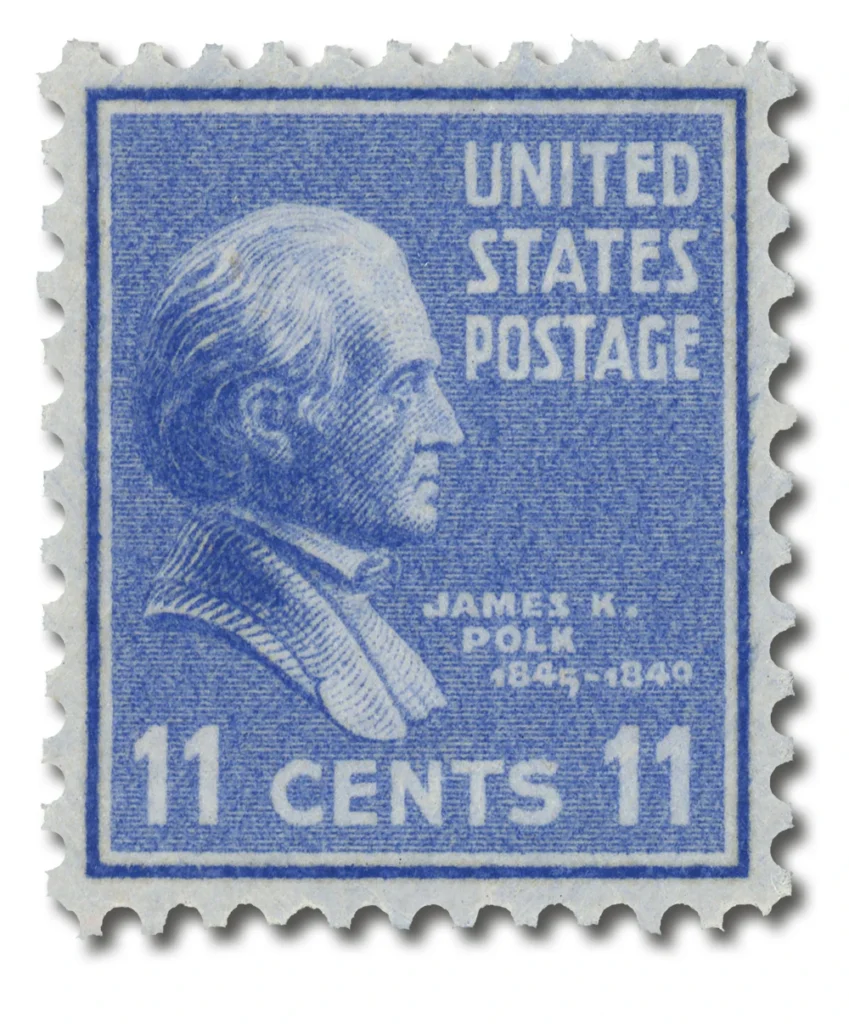
James Knox Polk was born on a North Carolina farm on November 2, 1795. By 1849, he had led the country through war with Mexico and expanded its territory to the Pacific, but his presidency left a bitter question unresolved: whether slavery would spread into the new lands.
Polk grew up in a large family. In 1806, his parents moved west from North Carolina to Tennessee, traveling by wagon. He was often ill as a child, but became an intense student. He entered the University of North Carolina in 1816 and graduated with honors in 1818. Back in Tennessee, he studied law with Nashville attorney Felix Grundy. Polk passed the bar in 1820 and opened a law practice. His health remained fragile, and he suffered from gallstones.

Politics soon became his main pursuit. Polk won election to the Tennessee legislature in 1823. Two years later, he entered the US House of Representatives, where he served seven terms. A firm ally of Andrew Jackson, Polk supported the president’s policies and earned the nickname “Young Hickory.” In 1835, he became speaker of the house, serving four years. He was elected governor of Tennessee in 1839, but lost reelection in 1841 and a second gubernatorial campaign in 1843.
At the 1844 Democratic convention, Polk was a surprise choice after party leaders deadlocked over other candidates. He had hoped to become vice president, but emerged as the party’s presidential nominee. Polk supported annexing Texas and acquiring Oregon. Those positions helped him win the election against Whig candidate Henry Clay, though Polk lost his home state of Tennessee. He became the first widely recognized “dark horse” presidential nominee.

Polk entered office in 1845 with a focused agenda. He wanted to lower tariffs, establish an independent treasury, settle the Oregon boundary dispute with Britain, and gain California. Congress passed the Walker Tariff in 1846, and Polk restored an independent treasury system. In 1846, the United States and Britain agreed to set the Oregon boundary at the 49th parallel. Texas had already been annexed before Polk took office, but its border with Mexico remained disputed.
Polk’s effort to acquire California and New Mexico helped lead to war. He sent diplomat John Slidell to Mexico to negotiate the border and offer to buy the territories. Mexico refused to receive him. Polk then ordered US troops into the disputed area between the Nueces River and Rio Grande. After fighting broke out in April 1846, Polk asked Congress to declare war. The United States defeated Mexico, and the 1848 Treaty of Guadalupe Hidalgo ended the conflict. Mexico ceded a vast region that included present-day California, Nevada, Utah, Arizona, and New Mexico. The United States also secured the Rio Grande as Texas’s southern boundary and paid Mexico $15 million.

The land gained during the war made the United States larger, but it intensified conflict over slavery. Polk was a slaveholder and supported allowing slavery to expand into the territories. Congress debated whether slavery would be permitted in land taken from Mexico, but it did not resolve the issue during his term. The dispute would deepen in the years before the Civil War.
Polk had promised to serve only one term and did not seek reelection. His wife, Sarah Childress Polk, had been an active political partner, advising him and helping with speeches. After leaving office in March 1849, the exhausted former president returned to Nashville. He died there of cholera on June 15, less than four months after his retirement.
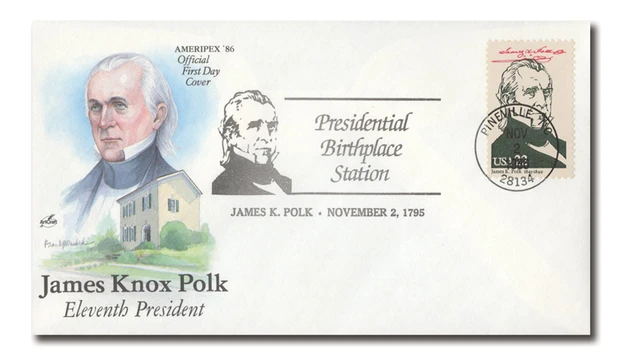
Polk’s presidency is often judged by how closely he achieved his stated goals. He fulfilled much of his program and oversaw the country’s largest expansion to that point. Yet the consequences of that expansion, especially the bitter dispute over slavery, complicate his legacy.
Click here for more about Polk’s life and the James K. Polk Home and Museum in Columbia, Tennessee.
| FREE printable This Day in History album pages Download a PDF of today’s article. Get a binder or other supplies to create your This Day in History album. |
Discover what else happened on This Day in History.
Interesting facts. I wasn’t aware that he was the only president that did not pursue reelection.
Not the only, just the first.
William Henry Harrison was technically the first President who would not seek re-election, and not because he died in office. Harrison put himself on record after his election in 1840 that he would only serve one term. Henry Clay had planned to devote the four years of what would have been Harrison’s administration building up his agenda for his 1844 presidential run. President Tyler frustrated him instead, and Clay opposed Polk in 1844 as a weakened candidate.
More than one President, including the current, as said that they only planned to serve one term. Even the founders debated how long that one term should be at the Constitutional Convention. It is a touch job. Look at how Presidents age while in office. “Hail to the Chief”.
trump in 2020 common sernse
HAHAHA
The article gives lip service to the expansionist agenda that amounted to an invasion of Mexico and was more than slightly unpopular at the time. To even begin to compare him to George Washington is just wrong. Yet he did successfully settle border disputes in Canada.