
On July 25, 1909, Louis Blériot became the first person to fly an airplane across the English Channel. Flying a small monoplane from near Calais to Dover, the French aviator completed the dangerous journey in just 36 minutes and 30 seconds.
Louis Charles Joseph Blériot was born in Cambrai, France, on July 1, 1872. He showed an early talent for technical subjects and later entered the prestigious École Centrale des Arts et Manufactures in Paris. He graduated as an engineer in 1895, completed a year of compulsory military service, and then joined an electrical engineering company.
Blériot soon developed a compact acetylene headlamp for automobiles. He left his job and founded a company to manufacture the lamps, which became widely used by the growing French automobile industry. The financial success of this business allowed him to spend large amounts of money on aviation experiments.
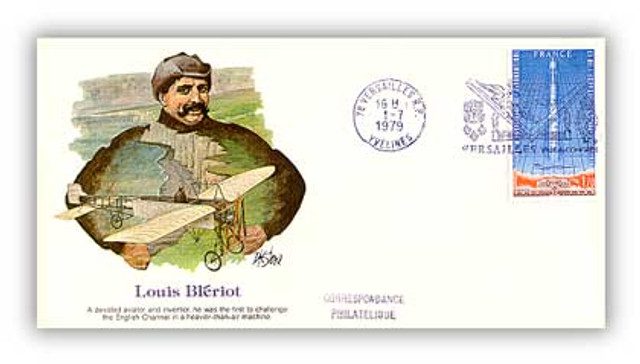
His serious interest in flight began around 1901, partly inspired by the aircraft experiments of French inventor Clément Ader. Blériot first tried to build an ornithopter, a machine designed to flap its wings like a bird. He then experimented with gliders and entered a partnership with aircraft builder Gabriel Voisin. Their powered machines failed, and the partnership eventually ended.
Blériot continued working independently. He tested different arrangements of wings, engines, propellers, and controls. Frequent crashes earned him the nickname “the man who always falls,” but the failures helped him improve his designs. His work eventually produced the Type XI, a light wood-and-fabric monoplane that became one of the most successful aircraft of aviation’s early years.
The Type XI was tested early in 1909. Blériot replaced its unreliable engine with a 25-horsepower, three-cylinder Anzani engine and added a more efficient Chauvière propeller. On June 26, he remained in the air for more than 36 minutes. On July 13, he won the Aéro-Club de France’s first Prix du Voyage by completing a cross-country flight of about 42 kilometers, or 26 miles, from Étampes toward Orléans.
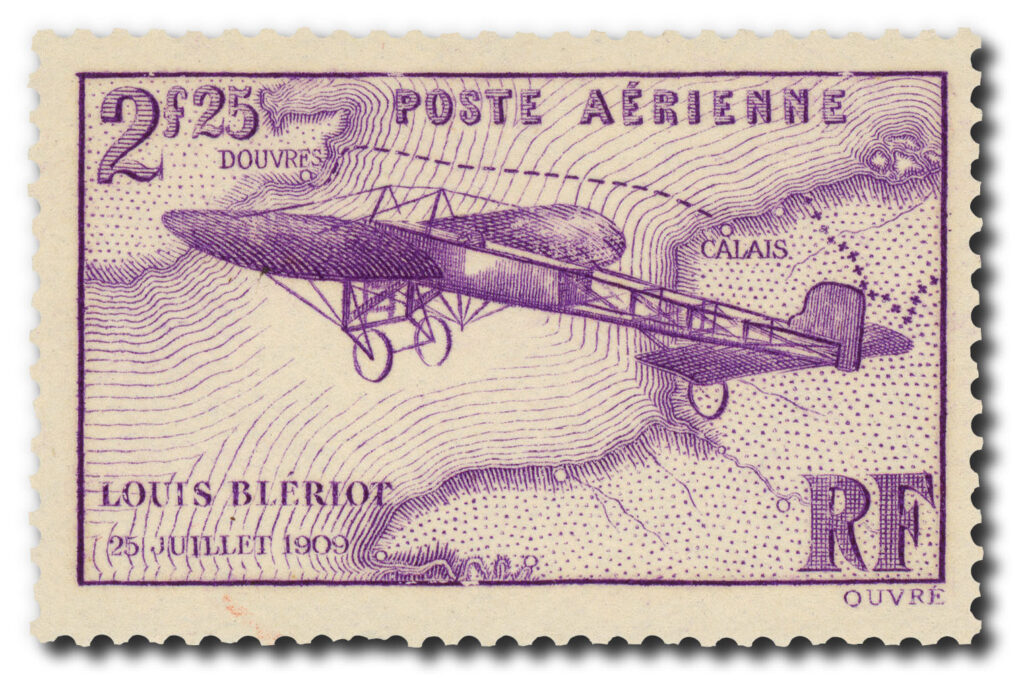
Meanwhile, London’s Daily Mail was offering a prize for the first airplane crossing of the English Channel. The newspaper announced a £500 award on October 5, 1908. When no one completed the challenge that year, it doubled the prize to £1,000 and extended the deadline through 1909. Blériot’s two serious competitors were Hubert Latham and Charles de Lambert.
Latham tried first on July 19. He flew about halfway across the Channel before engine failure forced his Antoinette monoplane onto the water. A French destroyer rescued him. De Lambert had been injured during a test flight, leaving Blériot and Latham as the leading contenders while poor weather delayed further attempts.
Before sunrise on July 25, Blériot made a short test flight near Les Baraques, outside Calais. He was still suffering from an injured foot caused by a recent accident. At 4:41 a.m., shortly after sunrise, he took off in the Type XI. The airplane traveled at about 45 miles per hour and flew roughly 250 feet above the water.
Blériot carried no compass. He initially followed the French destroyer Escopette, which was heading toward Dover, but his airplane soon overtook it. Clouds and mist left him unable to see either coast for several minutes. When the English shoreline appeared, he turned toward Dover and spotted journalist Charles Fontaine waving a large French flag from Northfall Meadow near Dover Castle.

Strong winds made the landing difficult. Blériot cut the engine and came down hard, damaging the landing gear and propeller. He was unhurt. His official flight time was 36 minutes and 30 seconds. Although balloons had crossed the Channel as early as 1785, Blériot had completed the first crossing in a heavier-than-air aircraft.
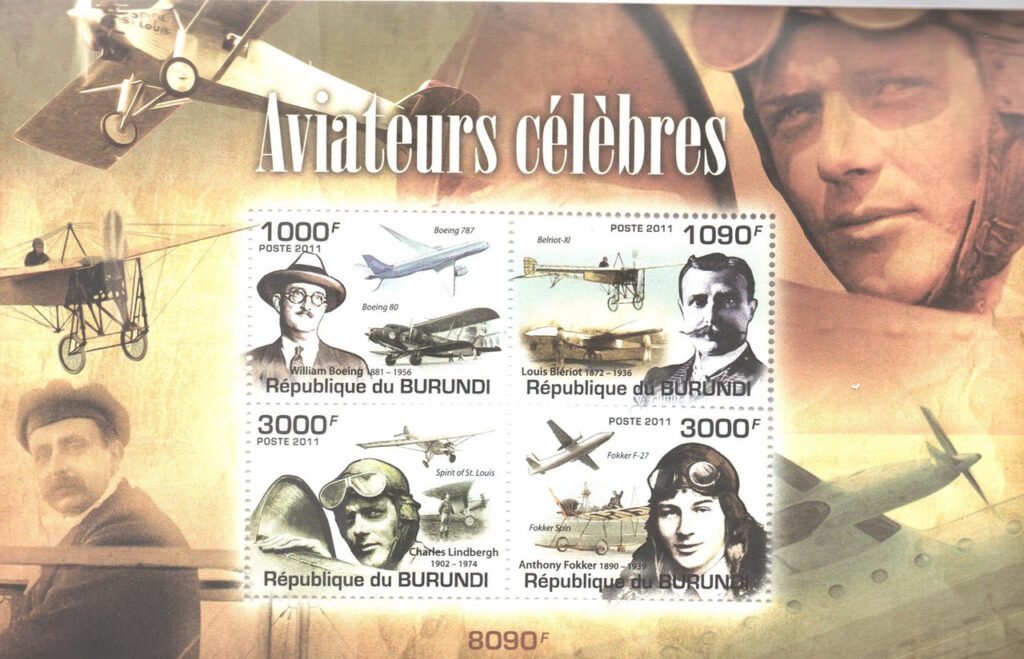
The achievement brought Blériot immediate fame and a flood of orders for the Type XI. In May 1927, he met Charles Lindbergh in Paris after Lindbergh’s solo transatlantic flight, and photographs captured the two aviation pioneers together. Blériot remained active in aircraft manufacturing until his death on August 1, 1936.
| FREE printable This Day in History album pages Download a PDF of today’s article. Get a binder or other supplies to create your This Day in History album. |
Discover what else happened on This Day in History.
Wow, great bit of history! Sounds like a member of his crew should be remembered also for his part in picking the best weather conditions for flight. And that is neat that he was present when Charles Lindbergh completed his historic flight. Thank you Mystic.
I wonder what plane he saw in Paris in 1900? Glider? Ornithopter? The infamous screw wing? Just curious since the first powered flight was still 3 years away.
Excellent article and great use of visuals with stamps and illustrated covers. Very informative. I commend Mystic on a great concept with this day in history.
As always standout. Thanks Mystic…
I have a real photograph of “Horace K. 1919 “Ace†Plane that a family friend rebuilt in 1956.