
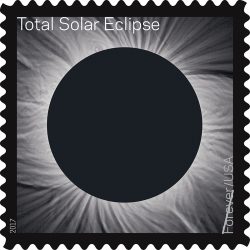
On June 20, 2017, the USPS issued its first stamp printed with heat-sensitive thermochromic ink, honoring the total solar eclipse expected later that summer. With the touch of a finger, the dark eclipse transformed into a glowing image of the full Moon.
The Total Eclipse of the Sun Forever stamp used two photographs taken by retired NASA astrophysicist Fred Espenak, widely known as “Mr. Eclipse.” The main image shows the March 29, 2006, total eclipse as seen near Jalu, Libya. Espenak created it from 22 separate photographs. He also took the underlying photograph of the full Moon from his observatory in Portal, Arizona, in 2010.
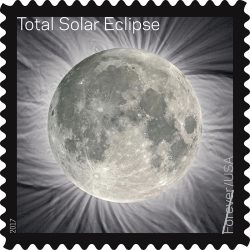
USPS art director Antonio Alcalá designed the stamp. It marked the first time the Postal Service used thermochromic ink on a US stamp. Placing a warm thumb or finger over the black disc causes the ink to become clear, revealing the Moon underneath. As the stamp cools, the black disc returns and recreates the appearance of a total eclipse.
The first-day ceremony was held at the University of Wyoming Art Museum in Laramie. It followed the museum’s annual summer solstice celebration. At exactly noon on the solstice, sunlight passes through a solar tube in the ceiling of the Rotunda Gallery. The narrow beam illuminates a silver dollar embedded in the center of the gallery floor.
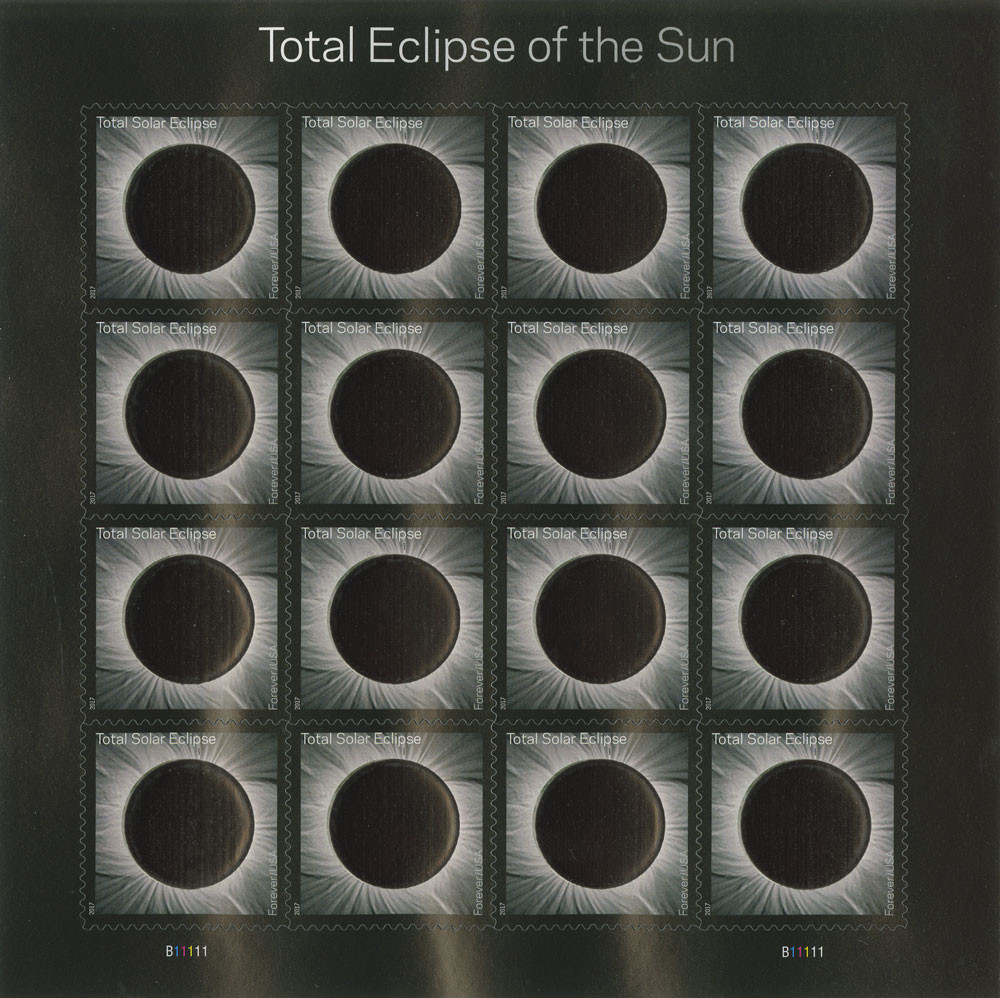
The back of the stamp pane pictures a map showing the eclipse’s path across the United States. It also lists approximate times when the eclipse would appear at selected locations. Because thermochromic ink can deteriorate when exposed to ultraviolet light, collectors were advised to keep the stamps out of direct sunlight. USPS also offered protective envelopes designed to shield the panes from UV light.
The stamp proved popular with collectors. It received 395 votes in the annual Linn’s Stamp News poll and was selected as the overall favorite US stamp of 2017.
More About the Eclipse of 2017…
A solar eclipse occurs when the Moon passes between Earth and the Sun. During a total eclipse, the Moon completely covers the Sun’s bright visible surface. The Sun’s much fainter outer atmosphere, known as the corona, can then be seen around the Moon’s dark outline.
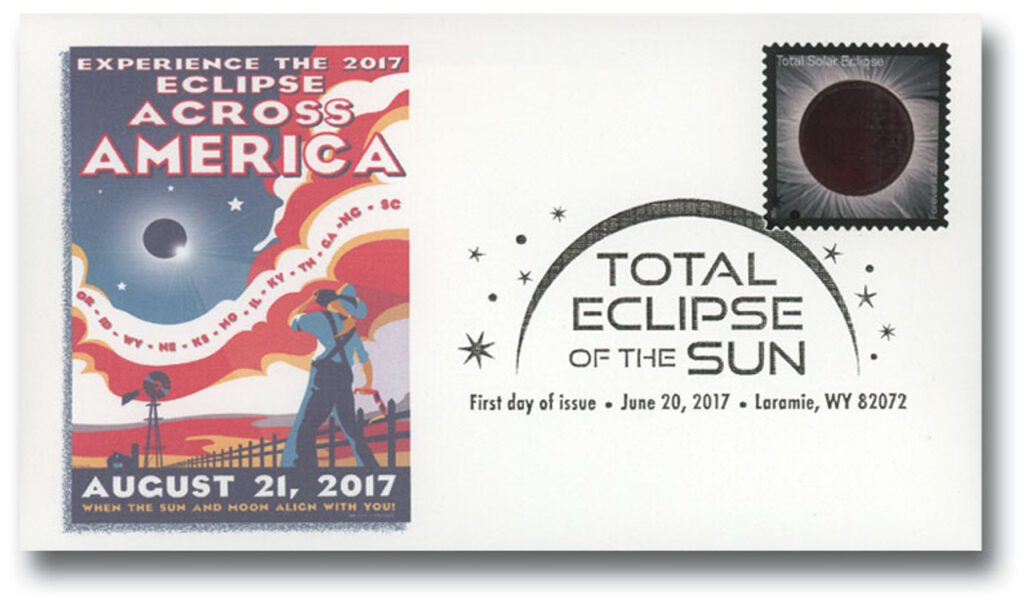
Because the Moon’s shadow moves across Earth, totality can only be observed within a relatively narrow path. People outside that path may see a partial eclipse, while those farther away may not see the event at all. Observers must use approved solar-viewing glasses during the partial phases. It is safe to look directly at the eclipse without them only during the brief period of complete totality.
On August 21, 2017, the path of totality entered the United States near Lincoln City, Oregon, and left the country near Charleston, South Carolina. The shadow crossed portions of 14 states along a path roughly 70 miles wide. Totality lasted no longer than about two minutes and 40 seconds at any single location. A partial eclipse was visible across the rest of North America and in portions of South America, Europe, and Africa.
The event was the first total solar eclipse visible anywhere in the contiguous United States since February 26, 1979. It was also the first to cross the United States from the Pacific Coast to the Atlantic Coast since June 8, 1918. Its path of totality crossed no country other than the United States, something that had not occurred over the land now forming the nation since 1257.
| FREE printable This Day in History album pages Download a PDF of today’s article. Get a binder or other supplies to create your This Day in History album. |
Discover what else happened on This Day in History.
Stamp did not work well in AZ with ambient temps a little high. Entertaining but one wonders about USPS costs.
I agree! The technique isn’t perfected by USPS. Here in Milwaukee WI, I too could not see any noticeable effect. It worked only when I kept the stamps sheet in my freezer (air tight) and then exposed it outside at room temperature. Walla -it worked but not that effectively. Same happened with those Canadian colorful Silver Dollar coins that are supposed to glow in a dark room. Not so clearly visible even in my totally dark powder room with its door shut. My conclusion: It’s a rip off!
I agree, they did not work well in Phoenix area.
What a remarkable phenomenon! We packed our bags and went south to Tennessee to an area where we could experience totality. It was awesome. I took several stamped and cacheted envelopes to be postmarked on the day of the actual event. We had a blast.
They worked for me here in SE Missouri. Amazing!
I believe that some people live in a partial eclipse. Amazing things occur around us each day yet they go unnoticed. Even the obvious go unseen right before our eyes. We were not in the zone, and our heat did not effect the wonders that occurred on that stamp issued day. Thanks, Mystic.
1257? The U.S. didn’t exist in the days of Genghis Khan!
You must mean 1957. Or possibly 1857?
Some clarification is needed here.
[It was also the first time since 1257 a total solar eclipse could be viewed only from within the continental United States.]
The United States didn’t have to exist for the eclipse to have been contained within the land area that we NOW know of as the US. I think that’s what they meant. I suppose it could have just as easily been written ‘within mid-North America’.
If you have any of these stamps they may work but you have to use a hair dryer, as your thumb may not generate enough heat.