

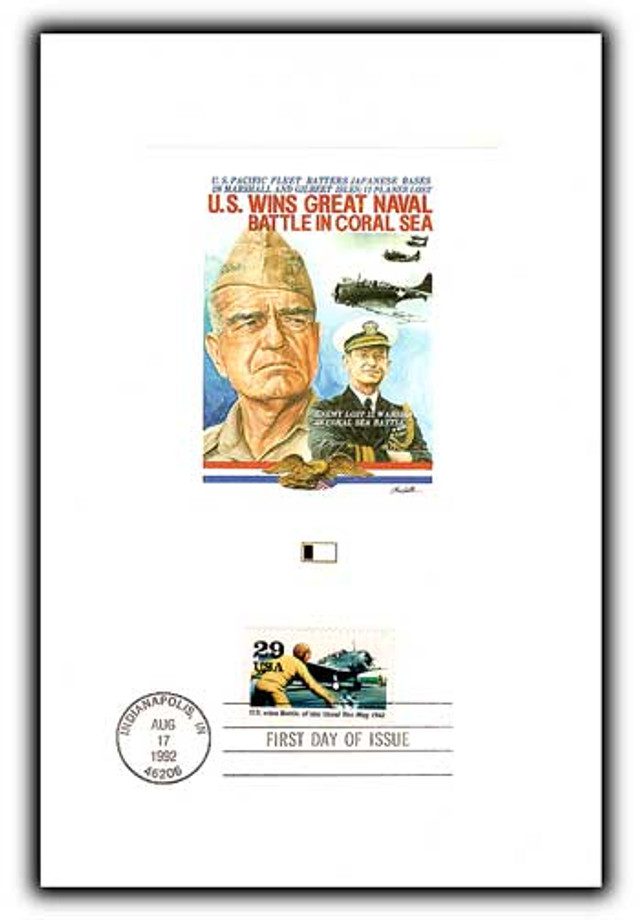
On May 4, 1942, the World War II Battle of the Coral Sea began. It became the first naval battle fought mainly by aircraft carriers, with opposing fleets striking each other by air while their ships never came into direct sight.
After the attack on Pearl Harbor, Japan advanced rapidly across the Pacific. In a matter of months, Japanese forces captured or threatened Hong Kong, Malaya, Singapore, the Dutch East Indies, and the Philippines. Their next goal was to isolate Australia from the United States and weaken Allied resistance in the South Pacific.
The Philippines had already suffered heavily. American and Filipino forces under Douglas MacArthur retreated to Bataan after Japanese landings. They held out for months but surrendered in April 1942 after severe shortages of food, medicine, and ammunition. The campaign delayed Japanese plans but did not stop them.
Japan then prepared Operation MO, a plan to capture Port Moresby on the southern coast of New Guinea and seize Tulagi in the Solomon Islands. If successful, Japan could threaten sea lanes to Australia and position aircraft closer to the continent.
The Allies had one major advantage: intelligence. American codebreakers had partially broken Japanese naval codes and learned enough to predict the operation. Admiral Chester W. Nimitz sent carrier forces to intercept. The main American carriers were USS Yorktown (CV-5) and USS Lexington (CV-2) under Rear Admiral Frank Jack Fletcher. They were joined by an Allied surface force including Australian cruisers under Rear Admiral John Crace.
On May 3, Japanese troops occupied Tulagi after a small Australian garrison withdrew. The next day, aircraft from Yorktown struck the invasion force. American planes sank the destroyer Kikuzuki, several smaller craft, and damaged other vessels. The raid showed the Japanese that Allied carriers were nearby.
Over the next several days, both sides searched a huge ocean area using scout aircraft. This was one of the new realities of carrier warfare: finding the enemy first often mattered more than gun range or armor. Mistaken sightings and incomplete reports created confusion on both sides.

On May 7, Japanese aircraft found and sank the destroyer USS Sims (DD-409) and badly damaged the oiler USS Neosho (AO-23) after misidentifying them as larger warships. That same day, American planes located the light carrier Japanese carrier Shoho protecting the invasion force. They attacked in waves and sank the ship. The famous radio message “Scratch one flattop” was sent after the victory.
The loss of Shoho was serious because Japanese transports needed air cover to approach Port Moresby. That night, Japanese commanders postponed the landing.
The decisive carrier clash came on May 8. Both fleets finally located each other in the morning and launched large air strikes almost simultaneously. American aircraft hit the Japanese fleet carrier Shokaku with bombs, heavily damaging its flight deck. Its sister ship, Zuikaku, avoided direct damage but lost many aircraft and experienced flight crews.
Japanese planes struck back hard. They hit Lexington with bombs and torpedoes and damaged Yorktown. At first, damage-control teams appeared to save Lexington. Later, gasoline vapors ignited and caused massive internal explosions. Fires spread beyond control. The crew was ordered to abandon ship, and most sailors were rescued before the carrier was scuttled by an American destroyer.
Tactically, Japan sank more tonnage because Lexington was lost and Yorktown damaged. Strategically, however, the Allies gained the more important result. The Port Moresby invasion was canceled. Japan’s advance toward Australia had been checked for the first time. Shokaku was too damaged for immediate action, and Zuikaku lacked enough aircraft. Neither carrier was available a month later for the Battle of Midway, where Japan suffered a major defeat.
The Battle of the Coral Sea changed naval warfare. Battleships never fired at each other. Instead, aircraft launched from moving carriers decided the outcome hundreds of miles away. It was the first clear sign that carriers, not battleships, now ruled the Pacific.
| FREE printable This Day in History album pages Download a PDF of today’s article. Get a binder or other supplies to create your This Day in History album. |
Discover what else happened on This Day in History.
Great story about our history.
Very thorough and interesting. Thanks!
As a boy in dinner camp in the fifties, one of our camp counselors mentioned that her brother had survived the sinking of the Lexington at Coral Sea. He also survived the sinking of his next ship, the Cartier Princeton in 1944. It wasn’t until years later that I realized what momentous times he endured.
The U.S. and allied effort to stop the Japanese was a victory in that Japan was
stopped. This led to the Japanese Naval leaders desiring to get rid of
the American carriers once and for all and they planned to attack Midway Island
to draw the remaining three serviceable Carriers (Yorktown, Enterprise and Hornet)
into a trap sert by Adm. Nagumo and his four fleet carrier strike force. The U.S.
intercepted and decoded the attack messages and the rest was history. The Japanese
lost four fleet carries, numerous aircraft and most of all the core of their experienced
senior pilots. The U.S. did lose the Yorktown, but with the industrial capacity of the
U.S. they replaced the Yorktown many times over. The Japanese, on the other hand,
did not have the capacity to replace four frontline fleet carriers.
It’s been 84 years and we still remember the sacrifices!
Great story, two of my brothers were involved in the Coral sea battle.
My father was at the Battle of the Coral Sea on the Lexington. He didn’t really like to talk about it much, but he did mention being picked up by an Australian ship after the Lexington sunk and they had to abandon it. My father has since passed away, but I know he would probably have been proud knowing, that what so many sacrificed for, has not been forgotten.
I think mention should be made that Gen. MacArthur was sent to Australia from Bataan. He was one of the main planners that carried the war back to Japan and defeat.
great reading, thanks, Ben Cunningham