

On November 18, 1928, Steamboat Willie introduced Mickey Mouse to moviegoers at New York’s Colony Theatre. Its carefully timed sound and animation helped turn the new character into a star.
Walt Disney’s route to animation began with a different ambition. In 1918, at age 16, he tried to enlist in the Army but was rejected because he was underage. He joined the Red Cross Ambulance Corps and was sent to France near the end of World War I. The armistice had already been signed when he arrived, and he drove ambulances and Red Cross officials rather than serving in combat. After returning to the United States in 1919, he found work at an art studio in Kansas City through a former colleague. He soon began making animated films.

By 1928, Disney and animator Ub Iwerks had created two Mickey Mouse cartoons, Plane Crazy and The Gallopin’ Gaucho. They were initially made as silent films, but distributors showed little interest. Disney decided to make another short with sound as a central feature. The animators tested the timing by watching the film while Wilfred Jackson played “Turkey in the Straw” on a harmonica. Others tapped pencils against spittoons, tables, and coffee cups to match the action. The experiment helped them work out how sound effects and music could follow the characters’ movements.
The result was Steamboat Willie, directed by Disney and animated largely by Iwerks. It premiered on November 18 at the Colony Theatre, now known as the Broadway Theatre, in New York. The short was an immediate hit. A few days later, Variety praised its cartooning and sound effects, reporting that the audience’s laughter came so quickly that “they were stumbling over each other.”
Earlier cartoons had experimented with synchronized sound, so Steamboat Willie was not the first sound cartoon. Its precise coordination of music, effects, and movement helped make it a success with audiences. Mickey’s actions seemed to produce the sounds on screen: he whistles, steers the boat, and turns animals and objects into instruments. The film’s reception gave Disney a strong foothold in the growing market for sound cartoons.
Disney’s first two Mickey films were then released with sound. In 1929, Mickey spoke on screen for the first time in The Karnival Kid. The character was often resourceful but imperfect, and his plans did not always work. These early cartoons established Mickey as the center of Disney’s growing studio.

The company went on to make films and cartoons featuring other characters and musical approaches. In 1937, Disney released Snow White and the Seven Dwarfs, the studio’s first full-length animated feature. Fantasia, released in 1940, paired animation with classical music and featured Mickey as the Sorcerer’s Apprentice. The studio also developed Silly Symphonies, a series of 75 short cartoons that explored music, sound, and animation. Several won Academy Awards. The Academy created its award category for short subjects in 1932, before the series began, so Disney’s work did not create the category.

Music remained part of Disney animation. The studio used existing songs and musical compositions, and later produced popular songs for its films. Steamboat Willie helped establish how sound could work with animated action, while Disney’s later productions explored that connection in different ways.
The original 1928 film entered the public domain in the United States on January 1, 2024. That applies to the film and the early versions of Mickey and Minnie shown in it. Later character designs remain protected by copyright, and Disney’s trademarks are separate from the film’s public-domain status.
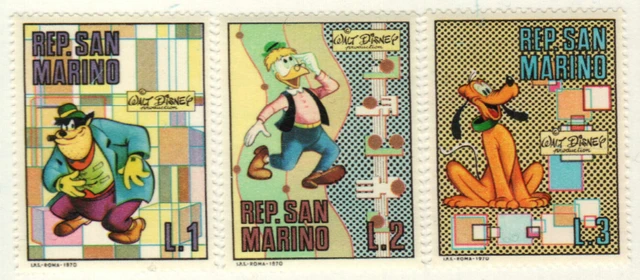
Click here for lots more Disney stamps.
Click here to watch Steamboat Willie on YouTube.
| FREE printable This Day in History album pages Download a PDF of today’s article. Get a binder or other supplies to create your This Day in History album. |
Discover what else happened on This Day in History.
muy interesante he instructivo Gracias Leonardo
Happy birthday little guy!!!!!
I grew up watching Mickey and his crew.
What a great inspration for young people who cannot make it in school. You do not need school to make it if you follow your talents.
These daily emails are wonderful. Thank you.
Thank you. Now I know the history of Mickey, my greatest love as a kid. We were born in the same year and I watched all of his movies as soon as they came to our theater in CT.
Watching Mickey was always a joy. I’ve tryed to collect all of his video
Happy Birthday Mickey Mouse!!!!
Its remarkable how Mickey Never Aged. I remember seeing the early pilots of Mickey and I think they were in Black and White. Went to Walt’s World when it opened in 1973 Orlando, and will never forget that first visit to the Magic Kingdom.
My favorite Disney character was Pluto. Now he’s gone and Pluto is no longer a planet. Thanks for the Disney history. Did Mickey ever get married to Minnie?????
Happy Birthday Mickey! Today is my Birthday also. ( 1951 )
M-I-C-K-E-Y M-O-U-S-E, Mickey Mouse, (Donald Duck). Thanks for the memories.
QUICK!!!! How many fingers does Mickey have on one hand? NO PEEKING
There is a belief that Walt Disney was actually born in Spain. His mother was a “lady of the night”. This is why a Secret Service Agents went to the small village in that country, and ‘paid’ his mother not to reveal who she was in Mr Disney’s life. If he (Walt) had been a regular person, it’s OK to be from anywhere and have any kind of family. Because of his fame in America and fortune, he has to be of a Caucasian American and well-to-do family. I may add that in the biographical book of Walt Disney, there is a one-page black and white photo of the village where he was supposedly born. The picture is taken from a certain altitude, looking out over the site.