

Jackson Pollock died on August 11, 1956, in Springs, New York, at age 44, after a career that had made his unconventional painting methods famous far beyond the art world. In less than two decades, he moved from Depression-era government art projects to the center of the emerging Abstract Expressionist movement.

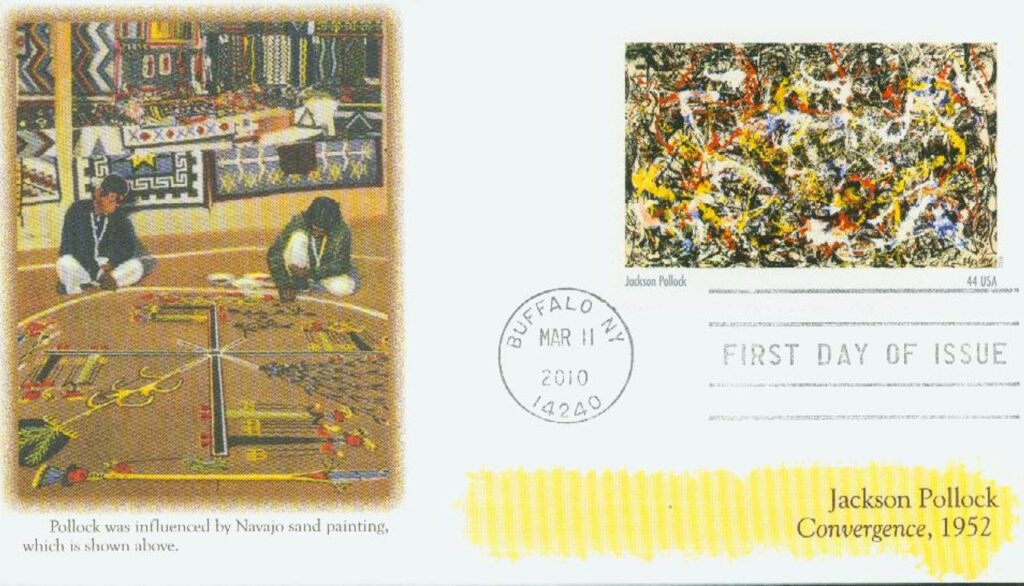
Paul Jackson Pollock was born in Cody, Wyoming, on January 28, 1912, the youngest of five sons. His family moved repeatedly, and he grew up mainly in Arizona and California. His father worked at times as a government land surveyor, and Pollock encountered Native American cultures while traveling in the West. Native American art, especially Navajo sand painting, later became one of several influences on his work.
In 1930, Pollock followed his older brother Charles to New York City. He studied at the Art Students League under Regionalist painter Thomas Hart Benton. Pollock had little interest in Benton’s rural American subjects, but he absorbed his teacher’s forceful rhythms and methods of organizing movement across a composition. Other influences soon followed. Pollock studied the work of Pablo Picasso and the Surrealists, admired Mexican muralists such as José Clemente Orozco, and in 1936 worked in David Alfaro Siqueiros’s Experimental Workshop, where artists experimented with industrial paints and unconventional application methods.
During the Depression, Pollock found steady employment through the Federal Art Project of the Works Progress Administration. He worked for the program during the late 1930s and early 1940s, producing art while continuing to develop a more personal style. In 1943, collector Peggy Guggenheim gave him his first solo exhibition at her Art of This Century gallery in New York. She also commissioned a large painting, Mural, for her townhouse. The approximately 20-foot-wide work helped push Pollock toward the large scale that later became central to his art.
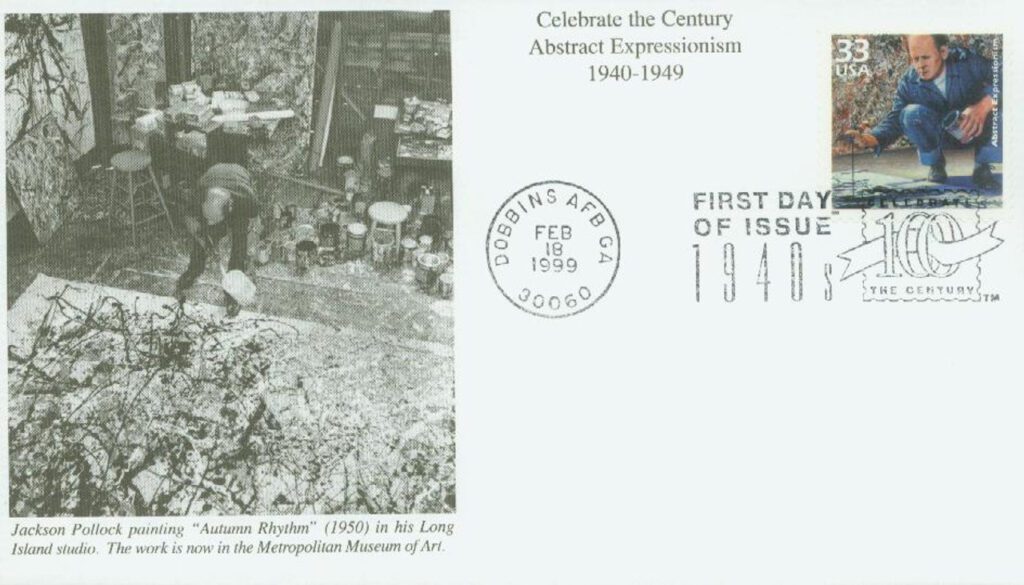
Pollock married fellow artist Lee Krasner in 1945. The couple left New York City for Springs, a hamlet in East Hampton on Long Island, where they bought a modest house and barn with financial help from Guggenheim. Pollock converted the barn into a studio. There, beginning in the late 1940s, he developed the poured and dripped paintings for which he became best known.
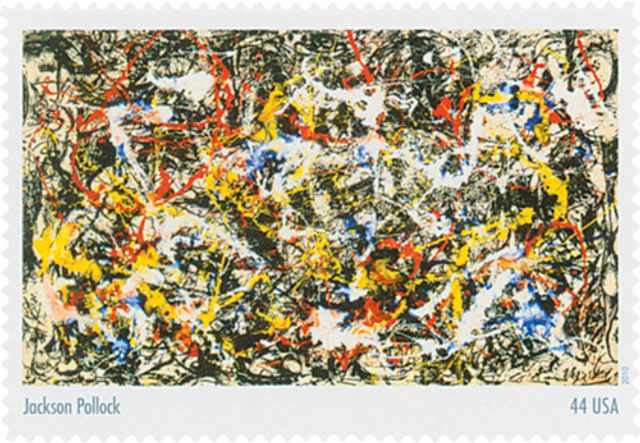
Instead of placing a stretched canvas on an easel, Pollock laid large pieces of canvas on the studio floor. He moved around them from every side, pouring, dripping, flinging, and trailing liquid paint with sticks, hardened brushes, and other tools. He often used commercial enamel paints along with traditional artists’ materials. The finished surfaces could look spontaneous, but Pollock’s process was not simply random. He controlled his movements and responded to the flow of the paint as he worked. Paintings such as Number 1, 1950 (Lavender Mist) reveal layers of lines, droplets, and even handprints built into carefully worked compositions.
His reputation expanded rapidly. A four-page Life magazine article published in August 1949 famously asked, “Is he the greatest living painter in the United States?” The provocative headline brought Pollock national attention and also fueled debate over paintings that some viewers dismissed as little more than random splattering.
Pollock did not remain with the drip technique. In 1951, he began creating darker works dominated by black enamel, some containing suggestions of human figures. He later returned to color and more recognizable forms as he continued searching for new approaches. His final two paintings, Scent and Search, were completed in 1955. He produced no paintings in 1956 and experimented instead with sculpture.
Pollock had struggled with alcoholism for many years. On the night of August 11, 1956, he lost control of his Oldsmobile convertible near his Springs home while driving under the influence. Pollock and passenger Edith Metzger were killed; Ruth Kligman, the car’s other passenger, survived. Four months later, New York’s Museum of Modern Art opened a memorial exhibition of Pollock’s work, bringing renewed attention to a career that had ended abruptly.
Click here to view a collection of Jackson Pollock paintings.
| FREE printable This Day in History album pages Download a PDF of today’s article. Get a binder or other supplies to create your This Day in History album. |
Discover what else happened on This Day in History.
Great information on someone I knew very little about.
It amazes me how profoundly different Pollock was from Benton. Apparently he either had very little respect for his teacher, or all he learned was technique, not the “art of seeing” which Benton mastered so well.
Modern art is nothing if not pretentious.
Folks no need to be so critical of his work. Just consider it the lighter side of artistry.
Could you please include the pdf?