
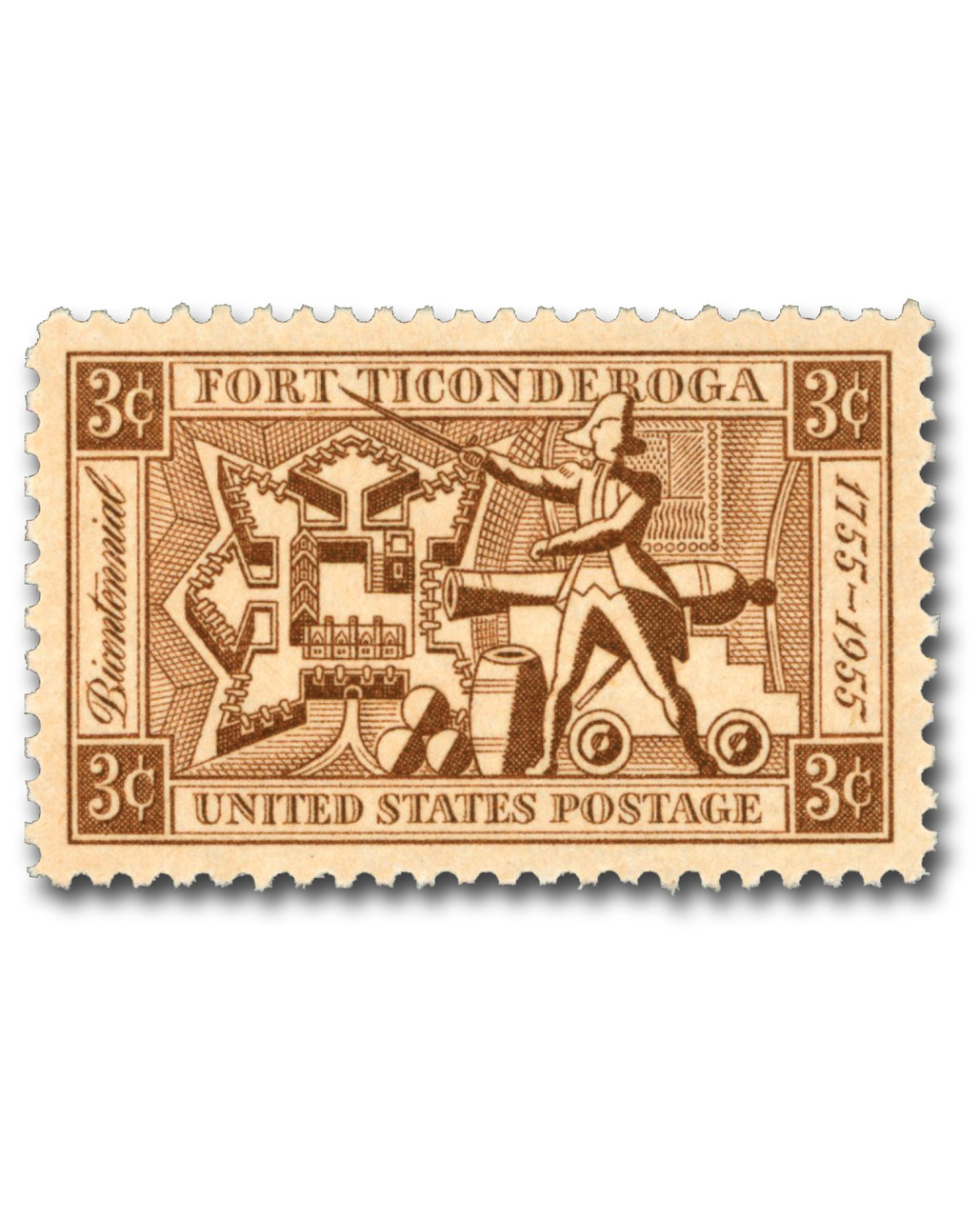
On July 6, 1777, British forces re-took Fort Ticonderoga, two years after Americans had captured it in a surprise attack. The victory seemed important at first, but it soon became one step in a campaign that ended in disaster for Britain at Saratoga.
Fort Ticonderoga stood on Lake Champlain in northern New York. Its location made it one of the most important military posts in North America. The fort guarded the water route between Lake Champlain and Lake George. In the 1700s, armies moved men, supplies, and cannon most easily by water. Anyone invading the colonies from Canada needed control of this route.
The French built the fort in 1755 during the French and Indian War and named it Fort Carillon. The British captured it in 1759 and later renamed it Fort Ticonderoga. By the start of the American Revolution, the fort was no longer as powerful as it had once been. Its walls needed repair, and it held only a small British force. But it still contained something the Americans badly needed: heavy artillery.
In 1775, Patriot leaders in Massachusetts planned to capture the fort. They gave Benedict Arnold a colonel’s commission and ordered him to lead the mission. At the same time, Ethan Allen and his Green Mountain Boys were also moving toward Ticonderoga. Arnold had official authority, but Allen had men ready to fight. The two agreed to work together, though they later argued over who deserved credit.
Before dawn on May 10, 1775, the Americans crossed Lake Champlain and entered the fort. The British garrison was caught by surprise. Allen, Arnold, and a small group went to the officers’ quarters and demanded surrender. According to later accounts, Allen claimed he acted “in the name of the Great Jehovah and the Continental Congress.” Captain William Delaplace surrendered the fort without a battle. No one was killed, though one American was slightly injured.

The captured artillery later became valuable to the Patriot cause. Henry Knox led many of the cannon from Ticonderoga to Boston during the winter of 1775–76. Their arrival helped force the British to evacuate Boston in March 1776.
Two years later, the British wanted Ticonderoga back. In 1777, General John Burgoyne began a campaign from Canada. His goal was to move south through New York, take control of the Hudson River Valley, and help cut New England off from the other colonies.
Burgoyne’s army was much larger than the American force at Ticonderoga. About 2,500 American defenders, led by General Arthur St. Clair, faced thousands of British, German, Canadian, and allied Native American troops. The Americans occupied both Fort Ticonderoga and nearby Mount Independence, but they were still badly outnumbered.

The greatest danger came from a nearby height known as Sugar Loaf, later called Mount Defiance. The mountain overlooked the fort. If the British placed cannon there, the Americans could not hold Ticonderoga. Burgoyne’s men worked to move artillery up the steep slope. Once St. Clair realized the British could fire down on his position, he knew the fort was lost.
St. Clair faced a painful choice. He could stay and fight, likely losing both the fort and his army. Or he could retreat, saving his soldiers but risking his reputation. He chose to save the army.
On the night of July 5, the Americans began evacuating. Boats carried supplies, weapons, sick soldiers, and civilians across the lake. Other troops marched away by land toward Castleton. On July 6, British forces entered Fort Ticonderoga without a major fight.

The British victory caused anger and embarrassment in the United States. Many Americans could not understand why such a famous fort had been abandoned. St. Clair was later investigated but was cleared of wrongdoing. His retreat had preserved much of the army, even though it cost him public trust.
In Britain, the news was celebrated. But Ticonderoga did not decide the campaign. Burgoyne left men behind to hold the fort, weakening his army as he moved south. In October 1777, he surrendered at Saratoga. That American victory helped convince France to join the war.
The British abandoned Ticonderoga later that year. After the Revolution, the fort fell into ruin, and some of its stone was reused by local residents. In the early 1900s, it was restored and opened as a museum. Today, Fort Ticonderoga remains a reminder of how geography, artillery, and difficult decisions shaped the Revolutionary War.
| FREE printable This Day in History album pages Download a PDF of today’s article. Get a binder or other supplies to create your This Day in History album. |
Discover what else happened on This Day in History.
Just a great story of our great country.
Great story. In these days of declining Christianity in America and political correctness, it was almost shocking to see that Ethan Allen used God’s name, Jehovah, as his authority to enter the fort way back in 1775.
As an aside, I always appreciate the TDIH articles. They are well written and interesting to read.
Jehovah is one of Judaism’s name for God or Yahweh.
Making this entire scenario all the more bizarre. But it is a beautiful stamp. The times I visited Fort Ticonderoga, as child, and as an adult, the narrative was far different. Frankly, many places, (and statues, and monuments, are best viewed for their structural and/or artistic merit). At lest they didn’t have socil media during all this. Can you imagine?
Hey Kit, there’s a decline in Christianity – but not in Jesus Christ. It’s the current state of the church and it’s twisting what the Bible actually reads to match their own personal agenda.
Fort Ticonderoga is now owned and operated by a family in Texas!
Fort Niagara was actually a more important location stategically.
Another article well covered this important time in history. I have a copy of a letter from my ancestor who guarded that fort just the Nov before with the NH militia. He was at Burgoyne’s surrender. Clark was just told to hold the fort as long as possible. Throughout the Revolution, the Americans would lose a battle only to win the campaign. In this case, Burgoyne overestimated himself and his confidence with this easy win. It would take him longer to get the next 50 miles than it did the first 150 and it would cost him his army.
Happy Birthday John Paul Jones US Navy in 18th century. https://www.linns.com/news/us-stamps-postal-history/2016/july/born-july-6-john-paul-jones.html
Thank You: Kit Kimes and Jim Watkins. I also noticed the use of God, by Ethan Allen in his actions against the fort. Also, you are correct in that Jehovah is the name of God, in the Old Testament. Yahweh refers to God as
something so great, it has no name. It is the Hebrew words, written in Latin:
YHWH.
This is, without a doubt, no tribute to the Patriots, nor to the Native Americans who sided with everyone BUT the Patriots, It is very interesting to better understand how a small group of people fleeing oppression were seen as such a threat to the – say entire British Empire – the French – the French-Canadians – Mack the bait seller. (And I wish that the guys at Mystic Stamp would edit out some of the Comments – including mine – although mine seems less inane for a change). Beautiful stamp.