

On October 20, 1964, Herbert Hoover, America’s 31st president, died at age 90. Before the Great Depression defined his presidency, he had built a career as a mining engineer and organized relief efforts for people in several countries.
Born in West Branch, Iowa, on August 10, 1874, Hoover was the son of a blacksmith and a Quaker mother. His parents died before he was ten, and he went to Oregon to live with his uncle, Henry Minthorn. In 1891, Hoover enrolled at the newly opened Stanford University. He studied geology and graduated in 1895.
Hoover began his career in mining, then joined the British firm Bewick, Moreing & Co. Assignments took him to Australia and China. In Australia, he evaluated mines and became a manager. In 1899, he married Lou Henry, a fellow Stanford geology student. The couple moved to China, where Hoover worked as a mining engineer. When the Boxer Rebellion reached Tientsin in 1900, he helped organize the city’s foreign residents and supplies during the siege. He later built an independent consulting business and became wealthy through international mining investments.
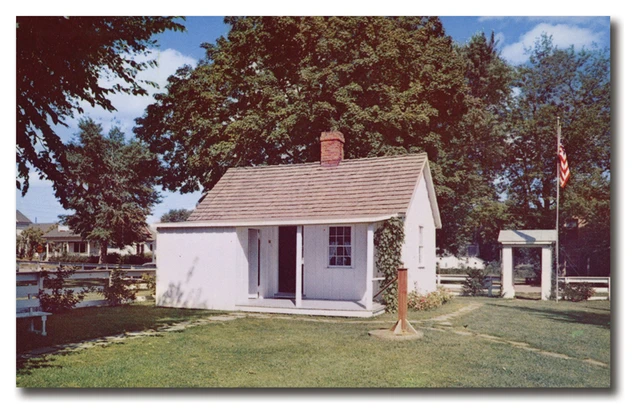
World War I brought Hoover into public service. In 1914, he helped stranded Americans in Europe arrange food and passage home. He then organized the Commission for Relief in Belgium, which brought food to civilians trapped by German occupation. The effort also aided people in northern France. After the United States entered the war, President Woodrow Wilson appointed Hoover to lead the US Food Administration. It urged Americans to conserve food through voluntary campaigns, including “Meatless Mondays” and “Wheatless Wednesdays.” The program increased supplies for the armed forces without imposing nationwide rationing.
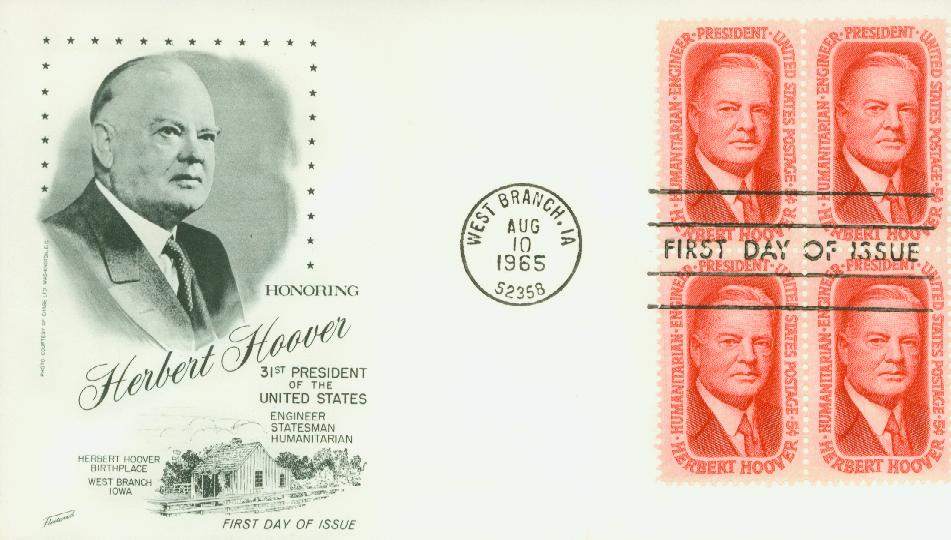
After the war, Hoover directed the American Relief Administration, which sent food and other aid to people in Europe. Admired for this work, he was urged to seek the presidency in 1920, but declined and backed Warren G. Harding. Harding appointed him secretary of commerce in 1921. Hoover served under Harding and Calvin Coolidge, promoting standards for manufactured products and supporting industries such as radio and aviation. In 1927, he coordinated federal relief after the Mississippi River flood. His public profile helped secure the Republican presidential nomination the next year.
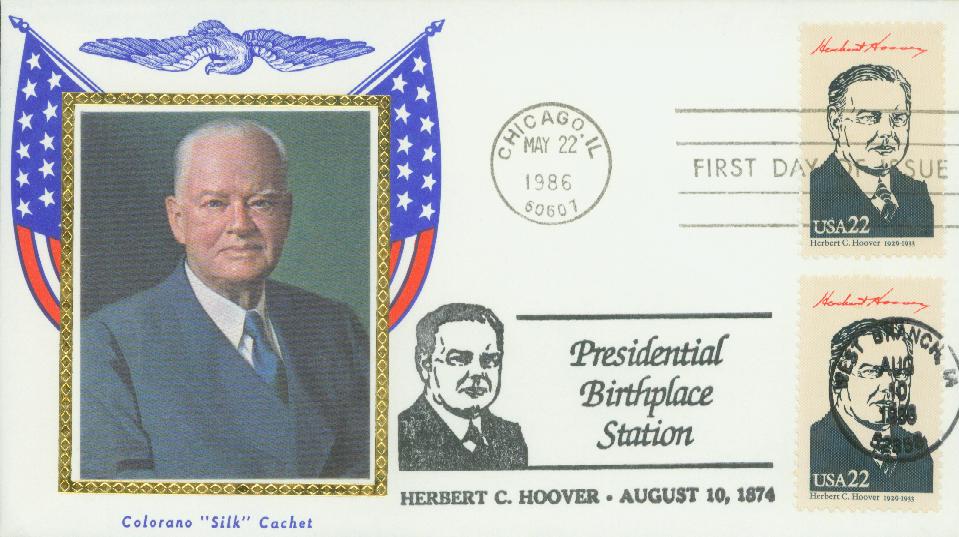
Hoover won the 1928 election, defeating Democrat Al Smith. The stock market crash came in October 1929, early in his presidency, and the Depression deepened. Hoover called business leaders to the White House and urged them to maintain wages. He encouraged state and local governments to expand public works and supported federal construction. He favored voluntary cooperation and private charity, however, and resisted direct federal relief payments to individuals. In 1932, he created the Reconstruction Finance Corporation to lend money to banks, businesses, and some public agencies. These measures did not stop rising unemployment and hardship. Shantytowns built by displaced people became known as “Hoovervilles.”

Hoover lost the 1932 election to Franklin D. Roosevelt, who promised a “New Deal.” After leaving office, Hoover wrote, spoke, and worked with the Hoover Institution at Stanford. During World War II, he organized aid for Polish civilians. In 1946, President Harry Truman asked him to survey world food needs. Hoover traveled to 38 countries and recommended ways to address the risk of famine. The two men worked together again on a 1947 commission to reorganize the executive branch; many of its recommendations became law. Hoover later chaired a second reorganization commission under President Dwight D. Eisenhower.
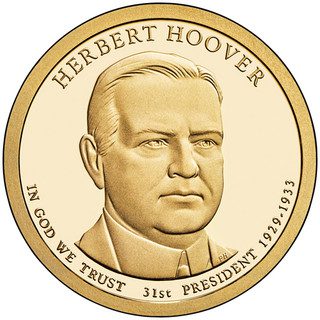
Hoover continued writing and public service, including work with the Boys Clubs of America. He died in New York City on October 20, 1964. He was buried in West Branch, overlooking the place where his life began.
Click here for more Hoover covers.
| FREE printable This Day in History album pages Download a PDF of today’s article. Get a binder or other supplies to create your This Day in History album. |
Discover what else happened on This Day in History.
I remember well that my father, a child during WWI, told me (a child during WWII) about the important US aid to Belgium contributing significantly to the relief of food shortages in Belgium that had for almost 95% been under German occupation (1914-1918). The aid came under the form of Hoover food bags that were very welcome everywhere in Belgium. This is in homage of President’s Hoover’s memory, one of the noble representatives of the US GOP, who unfortunately met the great financial crisis in the early thirties of last century and was because of its effects a one term US president.
Big piece of history made by one person .
The New York Times got it right…what accomplishments for one lifetime.
This is why I love collecting. Every stamp tells a story. What a fascinating man but he’s mostly remembered for what happened after the crash and the Hooverville’s which is an unfair depiction of the totality of this very accomplished man’s career.
I was just a little boy when President Hoover died in 1964. We studied his accomplishments in life right after his death in school. What an amazing man to have been able to do so much for others!
I was a boy when Hoover became President, and remember the country turning on him as the 1929 Depression progressed, so that by the 1932 election, there was loud call for a change, and Roosevelt was elected. As described above, Hoover became the scapegoat to blame for not being able to solve the depression problems and was vilified across the country. Sounds similar to today, but we really were in dire straits then as a country. Hoover’s reputation fortunately has been restored. Thanks for reminding us of his lifetime of significant contributions to society and to our country.
If your attempting to compare Obama to Herbert Hoover, you are very much uninformed. If anyone deserves to be vilified, Obama fits the bill.
Ooooh…another Obama hater, a minority, to be sure, but a persistent if misinformed one.
I, too, was a boy when Hoover lost the election in 1932. It was the first time that I was aware of the presidential election, and I don’t recall how my parents felt about him; later they were very much for Roosevelt, especially when they lost the house they were buying in Upstate New York, and we had to rent a small farm in the country. I agree that he was the scapegoat, and I’ve been left with unfavorable impressions of him. This account of his productive life in community service changes my mind about that. Thanks . . .
Amazing info. Amazing man.
WOW. That was a lot of information about a great man that we did not get in History classes. Keep uup the good work,
A great and unfairly maligned man. FDR’s socialist programs did get the country started in the right direction, but it was WWII that ironically saved the economy. Hoover never had a chance once the Depression hit, but what if his plan if recovery using private, not public, funding had been adopted and worked? He would have been a hero not a scapegoat.
It wasn’t World War II pre se that brought about the recovery of the American economy, it was the massive deficit spending by the federal government in response to World War II that brought about the recovery. That could have been done in the 1930s, but without the war, the political will to do so wasn’t there.
Wow, we could sure use some people in politics like him today.
Hoover was known for saying, “a chicken in every pot.” When in his career was that a popular phrase?
Hoover apparently never used the phrase, but the republican party used it as a campaign slogan during the 1928 campaign. According to Encyclopidia.com the phrase has its origin in the seventeenth century: “King Henry IV wished that each of his peasants would have a chicken in his pot every Sunday.”
Very informative article a lot I did not know about Hoover