
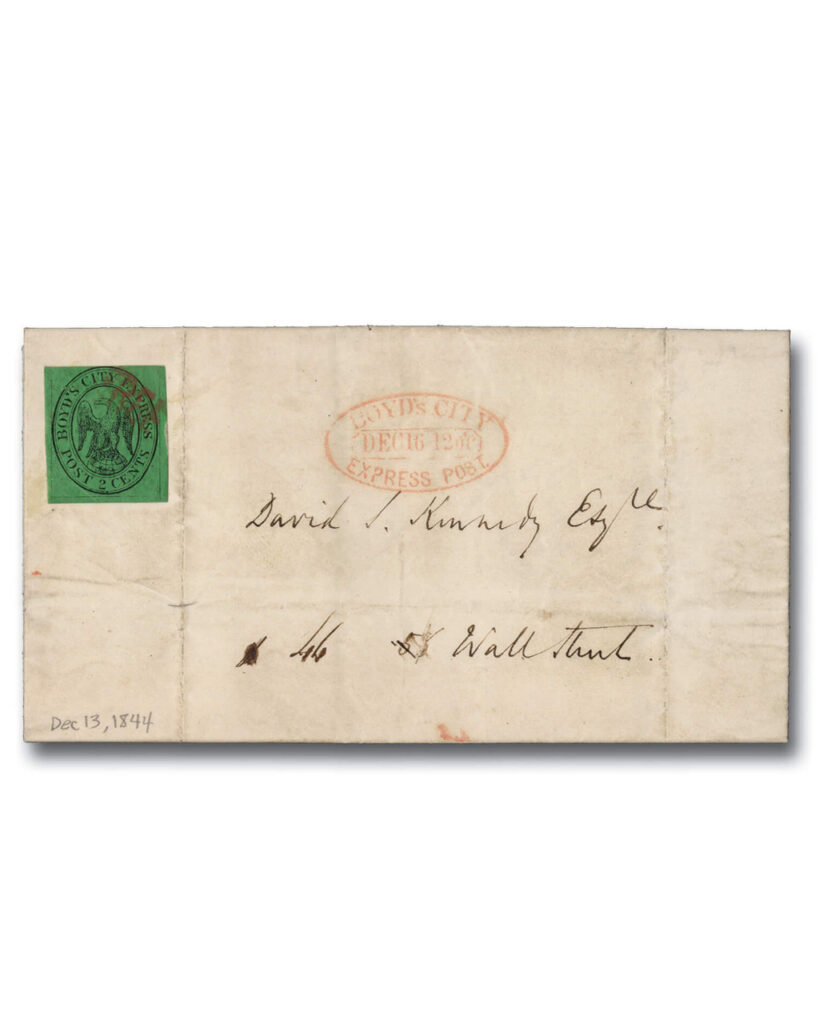
On June 17, 1844, Boyd’s City Express Post opened in New York City, offering residents a faster alternative for sending letters across the growing metropolis. Despite decades of government efforts to restrict private mail services, Boyd’s continued making deliveries for more than 40 years.
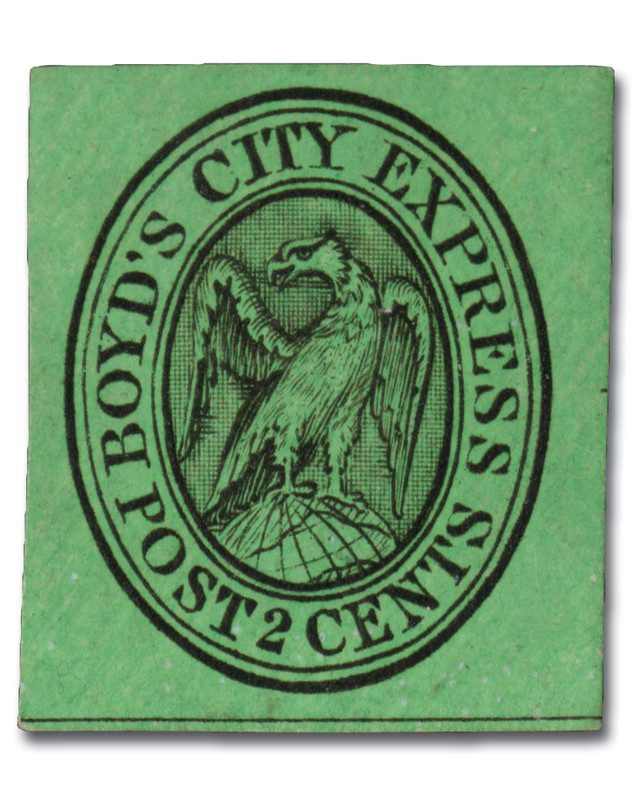
John T. Boyd established the post at 45 William Street, near Wall Street in downtown Manhattan. At first, Boyd offered two deliveries each day, at 9 a.m. and 3 p.m. Letters cost 2¢ to destinations as far north as 26th Street and 3¢ to Brooklyn. Letters addressed to newspaper editors were delivered free.
Boyd’s also handled money, but only if it was registered at the company’s office. John T. Boyd personally signed some surviving covers as the registry agent. The company expanded quickly. By September 30, 1844, it offered four daily deliveries, scheduled for 9 a.m., noon, 2 p.m., and 4 p.m. The Brooklyn rate was also reduced to 2¢.
During its first year, Boyd’s worked with several independent mail companies. These included Pomeroy’s Letter Express, Pullen & Company’s Express, the American Letter Mail Company, Wells’ Letter Express, and Hale & Company. The express companies transported letters between cities, while Boyd’s collected or delivered them within New York.
Boyd advertised that his company had 200 collecting stations when it opened. These were probably boxes placed in hotels, drugstores, stationery shops, and other businesses. Customers could leave letters at these convenient locations instead of traveling to Boyd’s office.

That arrangement changed after Congress passed a new postal law in 1845. Effective July 1, the law largely prohibited private companies from carrying letters between cities where the US mail already operated. However, city streets were not yet clearly covered by the government’s postal monopoly. Boyd’s therefore concentrated on carrying letters within New York City and taking outgoing letters to the post office.
The government-operated City Despatch Post was losing business during this period. It closed in late 1846, although its former manager soon reopened the service under private ownership. Several other local posts also competed with Boyd’s, but few lasted as long.
In January 1849, the New York Post Office made another effort to improve city delivery. It established 25 letter-deposit stations and offered four collections and deliveries each day. Boyd responded by claiming that his company had more than 1,000 collection boxes, with one on nearly every block below 50th Street.
That year, Boyd’s introduced die-cut stamps. They were sold in small boxes and cost slightly more than ordinary stamps. Because each stamp was already separated, businesses could use them more quickly. The federal government did not begin issuing regularly perforated US stamps until 1857, eight years later.
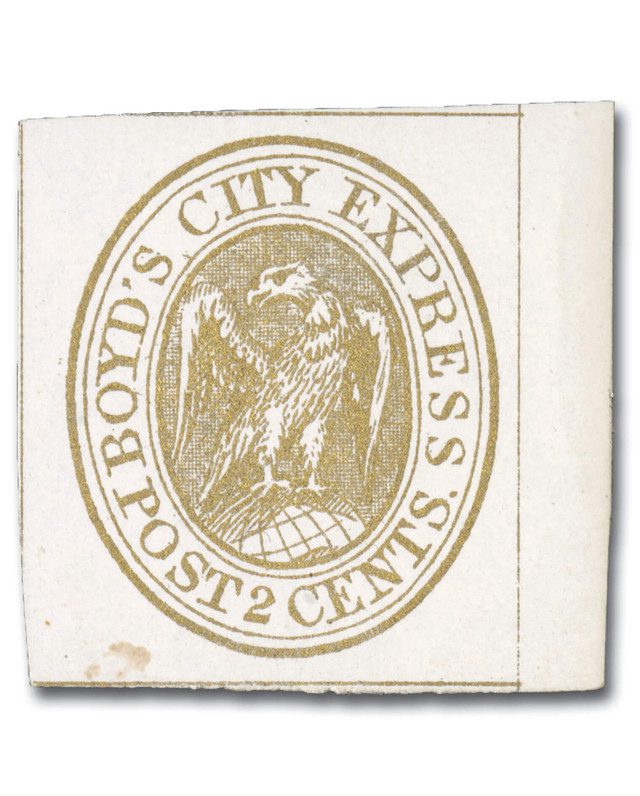
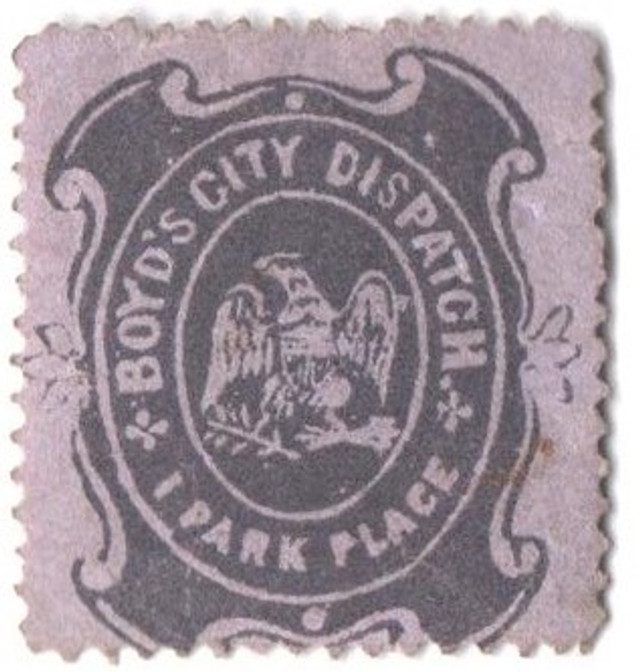
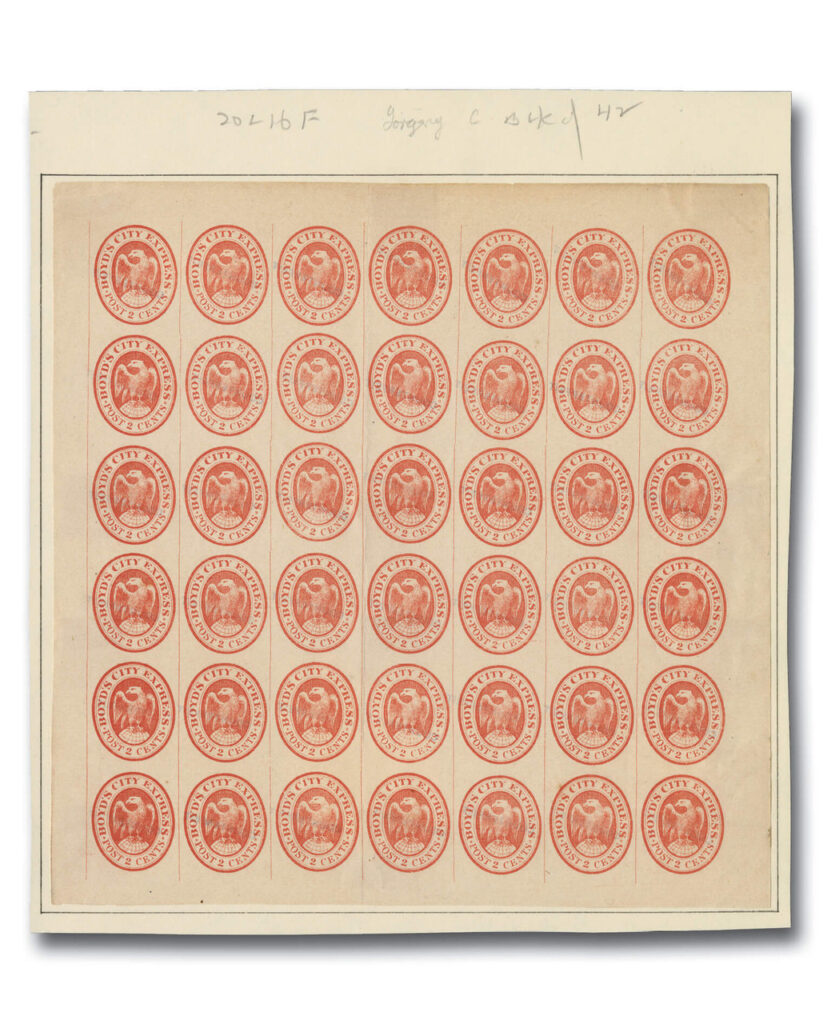
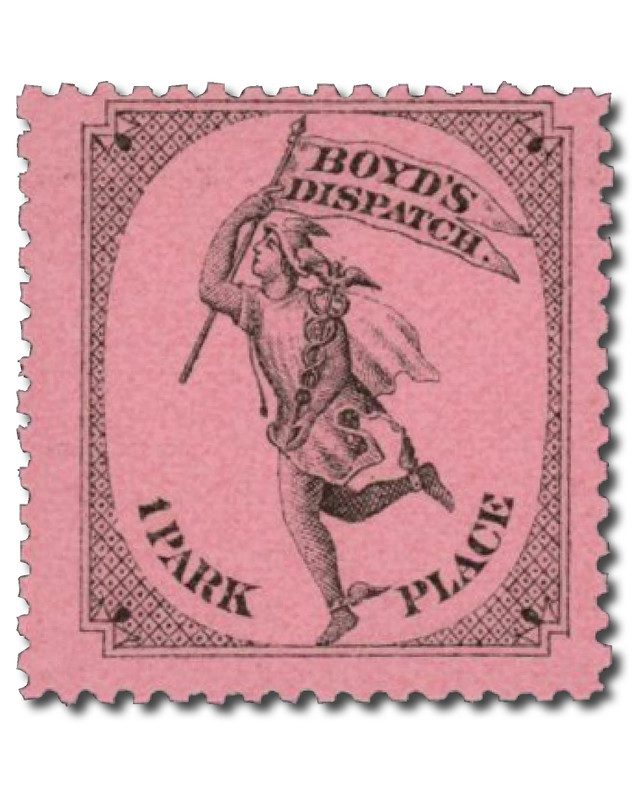
For more than two decades, most Boyd’s stamps featured an eagle standing on a globe. The design appeared in different colors, denominations, and formats. It was eventually replaced by a design featuring Mercury in 1878.
In 1851, Congress authorized the postmaster general to designate city streets as postal routes. Boyd nevertheless announced that he would continue delivering local letters. New York City’s streets were not formally declared post routes until 1860, and Boyd’s continued operating in defiance of the government’s attempts to control local letter delivery.
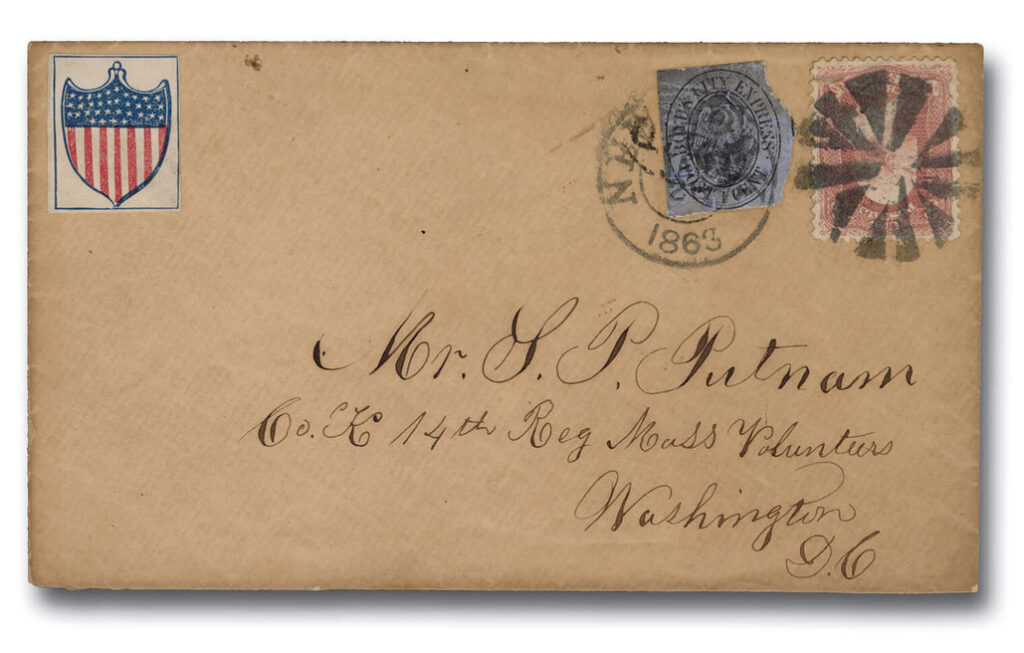
John T. Boyd died on June 8, 1859. His 17-year-old eldest son, also named John T. Boyd, took over the business. That same year, Postmaster General Joseph Holt began a determined campaign against the remaining private posts. He installed locked government mailboxes on New York streets and recommended changes intended to make federal service more competitive.
In May 1860, Boyd Jr. reduced the company’s rate to 1¢ for all classes of mail. He closed the post on August 1 and sold it later that year to William and Mary Blackham. The Blackhams reopened Boyd’s on December 24, 1860. They restored the 2¢ local-delivery rate but charged 1¢ for letters carried to the post office, as well as circulars and magazines.
Under the Blackhams, Boyd’s increasingly collected and delivered circulars, bills, notices, pamphlets, and other bulk mail. The company also maintained address lists for its customers. In 1862, it moved to 39 Fulton Street and began distributing railroad and steamship timetables free of charge. Advertising printed on the schedules paid their cost.
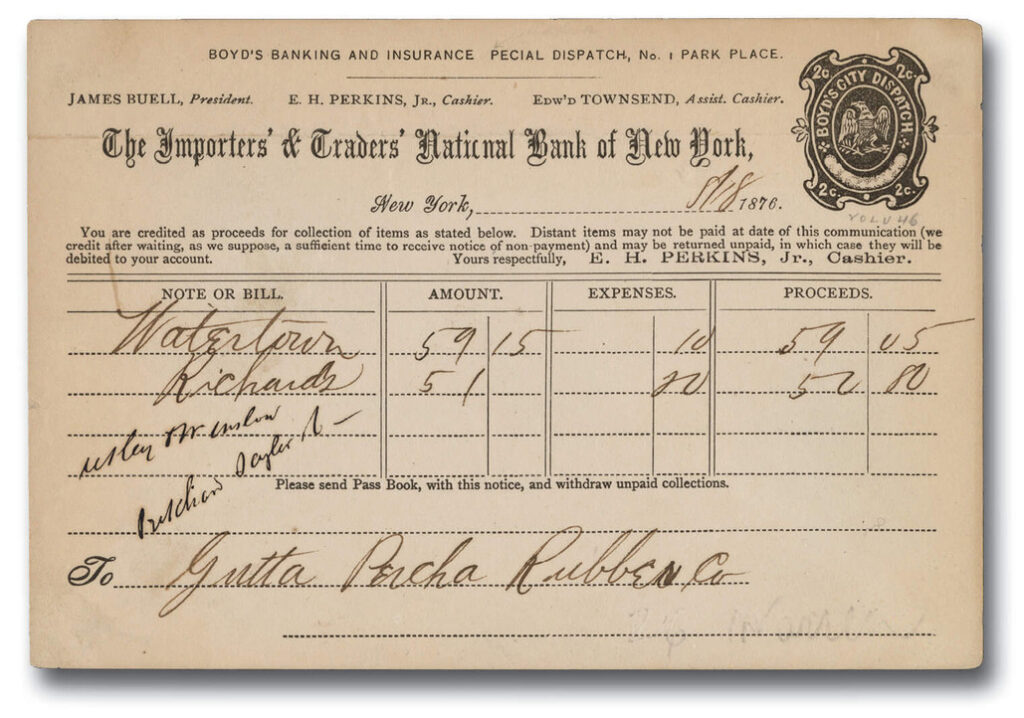
On May 4, 1883, federal officials raided Boyd’s and the competing Hussey’s Post. Fourteen Boyd carriers and 11 Hussey carriers were reportedly taken into custody. Fines were imposed, but both companies resumed operations. Boyd’s continued local mail delivery until about 1885. It then concentrated on mailing lists, address labels, and related services.
Boyd’s endured longer than nearly every other private local post in the United States. Its stamps, envelopes, covers, and handstamps preserve a detailed record of local mail service in 19th-century New York. Only two original Boyd’s collection boxes are known to survive, including one preserved by the Smithsonian’s National Postal Museum.
Click here for more Boyd’s stamps and covers and click here to explore many other Local stamps.
| FREE printable This Day in History album pages Download a PDF of today’s article. Get a binder or other supplies to create your This Day in History album. |
Discover what else happened on This Day in History.
Did not know about this service or stamps – thanks Mystic.
just another example of gov’t wrangling control from free enterprise. Does it ever end? Power and & money thats all the mechanisms of gov’t care about.
Now this essay was really interesting ! This is the FRIRST time in my 83 years that I have EVER heard or read ANYTHING about the NYC “Boyd postal service” office !! It is another Mystic history update for me and I appreciate it. Thanks again, Mystic !!