
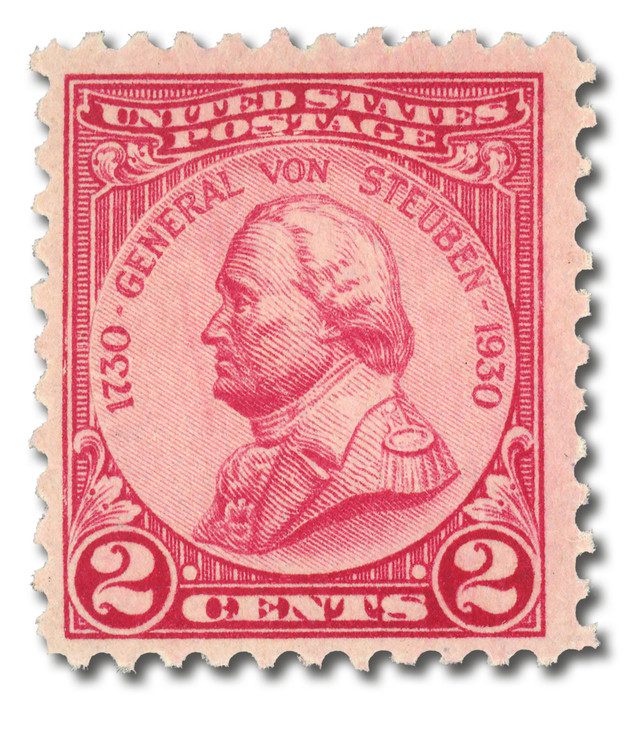
On September 17, 1730, Friedrich Wilhelm von Steuben was born in Magdeburg, Prussia, long before he became the drillmaster who brought order and consistency to the Continental Army at Valley Forge. His training methods did not win the American Revolution by themselves, but they gave inexperienced troops a clearer system for fighting, marching, camping, and working as an army.
Von Steuben was the son of a Prussian army engineer captain. As a boy, he traveled with his father during military campaigns, including the War of the Austrian Succession. He later returned to Prussia for school and entered the Prussian Army as a teenager.
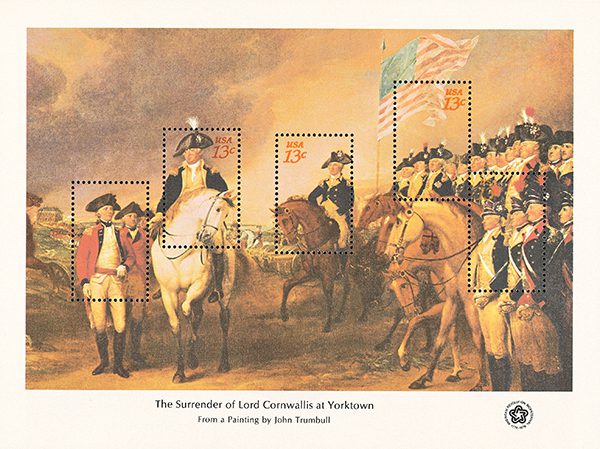
He served during the Seven Years’ War, which lasted from 1756 to 1763 and involved many European powers. Von Steuben was wounded at the Battle of Prague in 1757 and again at Kunersdorf in 1759. In 1761, Russian forces captured him at Treptow. After his release, he became a captain and served as an aide-de-camp, or military assistant, to King Frederick II of Prussia, known as Frederick the Great.
In 1762, von Steuben was one of 13 young officers selected for special instruction by Frederick. He learned the disciplined methods of the Prussian Army, then widely considered Europe’s best-trained force. When the war ended, however, Prussia reduced its army. Von Steuben left military service in 1763.

For the next several years, he held a court position in the small German principality of Hohenzollern-Hechingen. In 1777, while in Paris, he met the French minister of war, the Comte de Saint-Germain. Saint-Germain introduced him to Benjamin Franklin and Silas Deane, American representatives seeking help for the Revolutionary cause.
The Americans could not offer von Steuben a high rank or a salary. Congress had become cautious about foreign officers who expected major commands. Still, von Steuben agreed to travel to America as a volunteer. Franklin’s letter of introduction described him as a “Lieutenant General in the King of Prussia’s service,” although his actual Prussian rank had been captain. The exaggeration probably resulted from the translation of his staff title.
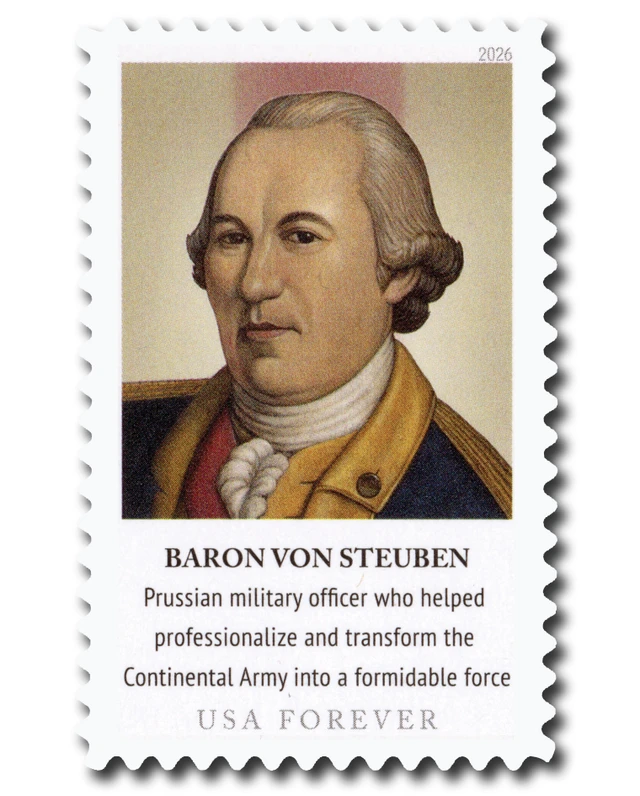
Von Steuben sailed from Marseille on September 26, 1777, and arrived at Portsmouth, New Hampshire, on December 1. He and several companions reportedly drew attention because they wore red uniforms, the color associated with British troops. After visiting Boston, he traveled to York, Pennsylvania, where the Continental Congress was then meeting.
He reached Valley Forge on February 23, 1778. George Washington appointed him temporary inspector general of the Continental Army, and Congress formally gave him the post on May 5. He found an exhausted army with uneven training, weak recordkeeping, and camp arrangements that often contributed to poor sanitation.
Von Steuben reorganized the camp. He recommended that troops be arranged by unit, with streets and company areas laid out in a regular pattern. He also directed that kitchens and latrines be placed on opposite sides of camp. His system of inspections and records made commanders more accountable for weapons and supplies.

His most memorable work was training the soldiers. Von Steuben selected about 120 men from Washington’s guard and from different state regiments to form a “model company.” He taught them how to march, load and fire more efficiently, use bayonets, maneuver in formation, and respond to commands. Those men then taught the same methods to other units.
Von Steuben spoke little English, so interpreters helped him give instructions. Stories of his frustration and his colorful language became part of his legend. More important, he trained alongside the men and explained drills in practical terms. That approach won respect from troops who had little patience for distant or overly formal officers.
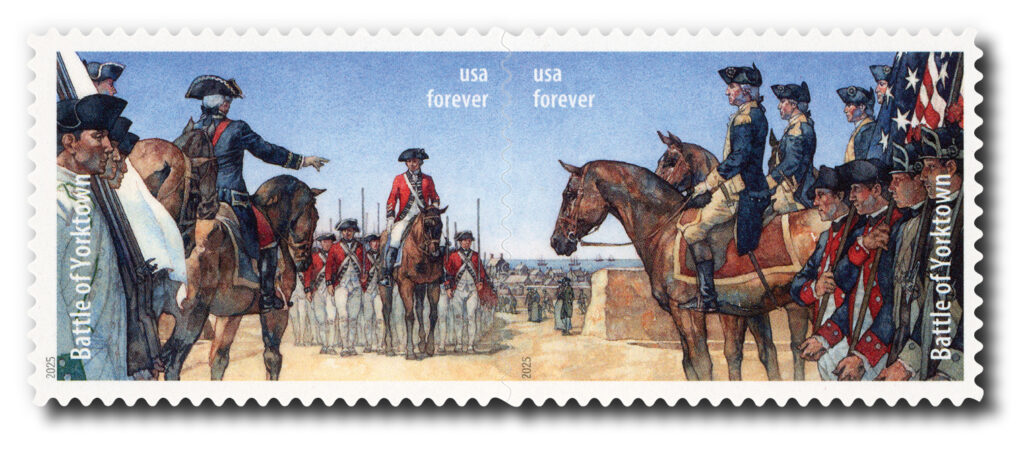
In 1779, he completed Regulations for the Order and Discipline of the Troops of the United States, commonly called the “Blue Book.” It standardized drill, camp procedures, inspections, and military conduct. The manual remained the Army’s principal drill guide until the War of 1812. Bayonet training was especially useful during the successful American assault on the British fort at Stony Point in July 1779, when many attackers used unloaded muskets to preserve surprise.

Von Steuben later commanded a Continental Army division in Virginia and at the Siege of Yorktown in 1781. After the war, he became an American citizen and served as president of the German Society of the City of New York, which assisted German immigrants. He also received land in New York for his service and spent his final years near present-day Remsen.
Von Steuben died on November 28, 1794, at age 64. His former estate became part of the town of Steuben, New York. Communities, counties, schools, military ships, and the annual German-American Steuben Parade in New York City continue to bear his name.
| FREE printable This Day in History album pages Download a PDF of today’s article. Get a binder or other supplies to create your This Day in History album. |
Discover what else happened on This Day in History.
Fascinating military history about an ally who helped contribute to the creation of our nation’s independence! Like a giant puzzle, so many people were necessary to form the picture of a new type of government. Bravo Mystic for your exceptional snapshots of significant importance to our national heritage.
I have been to the Von Steuben Day parade while visiting family in that area. It does great honor to this general who helped a fledgling United States.
80 + years and still learning, thanks Mystic
I’m a history Buff. It’s so good to see a refresh of the Revolution Days! Nice going Mystic!!!
I also am a history nut and read TDIH everyday. Tip my hat to Mystic and whomever put these stories together.
Delighted to learn how Washington welcomed a foreigner and trusted him with leadership that proved vital to our military winning the revolutionary war.